


We’ve had the Kansas Supreme Court’s opinion in Kansas City Power & Light Co. v. Strong, No. 110573 (Aug. 28, 2015) in the hopper for a while, but never quite got around to posting it. Something else always seemed to take precedence, and it’s just one of those decisions that doesn’t really reach out and grab you. [Unless you focus on the difference between the court-appointed appraisers’ valuation ($96,465) and that of the jury ($1,922,559). Lowball watch! material, but that’s not why we’re posting it.]

The opinion analyzes the condemnor’s three arguments that the trial court should have kept from the jury evidence offered by the property owners. Kansas has a statute which sets out the “formula” (the court’s words, not ours) for how valuation is calculated in a partial taking. The court notes it is a “simple” formula: the “before” value of the property less the value
Continue Reading Kansas: We’re Pretty Much Not Going To Second-Guess The Jury When It Comes To Compensation

We all know the old rule that “interest follows principal,” which means that when a deposit on account is private property, so is the interest which that deposit earns. 

Not according to the Florida Court of Appeals, however. In a 2014 decision, that court held that interest earned on quick-take deposits was not the private property of the owner whose land was taken, and thus the government could keep 90% of the money. After the Florida Supreme Court denied review, a cert petition was filed, asking the U.S. Supreme Court for review.  

Tampa needed land, and filed quick-take actions. It deposited the funds which it estimated to be just compensation with the court clerk. That transferred title from the owner to the City. The parties negotiated a settlement, and agreed that the settlement amount was “full compensation” for the taking. Problem was, the owner didn’t know that the

Continue Reading New Cert Petition: Interest Earned On Quick-Take Deposit Is Property, Gov’t Can’t Keep 90%

In General Commercial Properties, Inc. v. Florida Dep’t of Transportation, No. 4D14-0699 (Fla. Dist. App. Oct. 14, 2015), the court held that a statute which requires the trial court to use the “first written offer” by the condemnor made prior to the initiation of the eminent domain case as the benchmark when it is calculating attorneys’ fees, does not mean that the DOT is stuck with a very early offer it made under the “Early Acquisition Program.”

Under this program, the DOT made early offers to owners for properties it wanted to acquire. There was no obligation on the part of the owners to sell. As the court phrased it, it was an “arms-length negotiation[]” with no eminent domain threat. (Yeah, right.) This was supposedly outside the usual eminent domain-related acquisition program, and if the owner said no thank you, there was nothing the DOT could have done. So in

Continue Reading Fla App: Offer Early, Offer Often – Early Precondemnation Offer Does Not Trigger Attorneys’ Fee Statute

ALI-CLE-2016-masthead

Here’s the full agenda for the 2016 Eminent Domain and Land Valuation Litigation / Condemnation 101 Conference, January 28-30, 2016, in Austin, Texas. 

Together with our friend and colleague Joe Waldo, we think we’re put together a pretty good program that covers a lot of ground. This is the first time the conference has been to Austin, and we’re starting off with a talk by Austin Mayor Steve Adler, who in his former life was an eminent domain lawyer. Other highlights:

  • Professor Ilya Somin will speak about his recently-published book in a segment entitled “The Impact of Kelo and the Limits of Eminent Domain.”
  • Pipelines and Energy Corridors: Valuation Perspectives of Condemnors and Condemnees” with the lawyers on the front lines of one of the hottest topics in eminent domain law nationwide.
  • Retired Minnesota Supreme Court Justice Paul H. Anderson will give us his tips


Continue Reading It’s Here – 2016 ALI-CLE Eminent Domain Conference: Complete Agenda, Faculty, Registration Information

Our friend and colleague Alan Ackerman posted a note on his blog about a recent District Court ruling from the Western District of Virginia which upheld the power of a potential condemnor to enter property for the purposes of survey, without formally taking the property. See “Virginia Federal Judge Follows What May Be the Majority Rule for Surveys.” But Alan didn’t post the court’s written ruling. So here you go, all 35 pages of it.

The issue was whether a Virginia statute, which “authorizes a natural gas company to enter private property without the landowner’s written permission and perform a survey for a proposed natural gas pipeline,” is a facial violation of the U.S. and Virginia Constitutions, and “is thus void and unenforceable.” Slip op. at 1. The court granted the gas company’s motion to dismiss. It concluded that the facial challenge failed because the property

Continue Reading Federal Court: Virginia’s Entry Statute Not Facially Unconstitutional

WIN_20151002_13_15_51_Pro

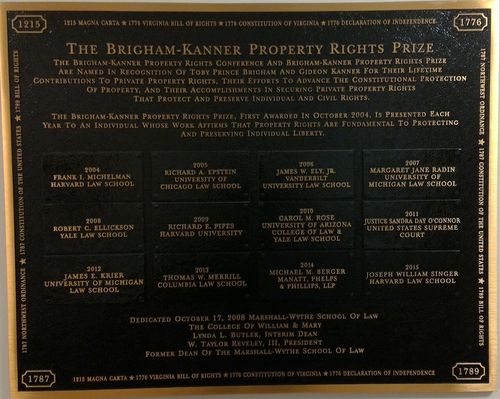
Greetings from the William and Mary Law School in (rainy) Williamsburg, Virginia, where we’re speaking at the 12th Annual Brigham-Kanner Property Rights Conference

This year’s B-K Prize winner is Harvard Law’s Joseph Singer, who we wrote is “an interesting choice, given his theory that a ‘robust regulatory structure’ goes hand-in-hand with property rights, liberty, and the free market. Robust regulation isn’t exactly what you might think of when you think property rights, is it?” As another lawprof noted about Professor Singer, he “is such a believer in private property that he thinks everyone should have some.”

If that quote doesn’t quite compute for you — it’s a nice thought, for sure, but how do you get from here to there is what we want to know — you are not alone. Last year’s B-K Prize winner, Michael Berger spoke during the first morning session, and submitted this piece

Continue Reading “Joe is such a believer in private property that he thinks everyone should have some” – The 2015 Brigham-Kanner Property Rights Conference

We don’t often post trial court decisions, but this recent ruling from an Idaho trial court awarding a property owner approximately $400,000 in fees and costs was a good read, and we’d like to share it with you all.

This is a ruling issued after a trial to determine just compensation for the partial taking of property for road improvements. The jury awarded approximately $146,000 to the property owner. There’s a lot of detail in the order, and we suggest you read the entire thing. But what grabbed us was the way the judge treated property rights, starting on page 11 of the order. 

Noting that “the Court’s analysis is rooted in the Constitution and this country’s long history of jealously protecting individual property rights,” (now there’s something you don’t hear from courts, much less trial courts, these days), the order concluded that the property owner was the “prevailing party,”

Continue Reading A Trial Judge Who “Gets” Eminent Domain

We’re not exactly sure why, but the facts in State of Texas v. Treeline Partners, Ltd., No. from the Texas Court of Appeals just crack us up.

First, the court comes up with a definition of “lowball” —

In attempting to ask potential jurors whether they believe that the State “lowballs,” the State’s attorney properly inquired about whether the venire members held a preexisting bias or prejudice that the State underestimates property values. See WEBSTER’S NEW WORLD COLLEGE DICTIONARY 801 (3d ed. 1996) (defining “lowball” as a verb meaning “to give an understated price, estimate, etc. to (someone), esp. without intending to honor it” or “to so understate (a price, etc.)”).

Slip op. at 7. Save that one for your briefwriting databank.

The case involved the State’s attempt to ask potential jurors and make arguments about whether they believed that the State lowballs eminent domain valuations. Now the

Continue Reading Condemnor Entitled To Ask Jurors Whether They Believe DOT “Lowballs,” If Condemnor Hints It Does

In those states with a commission process in condemnation, any guess where an appellate court comprised of judges will come down on who gets to make the final call about what evidence is admissible — a judge or the commissioners?

Well, if you guessed the judge, you’d be right. In Regional Transportation Dist. v. 750 W. 48th Ave., LLC, No. 14SC64 (Sep. 14, 2015), the Colorado Supreme Court summed up the applicable rule of law succinctly: “commissioners have some implicit authority to make evidentiary rulings without the oversight of the trial judge,” but “the judge is still the judge,” and she gets the final call. Slip op. at 11. So the commissioners cannot “overrule” or “reconsider” a judge’s earlier ruling that evidence is admissible, nor can they ignore a judge’s instruction that they disregard other evidence.

It shouldn’t have been too hard to presage that judges would conclude that judges have the final say (judges, not lay commissioners, are

Continue Reading Colorado: Judicial Evidentiary Rulings, Not Commission’s, Control In Eminent Domain Valuation Hearings