Here’s what we are reading today, eminent domain with a slightly offbeat theme:


Continue Reading Eminent Domain Round-Up: Aliens, Exotic Dancers, And Princesses
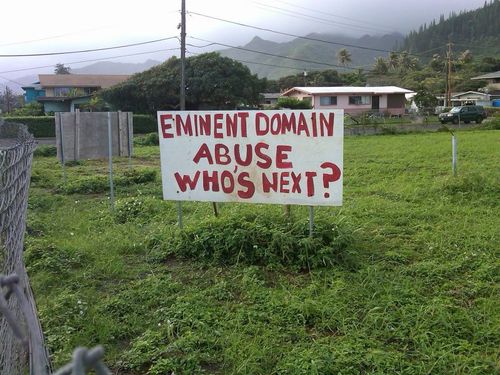
EM Hauulaeminent_domain_abuse

You remember that case about property on the rural north shore of Oahu, in which the City and County of Honolulu is condemning a vacant parcel in order to build a new fire station. The City hasn’t moved on building the station and hasn’t included money in the budget to do so. There’s even some question about whether this is a good place for a fire station.

All this caused the property owner to erect several protest signs on the parcel, one of which is depicted above. An additional brouhaha arose when the City removed and stored the signs, which caused the owner to sue the City in federal court, alleging among other things, due process and First and Fourth Amendment violations, and violations of the City’s “stored property” ordinance.  

We reported on proceedings in the first case, where the court denied the City’s motion for summary judgment. The City argued

Continue Reading Federal Court: City Stopped Blowing Hot And Cold And Had Exclusive Possession Of Property Under Quick-Take Statute, So It Was OK To Seize Anti-Eminent Domain Sign

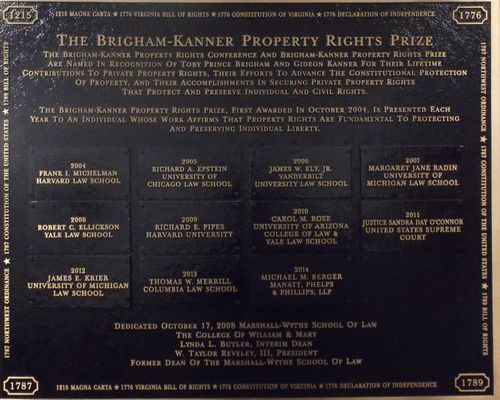
BK-plaque-2015

As we’ve done every year lately, we’re soon headed to the Brigham-Kanner Property Rights Conference at the William and Mary Law School in Williamsburg, Virginia.

This year, the B-K Property Rights Prize will be awarded to Harvard lawprof Joseph Singer, who is, shall we say, an interesting choice, given his theory that a “robust regulatory structure” goes hand-in-hand with property rights, liberty, and the free market. Robust regulation isn’t exactly what you might think of when you think “property rights,” is it? So it should make for an interesting conference.

Professor Singer publishes a blog that is worth following, “Property Law Developments.” It is not one of those blogs that are heavy on the analysis, but its a good place to keep up on recent developments in all things property law. 

The plaque pictured above is a list of prior prize winners.

Here are the conference details:

Continue Reading Join Us: 2015 Brigham-Kanner Conference At William And Mary Law School

We have learned that the North Carolina Supreme Court has granted the State’s request to review Kirby v. North Carolina Dep’t of Transportation, No. COA14-184 (Feb. 17, 2015).

That’s the case in which the Court of Appeals not only held that the property owners’ claims were ripe, but that the Map Act — which gives the DOT the ability to designate property for future highway use and prevent its development in the meantime — effected a taking. The appeals court reversed the trial court’s dismissal and sent the case back down for a calculation of the compensation owed to each property owner.

This is one to watch, for sure. We’ll keep on doing so and let you know as things develop. 

Continue Reading NC Supreme Court To Review “Map Act” Takings Case

A piece on the humor site Cracked, “4 Thriving Communities That Rich People Destroyed On Purpose,” tells an old story: modest-but-decent places “redeveloped” into (1) Dodger Stadium, (2) Brazil’s Olympic venues; (3) the Salton Sea, and (4) Central Park, respectively.

(We note that the segment on the Salton Sea is the odd man out, and we can’t figure out how that one fits with the other three. But no matter.)

In telling the story of the destruction of Los Angeles’ Chavez Ravine to make way for the ballpark, the piece links to the above video, which contains interviews with many of the Ravine’s former residents. The video also recounts how, using eminent domain, the City of Los Angeles condemned the homes in the village, supposedly to make way for a new, modern housing project.

The homeowners were offered about $10,000 for their homes and promised

Continue Reading Breaking Up Communities For Redevelopment

To those able to join us today for IMLA’s “The Takings Issue” webinar, thank you. Here are the links to the items which I discussed:

On Koontz:

On California Building Industry Ass’n v. City of San Jose:


Continue Reading Links From Today’s “The Takings Issue” Webinar

We’re in Chicago this week participating in the ABA Annual Meeting. While we really are looking forward to a slate of thrilling committee meetings, what we’re really anticipating is the CLE programming. Here are what we think are the highlights:

  • Looming Land Use Constitutional Issues –  Friday, July 31, 2:45 – 4:15 pm, Westin Chicago River North Grand Ballroom B –  Four hot land use issues: land use aspects of medical marijuana legislation; takings and exactions in San Francisco’s requirement for owners to pay departing tenants huge sums; Horne and takingsNew Jersey’s dune program. With Tony Della Pelle and Stephen Schwartz (one of the counsel for the Hornes), among others. 
  • The 2014 Supreme Court Term in Review – Friday, July 31, 2015, 10am – noon, Westin Chicago River North Promenade Ballroom C – “This panel of noted legal professionals, academics and journalists provides an overview of the Supreme Court


Continue Reading ABA Annual Meeting Programming: Takings, Land Use, Supreme Court, Election Law, Appellate Traps

No, it’s not the latest economic development project, but an item we’ve reported on earlier: Jeff Benedict’s Little Pink House” book about the Kelo case is being turned into a movie. Here’s a Reason interview with one of the movie’s producers explaining why the story attracted them, and what we can expect from the film.

Biggest question we have is the casting. Here are our earlier suggestions

Continue Reading Eminent Domain Abuse, Coming To A Theater Near You

We’ve covered this topic before (see here, here, and here), but we haven’t heard much about it lately. But thanks to this new article by colleague Dwight H. Merriam, we can get back up to speed.

In “Eminent Domain for Underwater Mortgages: Already on the Way to the Bottom of the Sea of Bad Ideas,” from the Virginia State Bar’s Real Property Section’s journal, The Fee Simple (Spring 2015), Dwight discusses “the foreclosure crisis and how so many homeowners became victims of bad lending practices and a deep economic recession. Many are stuck in their homes, which are underwater with a value far below what was owed on them.” The article explores the question: can eminent domain bail out underwater mortgages?

Short answer: no.

To learn more, click here to view the article.

And what’s the latest that Richmond, California, which was leading the

Continue Reading New Article: “Eminent Domain for Underwater Mortgages: Already on the Way to the Bottom of the Sea of Bad Ideas”

Readers know that some jurisdictions have statutes which permit private condemnations — actions in which the owner of a landlocked parcel can exercise eminent domain to take the property of a neighbor for access. They are somewhat like common law easements by necessity, and we’ve seen then in Pennsylvania (private takings still must serve a public purpose) and Colorado (condemning owner must have concrete development plans), for example. 

In Vise v. Pearcy Tennessee River Resort Inc., No. W2014-00649-COA-R3-CV (July 15, 2015), the Tennessee Court of Appeals reviewed that state’s private condemnation statutes and concluded they only allow use of the private condemnation mechanism to create access to a landlocked parcel, and do not allow an owner who already enjoys limited access to condemn a neighbor’s property to create “better” access.  

Pearcy’s parcel wasn’t completely landlocked, and dirt roads over a neighboring TVA-owned parcel allowed limited access. Another

Continue Reading Tennessee Doesn’t Allow Private Condemnation For Better Access, Only To Create Access To Otherwise Landlocked Parcels