Here’s one that just rolled in, from the Iowa Supreme Court. In Clarke County Reservoir Comm’n v. Edwin D. & Deloris A. Robins Revocable Trust, No. 14-0774 (Apr. 10, 2015), the court held that the Commission did not have the power of eminent domain because several of its members were private actors. The court also concluded that the post-judgment withdrawal of those members did not moot the property owner’s appeal.

Property owners are entitled to strict compliance with legal requirements when a government entity wields the power of eminent domain. These legal requirements help protect against abuse of the eminent domain power. We strictly construe statutes delegating the power of eminent domain and note the absence of a clear legislative authorization for a joint public-private entity to condemn private property.

For the reasons elaborated below, we hold a 28E commission with members lacking the power of eminent domain cannot

Continue Reading Iowa: “Liberty Requires Accountability” – Delegation Of Eminent Domain Power Strictly Construed, And Commission With Private Members Could Not Take Property

A few years ago, in Gallenthin Realty Development, Inc. v Borough of Paulsboro, 191 N.J. 344 (2007), the New Jersey Supreme Court held that in order to target property for redevelopment as “blighted,” the government must show that it is in such condition that it “negatively affects surrounding areas” by promoting conditions that can develop into blight. In that case, the targeted property was mostly undeveloped wetlands, and the “blight” of which it stood accused was the owner’s failure to put it to a more intensive economic use. But that was not sufficient to support a blight finding, and the court held that the government must have done more than simply recited the standards for blight redevelopment, and declare they were met. 

We were going to do a complete write-up of the New Jersey court’s latest foray into blight and redevelopment, 62-64 Main Street LLC v. City of Hackensack

Continue Reading New Jersey: When Designating Blight, Baby Can Be Tossed Without First Showing The Bathwater’s Dirty

It’s not often that we say a law review article is a “must-read.” But this one definitely is, especially for all you regulatory takings mavens: David L. Callies, Through a Glass Clearly: Predicting the Future in Land Use Takings Law, 54 Washburn L. Rev. 43 (2014). A pdf of the article is posted here

From the Introduction:

The subject of takings—the government taking of an interest in real property, either through eminent domain or through the exercise of the police power—has been the subject of continuous litigation for nearly a century. The past ten years have been particularly fruitful, as litigants struggle with the meaning and extent of the Fifth Amendment’s Public Use Clause and the extent to which the overzealous exercise of the police power can sufficiently deprive a landowner of rights in property so that the property has been “taken” by regulation, ever since Justice Holmes

Continue Reading New Law Review Article Worth Reading: “Through a Glass Clearly: Predicting the Future in Land Use Takings Law”

131996

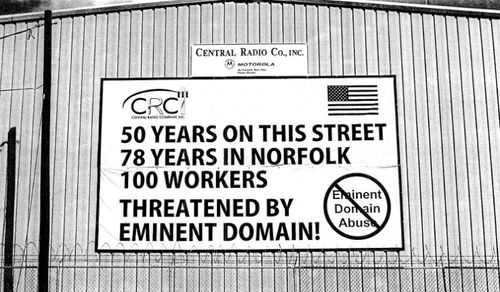
As we hoped it might, the Norfolk, Virginia property owner — represented by the Institute for Justice — who was on the losing side of the Fourth Circuit’s 2-1 recent opinion in Central Radio Co. Inc. v. City of Norfolk, 776 F.3d 229 (4th Cir. Jan. 13, 2015) has filed a cert petition.

In that case, the Fourth Circuit held that the above sign, erected on the owner’s building to protest a separate eminent domain action, violated the city’s sign code, and this restriction did not violate the First Amendment. The court concluded that the sign ordinance was content-neutral, even though it exempted national and religious “flags” and “emblems,” and “works of art” that do not relate to a product or service. The city lacked “censorial intent to value some forms of speech over others to distort public debate, to restrict expression because of its message, its

Continue Reading New Cert Petition: Property Owner Should Not Be Limited To “Whispering” Anti-Eminent Domain Message

The short answer: taxes.

[Update #1: a report from last night’s community meeting, “Railing Against Honolulu’s $6 Billion Rail Project” (“Honolulu Mayor Kirk Caldwell and his top transit official took their licks from a decidedly anti-rail crowd during a boisterous town hall meeting at Washington Middle School on Wednesday.”

Update #2:A Hawaii Senate committee passes a bill to extend the GET rail surcharge another give years, but makes clear the money should only be used to build the rail line” (4/8/2015, via Civil Beat).]

There’s been a lot of breathless reporting over the past couple of weeks about the skyrocketing cost of the 20-mile, 21-station Honolulu rail project. Cost estimates to build the line from Ewa to Ala Moana Center started off in the range of $3.5 billion, but anyone who was paying attention knew this wasn’t anywhere in the ballpark.

Continue Reading How Are They (I Mean *We*) Going To Pay For Honolulu’s Rail?

PBN_rail

The cover story in Pacific Business News‘ recent edition, “Honolulu rail transit’s eminent domain” is worth reading. Most importantly, the PBN staff created maps which show how much property is targeted for acquisition, and where it is located, precisely. Yes, the full story is behind a partial paywall, but as we said last week, if you are in Honolulu you really should be a PBN subscriber. Plus, there are a few quotes from our side in the piece:

  • “’Eminent domain cases are rare in Hawaii,’” Thomas said. ‘Hardly anyone has a living memory — not the landowners, judges, lawyers or even the government officials — they can draw from when there are this many takings.'”
  • “However, this could hurt property owners who choose to sell later, as they’ll have to disclose the illegal status of their building. Future owners may be confronted with the cost of


Continue Reading Pacific Business News Details The Rail’s Impact On Honolulu Property

Alderwoods

Here’s the amici brief on behalf of Central Oregon Builders Association, Oregonians in Action, and Owners’ Counsel of America in a case being considered by the Oregon Supreme Court, State of Oregon v. Alderwoods (Oregon), Inc., No. S062766. 

In an eminent domain action to improve Highway 99W in Tigard, Oregon, the DOT condemned Alderwoods’ two driveways, which had been in place since the 1930’s, which provided direct access to and from the property to the highway (approximate location red arrow). After it filed the action, however, the DOT purported to administratively eliminate the driveways because they were too close to the 99W/217 intersection to be safe. The trial court agreed with the DOT that the post-condemnation elimination meant that Alderwoods did not have a property interest in the two direct access driveways. The court prohibited Alderwoods from presenting evidence to the jury of the loss of value to its

Continue Reading Amici Brief: Property Owners Have Right Of Direct Access To Highways That Can’t Be Regulated Away

The Wisconsin Court of Appeals’ decision in Somers USA, LLC v. Wisconsin Dep’t of Transportation, No. 2014AP1092 (Mar. 25, 2015), is the second case we’re posting today that has us asking — just what was the government thinking?

This kerfuffle resulted from the DOT trying to take advantage of Somers’ scrivener’s error, made when Somers recorded a map (known as a “CSM”) that stated it was “dedicating” some of its property for a future state highway, rather than merely “reserving” it for highway use. No one disputed that this was an error, and no one doubted that Somers had not intended to donate its property for the highway. 

But the DOT said “thank you very much,” and it went ahead and built its highway without condemning the land or paying compensation.

Somers’ inverse condemnation claim followed, as you might expect. The DOT conceded that the “dedication” language was “no doubt

Continue Reading What Were They Thinking, Part II: DOT Can’t Take Advantage Of “Scrivener’s Error” To Avoid Eminent Domain

IMG_1534

We can’t reproduce the entire interview, and the link to the online version is behind a partial paywall, but here are the highlights of a recent interview, where A. Kam Napier, the Editor-in- Chief of Pacific Business News, came by and chatted with us about eminent domain, property rights, and the Honolulu rail project.  

  • Robert H. Thomas thinks it’s no accident that the Fifth Amendment in the Bill of Rights protects not only the right to due process for people accused of a crime but also the same rights for people who own property the government would like to take. The right of the people to be secure in their private property was that essential to the Founders.
  • “’The Kelo decision was a direct result of the Midkiff decision, where essentially any public purpose that the government advances is going to be enough [to take the


Continue Reading Pacific Business News Report On Eminent Domain And The Honolulu Rail

In Coleman v. Mississippi Transportation Comm’n, No. 2013-CA-01161-SCT, the Mississippi Supreme Court addressed an issue we’ve been pondering lately, holding that evidence of the condemnor’s initial appraisal, its offer, and its deposit, were admissible when its appraiser presented a lower valuation at trial. The appraiser was also subject to cross-examination about why he lowered his valuation.

We’ve been pondering this issue lately, because the Virginia Supreme Court currently has under submission a case dealing with pretty much the same issue in which we filed an amicus brief, which argues for admissibility of this type of evidence. So naturally we think the Mississippi court came down on the right side of this question.

The court concluded that the property owner was entitled to introduce evidence of the condemnor’s initial offer and deposit of $380,300, and to cross-examine the Commission’s appraiser about why his trial testimony was that the property was

Continue Reading Condemnor’s Higher Initial Appraisal, Offer, And Deposit Admissible