


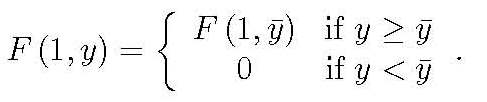
If you, like us, went to law school to avoid things like this:
Untitled Extract Pages

then perhaps this recently-published paper is not going to be your cup of tea.

But seriously, folks, this one might be worth your time, even if you are numbers-challenged, because it is a look at the “holdout” issue from the standpoint of economists.

In “Private Takings,” the authors “examine[] the implications associated with a recent Supreme Court ruling, Kelo v. City of New London.” From the Introduction:

This paper examines the implications associated with a recent Supreme Court ruling, Kelo v. City of New London. Kelo can be interpreted as supporting eminent domain as a means of transferring property rights from one set of private agents — landowners — to another private agent — a developer. Under voluntary exchange, where the developer sequentially acquires property rights from landowners via bargaining, a holdout problem arises.

Continue Reading New Article: “Private Takings” (via Fed Reserve Bank of Chicago)
The first time the government tried to take the property, it screwed up: the ordinance authorizing the taking failed to state that the property was necessary, and failed to adequately describe the property to be taken. The trial court dismissed the case.

As we all know, in most cases that means the government just reboots and tries again. Which it did. It adopted another ordinance in which it attempted to cure the problems that led to the first dismissal. When negotations between the agency and the property owner could not be concluded successfully, the agency filed a second condemnation action.

The owner asserted res judicata, arguing that the two eminent domain actions were the same, and thus the agency could not get a second bite of the apple. 

In Rock River Reclamation District v. Sanctuary Condominiums of Rock Cut, No. 2-13-0813 (Dec. 11, 2014), the Illinois Court of Appeals

Continue Reading Ill App: First Condemnation Was Not Res Judicata To Second

Here’s the Verified Complaint in a case recently filed in U.S. District Court in New Jersey:

Plaintiffs Jenkinson’s Pavilion, a corporation of the State of New Jersey and Jenkinson’s South, Inc., a corporation of the State of New Jersey, (collectively “Plaintiffs”), bring this action, inter alia, (a) for a declaration as a matter of law that the United States Army Corps of Engineers (“USACOE”) has not required, and does not require, for purposes of the “Manasquan Inlet to Barnegat Inlet Storm Damage Reduction Project,” the acquisition of perpetual rights in privateproperty for purposes of establishing recreational public beaches landward of the area already subject to public ownership and rights of public user pursuant to the New Jersey Public Trust Doctrine, and (b) enjoining the Defendants from taking actions in furtherance of the “Manasquan Inlet to Barnegat Inlet Storm Damage Reduction Project,” in advance of a determination on the relief

Continue Reading Federal Court Challenge To NJ’s Beach Replenishment Plan

Under Virginia’s condemnation procedures, as a prerequisite to a court exercising jurisdiction over an eminent domain action, a state condemning agency must as an initial step present to the property owner a statement of “the amount which [the condemnor] believes to be just compensation,” and must include an appraisal if an appraisal is required:

The state agency concerned shall provide the owner of real property to be acquired with a written statement of, and summary of the basis for, the amount it established as just compensation, and, if an appraisal is required or obtained, such written statement and summary shall include a complete copy of all appraisals of the real property to be acquired that the state agency obtained prior to making an offer to acquire or initiating negotiations for the real property.

Virginia Code § 25.1-204(E)(1)

In a case we posted about briefly here, a Virginia trial

Continue Reading Amicus Brief: Eminent Domain Jury Can’t Be Kept In The Dark About The Condemnor’s Initial Valuation

Here’s the Opening Brief on the Merits, filed by the State of California in Property Reserve, Inc. v. California, No. s217738 (Sep. 26, 2014).

That’s the case in which the California Supreme Court is reviewing a court of appeal decision which invalidated California’s entry statute (Cal. Civ. Pro. Code § 1245.010 et seq.), concluding it was unconstitutional because it allowed an uncompensated taking. We summarized the court of appeal opinion here.

The property owner’s answering brief is due to be filed shortly, and amici briefs will be filed thereafter. Disclosure: we are authoring an amici brief in the case in support of the property owner. 

Opening Brief on the Merits, Property Reserve, Inc. v. California, No. S217738 (Sep. 26, 2014)

Continue Reading Opening Brief In Property Reserve: Eminent Domain Is Such A Bother

Muskogee-map

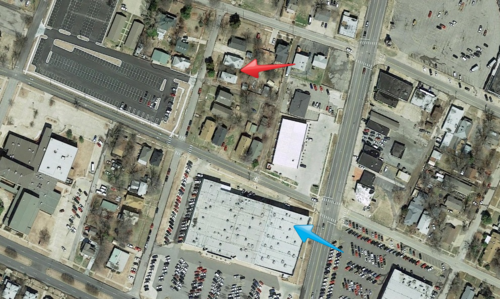
A must-read from the Oklahoma Court of Appeals. In City of Muskogee v. Phillips, No. 111,501 (Nov. 21, 2014), the court invalidated a taking, concluding that it was not a public use under the Oklahoma Constitution for a city to condemn private property for a parking lot when the primary apparent beneficiary of the parking lot would likely be the owner of a nearby office building whose tenants were responsible for an increase in on-street parking in the neighborhood.

Quick background: the federal government leased a privately-owned office building for a call center (the blue arrow on the above map). Employees of the call center parked on the street in the neighborhood. The city decided to build a parking lot and parking structure “for the health and safety of the Citizen’s [sic] of Muskogee by reducing the volume of on-street parking in the areas near and surrounding” the call

Continue Reading OK App: Taking A Home For A Parking Lot, When Primary Beneficiary Is Private, Is Not A Public Use

We’ve been over this territory before:

And now, in an effort to convince New York City to go down the lets-take-underwater-mortgages-by-eminent-domain path, Cornell lawprof Robert Hockett, whose brainchild this is, has published “‘We Don’t Follow, We Lead’: How New York City Will Save Mortgage Loans by Condemning Them” (Nov. 29, 2014) in the Yale Law Journal Forum. From the piece’s Introduction:

Many cities across the nation have begun to consider exercising their eminent

Continue Reading Yet Another Effort To Justify Taking Mortgages By Eminent Domain

Check out this story from today’s Greensboro/Winston-Salem (NC) News-Record, “DOT’s long road to nowhere angers property ownersabout the practice in North Carolina of using “protected corridors” to designate property under the state’s Transportation Corridor Official Map Act for future highway use, but then not condemning and paying for the land (while preventing the owners from making any use of it). 

We posted about the NC Supreme Court’s decision in one of those cases, where the court concluded that the property owners could not litigate it as a class action, but must do so in individual cases (800 of them!). Another post on the Map Act cases here (“Lines On A Map” Or Inverse Condemnation: How Long Can A Taking Be Only ‘Planned’ But Not Executed?“). 

The News-Record story is a good read, and a quick summary; recommended reading. It doesn’t hurt that the

Continue Reading N.C.’s Map Act: Clouding Use By Condemnation On The “Long Road to Nowhere”

The use of eminent domain for energy transmission corridors has become a hot topic lately. See, for example, the following posts:

The current center of the controversial issue is the TransCanada Keystone XL pipeline, and there’s been a lot of dis- and mis-information generated. Even Jon Stewart got in on the act.

So it was with relief that we have a new article by our Owners’ Counsel of America colleague William Blake, a partner in the Lincoln office of Nebraska law

Continue Reading A Clear-Eyed Explanation Of The TransCanada Keystone XL Pipeline Eminent Domain Issue

For those of you who couldn’t join us at the William & Mary Law School last month for the Brigham-Kanner Property Rights Conference (see our report here), the law school has made videos of the four panel presentations available here

They’re high quality videos, so be prepared for big downloads, but the presentations are worth it. While they are all good, our favorite was the impromptu discussion/debate during the third panel, “Balancing Private Property and Community Rights,” featuring panelists Kames Burling (Pacific Legal Foundation), Professors Richard Epstein (NYU), Steven Eagle (Geo. Mason), Mark Poirer (Seton Hall), and James Stern (William & Mary). 

Continue Reading Brigham-Kanner Property Rights Conference – Panel Videos Now Available