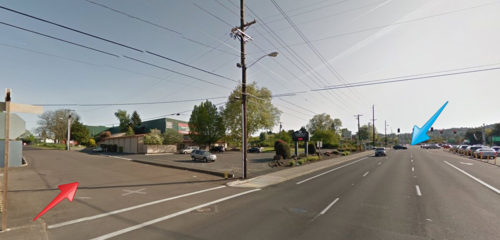
Alderwoods

In reading State of Oregon v. Alderwoods (Oregon), Inc., No. A146317 (Sep. 17, 2014), we learned two things we didn’t know before: that the Oregon Court of Appeals can sit “en banc,” and also that it can affirm by an equally-divided court. Eight judges considered the case, and since the split was 4-4, the court affirmed per curiam, with several of the judges filing separate opinions.

As we detailed in our earlier post on the case,

fjfjfkdjd

The court of appeals’ opinions

fjfkriridk

Alderwoods2

tttrtrtr

Petition to the Review the Decision of the Court of Appeals, State of Oregon Dep’t of Transportation v…

State of Oregon v. Alderwoods (Oregon), Inc., No. A146317 (Or. App. Sep. 17, 2014) (en banc) 

Continue Reading Oregon Supreme Court Asked To Rule Whether Highway Access Is Property Right
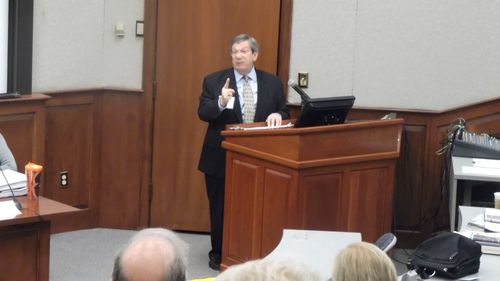
To all who were able to join today’s ABA Section of Real Property, Trust and Estate’s Condemnation, Zoning and Land Use Committee’s call on the AIG takings trial, currently pending in the U.S. Court of Federal Claims, thank you for participating. I’ve posted the entire talk (minus questions) above.

Here are the links to the stories, analysis, and materials I mentioned: 

  • The original complaint, first filed in the CFC in November 2011. 
  • Second Amended Complaint in the CFC case, along with Mr. Boies’ quote that this will be “an easy case to litigate.” We described the case as “audacious,” if only because it seeks $25 billion in just compensation. 
  • Professor Gideon Kanner’s (who has been following this case more closely than we have) first thoughts on the complaint. 
  • The CFC’s Opinion and Order granting in part and denying in part the United States’ motion to dismiss.  


Continue Reading Links From Today’s ABA Talk On The AIG Bailout Takings Case

Here’s what caught our eye today:

  • Last evening, we attended lawprof Gregory S. Alexander‘s talk at the U. Hawaii Law School, “Five Easy Pieces: Recurrent Themes in American Property Law.” You know it’s not a real academic talk until the speaker uses the words “normative” and “neologism,” and Professor Alexander did not disappoint. But seriously, it was a thought-provoking hour, focused on our favorite topic, property law. A video was made, and hopefully the law school will post it on line so you can watch. We’ll link to it when they do. 
  • Va. high court to look at Beach eminent domain appeal,” from the Hampton Roads newspaper, about a case which the Virginia Supreme Court just accepted. The case was triggered when the trial court refused to allow the jury to hear evidence of the DOT’s first appraisal and deposit, which was higher than its final appraisal


Continue Reading Thursday Round-Up: “Five Easy Pieces” Talk, Re-appraisals, Foie Gras Ban Lives, Kelo In China, Kelo Movie

  DSCF2208

You can’t have rights without advocates.”

                              – Michael Berger

We’re at the William and Mary Law School in Williamsburg, Virginia today for the 11th Brigham-Kanner Property Rights Conference. As we’ve noted earlier, Michael Berger is this year’s B-K Prize honoree, for his career contributions to property law and his “scholarly work and accomplishments [which] affirm that property rights are fundamental to protecting individual and civil rights.”

The list of past recipients is an All-Star roster of property scholars and jurists, including lawprofs Frank Michelman, Richard Epstein, James Ely, Carol Rose, Thomas Merrill, and Supreme Court Justice Sandra Day O’Connor (the latter perhaps more for where she ended up in her Supreme Court career than where she started). See the plaque on the Law School’s wall for the complete list of

Continue Reading 2014 Brigham-Kanner Property Rights Conference Report: Honoring Michael Berger

Banner

If you haven’t already, please mark you calendars: the agendas and faculty lists for the February 5-7, 2015 ALI-CLE eminent domain programs in San Francisco have been finalized. Registration is ongoing, and there’s even a few more days left for the early registration discount. Substantial group discounts are also available. 

We’re talking, of course, about Eminent Domain and Land Valuation Litigation (the “masters” program, now in its 32nd year), and Condemnation 101: How to Prepare and Present an Eminent Domain Case (the boot camp or refesher course on eminent domain fundamentals).  We’re the co-Planning Chair of the Eminent Domain and Land Valuation Litigation program along with Joe Waldo, and we think we’ve assembled an exciting agenda, presented by a faculty comprised of the nation’s best-of-the-best in our field of law.

Some highlights:

  • Eminent Domain National Law Update – Amy Brigham Boulris, Gunster, Yoakley & Stewart, P.A.,


Continue Reading ALI-CLE 2015 Eminent Domain and Land Valuation Litigation & Condemnation 101 Agendas And Faculty Announced

As we all understand, when valuing property in eminent domain, the highest and best use of not limited to the property’s existing use or its current zoning. The owner is entitled to prove that she could reasonably make a more intensive use of the property.

Rodman v. Commonwealth, No. 12-P-223 (Oct. 7, 2014) involved a partial taking of partially developed land (part of it was used as temporary parking lot for the Patriots’ stadium, across Route 1 from the property) for a road expansion by the Massachusetts Department of Highways. When at trial the property owner attempted to show that the land could be developed much more intensely before the taking than after, the court refused to let the jury hear evidence of the owner’s development plans, and evidence of the development approach to value. “Ultimately, the jury awarded damages of $600,800, the exact amount the Commonwealth’s expert testified

Continue Reading Mass App: Eminent Domain Jury Entitled To Consider Evidence Of Potential Development

Here’s a very important case from the Pennsylvania Supreme Court (Middle District). The question before the court in Reading Area Water Auth. v. Schuylkill River Greenway Ass’n , No. J-13-2014 (Sep. 24, 2014) was this:

The primary question raised is whether a municipal authority may exercise its eminent domain powers to condemn an easement over privately-owned land, where the sole purpose of the easement is to supply a private developer with land to install sewer drainage facilities needed for a proposed private residential subdivision.

Slip op. at 1. 

Short answer: no.

The Schuylkill River Greenway Association, true to its name, intends to build a public walking and recreational trail on land it owns along the bank of the river in conjunction with Bern Township. Unfortunately (for the Association), the property next to their is slated for development into an “adult residential subdivision,” and it needed access to the river’s water. We

Continue Reading Pennsylvania: No Public Use To Condemn, When “Sole Purpose” Of Taking Benefits Private Developer

We like the Texas Supreme Court, because (among other things) it livestreams oral arguments, and once completed, archives them for those who can’t be there in person, or watch live. So even though we couldn’t make it to Austin for the arguments earlier this month in Texas v. Clear Channel Outdoor, Inc. (a case which we posted about here), we were able to follow along with the archived video

The case presents two questions: first, whether a billboard owner is entitled to just compensation when the land on which it sits is taken by eminent domain because it may be possible to relocate the billboard, and second, what method of valuation can be used to measure compensation, if so. We filed an amicus brief in the case arguing that “[b]illboards are not designed to be moved. And the most valuable part of a billboard is not steel

Continue Reading Oral Argument Video In Texas Supreme Court Condemnation Case: Is A Billboard Moveable Property?

We’re tied up in court today, so don’t have time to post up the latest cases which have crossed our desk in the past few days.

We will get to them soon, but in the meantime, check out this story (“The Stubborn ‘Nail Houses’ That Refuse to Get Demolished“) from Gizmodo (a blog about tech gear) about eminent domain holdouts, including one particularly endearing woman who refused to go gentle into that good night.  

We”ll return to our regularly scheduled programming shortly. Continue Reading “Nail Houses” And Eminent Domain

A reminder: the 11th annual Brigham-Kanner Property Rights Conference is coming up on October 30-31, 2014, at the William and Mary Law School in Williamsburg, Virginia. As we noted earlier, Michael Berger will receive the Brigham-Kanner Prize, so this one is special – he’s the first practitioner to receive the Prize.

More here, from W&M, including agenda and registration information. Here’s the flyer.

We’re going – hope to see you there. 

11th Annual Brigham-Kanner Property Rights Conference – Oct 30-31, 2014 – Michael Berger

Continue Reading October 30-31, 2014: Brigham-Kanner Property Rights Conference @ William & Mary Law