0606191053_HDR

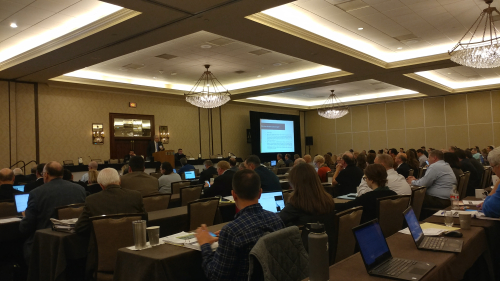
Here are the links to the cases which were not in your materials. Theme of the day: amateurs! 

Our thanks to colleagues Jill Gelineau and Paul Sundermier for asking us to present. It was good to see our Oregon friends again. 


Continue Reading Links From Today’s Portland Eminent Domain Conference
An issue we’ve been tracking for a while — are takings for pipelines for the public’s benefit? — raises another question: how is “the public” defined?

Some courts, like Kentucky’s, define the public as the public which the jurisdiction serves. In the Bluegrass Pipeline case, for example, the court of appeals held that a natural gas pipeline which went through Kentucky, but did not have any offramps for the natural gas in Kentucky — was not “in public service” as required by that state’s eminent domain statutes. A Pennsylvania court adopted a similar rationale (even though it held a private pipeline could exercise eminent domain power because it planned gas offramps in Pennsylvania).

And in City of Oberlin v. FERC, No. 18-1248, the U.S. Court of Appeals for the D.C. Circuit recently heard oral arguments about whether FERC can consider

Continue Reading Are Pipelines For The Public’s Benefit? If So, What Public?

Here’s what we’re reading today, in between real work:

Continue Reading Friday Reading: Pipeline Injunctions, Justifying Kelo, And Maui Groundwater Case

On one hand, there’s nothing really new in the Hawaii Supreme Court’s opinion in In re Hawaii Electric Light Co., No. SCOT-17-630 (May 10, 2019), because the court has previously told us the answers to each the component questions in the case:

  • On the ultimate question posed in the title, must the PUC consider whether a power purchase agreement for a Big Island “woody biomass” electric plant might have an effect on a clean and healthy environment by affecting the utility’s willingness to purchase electricity generated by more “pure” means such as wind and solar: you don’t need to read the 66 page unanimous opinion to know the answer: of course it has to. The statute mostly says so, and you didn’t need a deep understanding of the other details in the case to be able to predict about how this one was going to end up, merely the


Continue Reading HAWSCT: PUC Must Consider Whether Renewable Biofuel Energy Plant Might Impact Property Right To Clean And Healthful Environment

Remember that Christopher Nolan movie from a few years ago, “Inception,” with its dream-within-a-dream storyline?

Well, that’s what a recently-filed cert petition which asks the U.S. Supreme Court to jump into California’s inverse-condemnation-liability-for-wildfires issue reminds us of with its taking-within-a-taking argument, as detailed in the Question Presented:

Whether it is an uncompensated taking for public use in violation of the Fifth and Fourteenth Amendments for a State to impose strict liability for inverse condemnation on a privately owned utility without ensuring that the cost of that liability is spread to the benefitted ratepayers.

Let’s see if we are keeping the argument straight: it’s a taking to hold a private entity which possesses the delegated power of eminent domain liable for a taking for burning down private property unless the utility is also entitled to pass the cost of any taking judgment on to those who benefit from

Continue Reading New Cert Petition: Fifth Amendment Requires California To Spread The Cost Of Wildfire Inverse Condemnations To Ratepayers

0412191003c_HDR

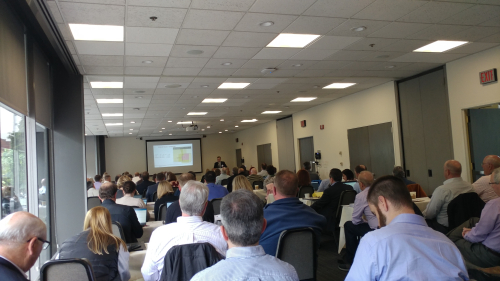
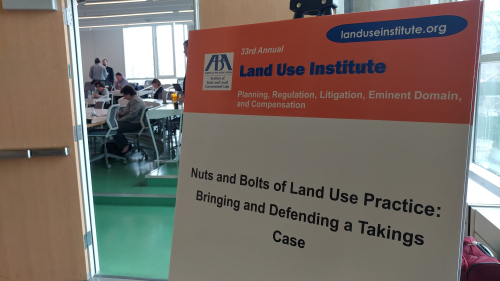
Here are the links from today’s two sessions (the first, federal water issues impacting local land use; the second, Bringing and Defending a Takings Case):

The morning started off with a talk by former Detroit Mayor (and Michigan Supreme Court justice) Dennis Archer, about Poletown, eminent domain, and economic

Continue Reading Links And Materials From Today’s Land Use Institute Sessions, Baltimore

0401191044b_HDR

Great crowd today in Austin for CLE International’s Eminent Domain seminar, co-chaired by our colleagues Chris Clough, Sejin Brooks, and Christopher Oddo. We spoke about “National Trends and Developing Issues in Eminent Domain.” 

Here are the cases I referred to which are not included in your written materials:


Continue Reading Materials And Links From Today’s Austin Eminent Domain CLE

IMG_0123

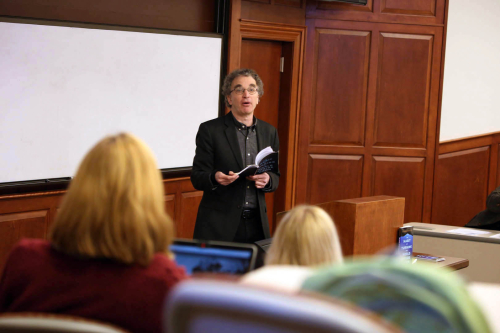
Last week, author Howard Mansfield joined us at the William and Mary Law School for two sessions about his recently-published book, “The Habit of Turning the World Upside Down – Our Belief in Property and the Cost of That Belief.”  His book is about property, property rights, and what he has discovered about how these ideas are processed by the American psyche.

The first session was open to the entire student body, faculty, and public, and the highlight was Mr. Mansfield reading some of his favorite passages from his book. The second session was a student-only chat about some of the themes that he emphasizes. 

If you were not able to join us in-person, listening will be able to give you a sense of why we think this book is a timely rumination on what “property” means, both good and not-so-good. 

If you can’t stream the audio above, Continue Reading Audio: Readings From “The Habit of Turning The World Upside Down”

Header image LUI 2019

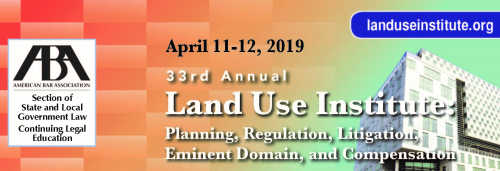
Come join us at the 33rd Annual Land Use Institute, in Baltimore, Maryland, April 11-12, 2019.

As the brochure notes:

This Annual Land Use Institute program is designed for attorneys, professional planners, and government officials involved in land use planning, zoning, permitting, property development, conservation and environmental protection, and related litigation. It not only addresses and analyzes the state-of-the-art efforts by government to manage land use and development, but also presents the key issues faced by property owners and developers in obtaining necessary governmental approvals. In addition, the entire approach of the program is to provide practice pointers that give immediate “take home value” by focusing on topics relevant to the average practice of the attendee.

The keynote will be delivered by Dennis Archer, former mayor of Detroit (and former Justice of the Michigan Supreme Court, and former President of the ABA), speaking about “Detroit’s New GM Plant from

Continue Reading 33rd Annual Land Use Institute: Baltimore April 11-12, 2019

Our colleague Dwight Merriam was recently interviewed on the radio about issues surrounding the existing and proposed wall and fence along portions of the southern border.

If you want to get educated on this issue, here’s the quick way to do it.

Dwight discusses funding, emergency powers, the Declaration of Taking Act, and other topics. You may not be practicing where border wall issues are among your cases. But trust us: even so, if you tell people you are an eminent domain lawyer at a cocktail party, the first thing someone is going to ask is what your thoughts are on the border wall. Doesn’t matter if you are in a state far from the border. And if you aren’t familiar with the border wall issues and able to chat about them, they will conclude you are a bad eminent domain lawyer. So get educated! Here’s your chance. 

Dwight has

Continue Reading Dwight Merriam Interviewed On Border Wall Legal Issues