Mansfield flyer 3-13-2019

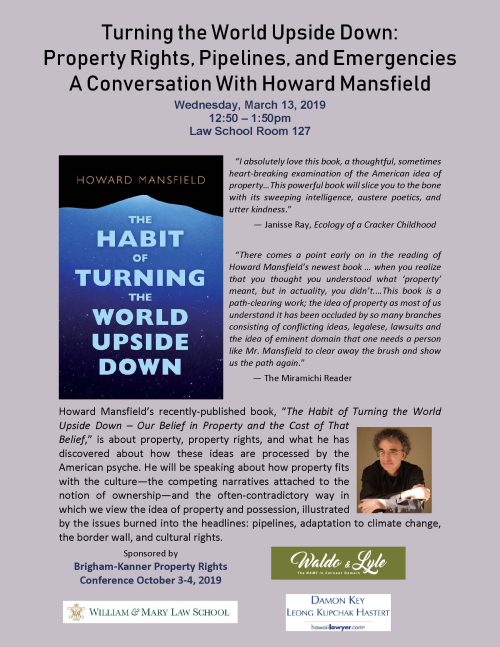
If you are in the Williamsburg, Virginia area next week Wednesday, March 13, 2019, please hold the lunch hour (12:50-1:50pm, Room L127) on your calendar to come join us for a session with Howard Mansfield, author of the recently-published book “The Habit of Turning the World Upside Down – Our Belief in Property and the Cost of That Belief.”

In November, we chatted with Mr. Mansfield, and this semester are basing a seminar on property rights at the William and Mary Law School on the book. Well worth reading. Here’s the printable flyer

His book is about property, property rights, and what he has discovered about how these ideas are processed by the American psyche. He will be speaking about how property fits with the culture—the competing narratives attached to the notion of ownership—and the often-contradictory way in which we view the idea of property and
Continue Reading Upcoming 3/13/2019 Book Talk: Turning the World Upside Down: Property Rights, Pipelines, and Emergencies – A Conversation With Howard Mansfield

IMG_20180720_151841

Rather than sum up the issue and the Massachusetts Appeals Court’s** conclusion in Smyth v. Conservation Comm’n of Falmouth, No. 17-P-1189 (Feb. 19, 2019), here’s the first part of the opinion:

GREEN, C.J. A land owner brought this action in the Superior Court, claiming that local land use regulation effected a taking of her property, requiring just compensation under the Fifth Amendment to the United States Constitution and art. 10 of the Massachusetts Declaration of Rights. This appeal presents a question of first impression in Massachusetts: whether the land owner is entitled to have her regulatory taking claim decided by a jury. We conclude that the jury right does not attach to such a claim, and that the judge erred in denying the defendants’ motion to submit only the question of damages to a jury. We further conclude that the evidence presented at the trial did not, as matter

Continue Reading Mass App: Regulatory Takings Claims Don’t Get A Jury Trial

We suppose we should not be too surprised by the U.S. Court of Appeals for the Fourth Circuit’s panel opinion in Mountain Valley Pipeline, LLC v. 6-56 Acres, No. 18-1159 (Feb. 5, 2019), which concluded, like the Third, Sixth, and Eleventh Circuits did recently, that a private condemnor may obtain immediate possession of property that it may condemn, even though Congress did not delegate the quick take power to those private condemnors in the Natural Gas Act.

After oral argument, we had a faint hope that the panel might see things differently. See4th Cir Judge In Pipeline Arguments: “Condemnation is one of those monarchy things” – Is Immediate Possession Unconstitutional When Congress Has Not Delegated That Power To A Pipeline?

But alas no, it was not to be. All three judges concluded that this case is “on all fours” with the Fourth Circuit’s earlier

Continue Reading Fourth Circuit Panel Sticks With Sage: Natural Gas Act Condemnor Given Immediate Possession Even Though No Grant Of Quick Take Power In The Statute

Psweather

If you didn’t register to attend the 36th Annual ALI-CLE Eminent Domain and Land Valuation Litigation Conference later this week in Palm Springs, California, well then, shame on you!

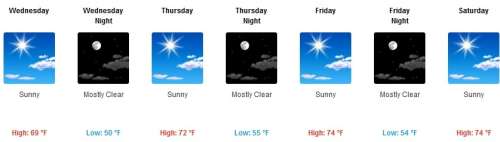
According to the National Weather Service, while you and the rest of the country is freezing, we’ll be enjoying the balmy desert climes, and discussing the topics we love: eminent domain, redevelopment, relocation, regulatory takings, trial and appeal strategies, doctrinal changes on the horizon, hot topics (border wall, pipelines, wildfires, and flooding), and others. 

Featuring a national faculty (many new to the ALI-CLE dais), and attendees from the entire spectrum of practice, academia, and the bench. 

If you are not joining us, be sure to follow along on the blog (we will post updates daily), and on Twitter (@invcondemnation, @ALI_CLE #EminentDomain2019). And plan on joining us in 2020, when we’ll be in a new city (by

Continue Reading ALI-CLE Palm Springs (72º, Sunny) Here We Come

Don’t Miss the 2019 Eminent Domain Litigation Conference from American Law Institute CLE on Vimeo.

Check out this sound blurb, produced by the good media folks at ALI-CLE, about the upcoming Eminent Domain and Land Valuation Litigation Conference. (And no, we didn’t record this in a jazz club; although I wish we had.)

There’s still time to register, and come and join us in Palm Springs. Continue Reading Hot (Eminent Domain) Topics, Cool Jazz

1126181629e_HDR

We’re almost there, but we still have room remaining. At the 2018 Conference in Charleston, we both sold out the registrations and the conference hotel, so we planned ahead for the upcoming 2019 Conference in Palm Springs at the Renaissance Palm Springs Resort

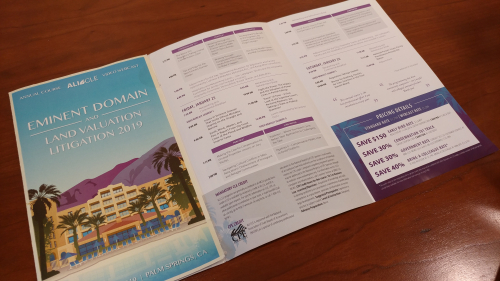
Register here. You will also be able to download the print brochure (above), or find out more details about the agenda and faculty on line. As always, we have assembled a great faculty — many of them new speakers — on the hottest topics in eminent domain and takings law: pipelines, jury presentations, challenging the take, an update on the most important decisions of 2018, pre-condemnation planning (from both the condemnor and property owner perspective), the border wall, and relocation. 

And of course, ethics and the “101” track for those new to the field, or experienced lawyers who would like a refresher on the

Continue Reading Space Remaining Is Limited – Register Now For ALI-CLE Eminent Domain And Land Valuation Litigation Conference (Palm Springs, Jan. 24-26, 2019)

Here’s the Eleventh Circuit’s opinion in a case that adds to a circuit split (CA7 vs others) about whether a private condemnor, exercising the delegated federal power of eminent domain for a pipeline corridor under the Natural Gas Act, can obtain pre-judgment possession of the property, even though the NGA does not delegate the power to do so.

The Eleventh Circuit, like the Third and Fourth Circuits, concludes that the lack of delegation from Congress isn’t a problem, because, hey, Congress didn’t say that federal courts couldn’t exercise their “equitable” powers under Fed. R. Civ. P. 65, and issue injunctions to reach the same result.

We won’t go into the detail of the panel opinion (it pretty much tracks the other federal courts which have, for decades, been approaching this the wrong way). Nor shall we go into detail about why these courts are wrong, because we did so, in

Continue Reading CA11 Adds To Circuit Split: Private Pipeline Condemnor Can Get Immediate Possession, Even Though Natural Gas Act Doesn’t Delegate Quick Take Power

Earlier this week, we spoke to Howard Mansfield, author of the recently-published book “The Habit of Turning the World Upside Down – Our Belief in Property and the Cost of That Belief.”

His book is about property, property rights, and how these ideas are processed by the American psyche. But instead of the usual scholarly (and very often dry) treatment of these topics that we might expect – especially those of us in the legal and academic world – Mr. Mansfield takes a slightly different approach. He relates stories of how property fits in with the culture – the different and often competing narratives that are attached to the notion of property – and the often-contradictory way in which we in the United States view the idea of ownership and possession.

Listen to our interview above (Sound Cloud stream), or if that does not work for you

Continue Reading Audio: Our Interview With Author Howard Mansfield – “The Habit of Turning The World Upside Down – Our Belief in Property and the Cost of That Belief”

A unanimous opinion from the Supreme Court, which can only mean one thing: a narrowly-drawn opinion that doesn’t resolve much.

But we’re grateful anyway, because the opinion is one that appreciates the plight of property owners whose land is subject to being designated as “critical habitat” under the Endangered Species Act.

Intervenor Center for Biological Diversity raises an additional question in its brief, arguing that Weyerhaeuser lacks standing to challenge the critical-habitat designation because it has not suffered an injury in fact. We agree with the lower courts that the decrease in the market value of Weyerhaeuser’s land as a result of the designation is a sufficiently concrete injury for Article III purposes. See Village of Euclid v. Ambler Realty Co., 272 U. S. 365, 386 (1926) (holding that a zoning ordinance that “greatly . . . reduce[d] the value of appellee’s lands and destroy[ed] their marketability for industrial, commercial and

Continue Reading Supremes: “According to the ordinary understanding of how adjectives work, ‘critical habitat’ must also be ‘habitat’” … Whatever That Is

Get ready. In this and upcoming posts, we’re going to be featuring the items on our agenda for the upcoming ALI-CLE Eminent Domain and Land Valuation Litigation Conference, January 24-26, 2019, in sunny Palm Springs, California. 

ALI-CLE has released the brochure, which those of you on the mailing list should have received — or will be receiving — in your brick-and-mortar inboxes. If not, download it here. Looking it over, you will see that we have assembled a great faculty with expertise in the range of issues that are driving our branch of the law, locally and nationally.

And, as always, one of the best aspects of this conference is the collegiality. Our attendees and faculty find that one of the most beneficial parts of the conference is to meet your colleagues from across the country, and talk shop about the issues we love.  

Of course we

Continue Reading ALI-CLE Eminent Domain And Land Valuation Litigation Palm Springs Brochure Is Out