20180717_135234_HDR

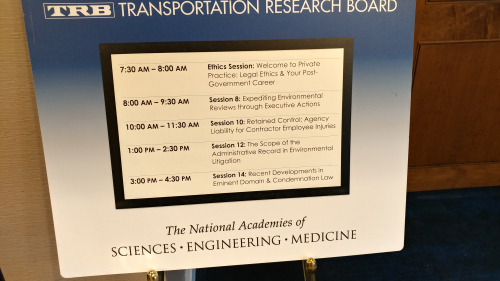
Here are the cases and other items I either spoke about or mentioned at today’s Transportation Research Board‘s 57th Annual Workshop on Transportation Law in Cambridge, Massachusetts:


Continue Reading Links And Materials From Today’s Transportation Research Board Session

The plaintiffs owned mining and homestead claims on land in the Santa Fe National Forest. They claimed they own easements to access these lands, recognized by federal statutes. The government said no, these are just access rights, not easements. 

Then a fire, followed by flooding which severely damaged the Forest Service roads which the plaintiffs used for access. The Forest Service declined to repair the roads, but the plaintiffs said they’d intended to do so. But you have to do so by our rules, the Forest Service responded. Meaning the landowners would need to get a permit first. Apparently, they didn’t.

Instead, they brought suit in the Court of Federal Claims, asserting the loss of their easements was a physical taking. The CFC dismissed because the case was not ripe under Williamson County‘s “final decision” rule — the plaintiffs had not sought permission to repair the roads. 

In Martin

Continue Reading Fed Cir: Takings Claim For Loss Of Access To National Forest Land Not Ripe

Remember that case from earlier this year where the Hawaii Supreme Court held that for purposes of Hawaii’s Due Process Clause, the Sierra Club (any “person,” actually) has a property right in a “clean and healthful environment?”

We asked if that were the case, then what does that “property” right look like? For example, how does the Sierra Club exclude others from this property? And if it is a property right shared by all, it it really a “property” right? 

In Delaware Riverkeeper Network v. FERC, No. 18-5084 (July 10, 2018), the U.S. Court of Appeals addressed that same question, but reached a different result. The court held that the Pennsylvania Constitution’s Environmental Rights Amendment’s guarantee of “clean air, pure water, and to the preservation of the natural, scenic, historic and esthetic [sic] values of the environment” was not a liberty or property interest triggering the Fourteenth Amendment’s due

Continue Reading DC Cir: No Property Right In A Clean And Pure Environment Because No Right To Exclude Others

18730910_303

Here’s the not unexpected decision from the U.S. Court of Appeals for the Ninth Circuit in a case we’ve been following (sort of). It should never have gotten this far, even as the “plaintiffs” raise the specter of a cert petition.

We say again: the federal courts seem to have time for this brand of nonsense, but when it comes to land use and takings cases, they won’t be “super zoning boards of appeals,” and almost always refuse to give them the time of day. At least PETA didn’t make a takings claim and further hose up the law. 

Once again, Dr. Zaius could not be reached for comment.

Rock on, Naruto.

Naruto v. Slater, No. 16-15469 (9th Cir. Apr. 23, 2018)

Continue Reading 9th Cir: “Ape Shall Not Sue Ape!” Court Has Time For Silly Monkey Selfie Case, But Not For Takings

IMG_2947
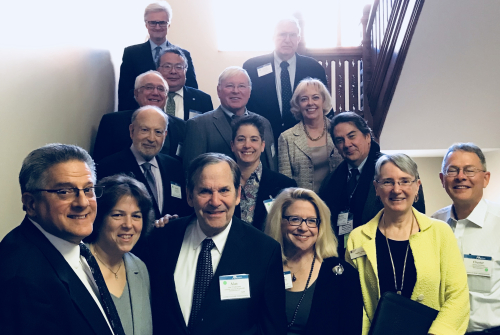
Some of the Land Use Institute faculty, including (front row left), Planning Chair Frank Schnidman and Planning Co-Chair Patty Salkin

Last Friday at the 32nd Annual Land Use Institute in Detroit, I was honored to moderate a freewheeling discussion by a panel of takings experts, Professor Steven Eagle, Minnesota lawyer Howard Roston, and Michigan’s own Alan Ackerman on “Takings, Eminent Domain, and Vested Rights.”

Here are the cases and other materials we discussed, as well as a few others which we did not have time to cover (but wish we could have):


Continue Reading Cases And Materials From The Takings And Eminent Domain Session At The Land Use Institute

20180419_150416_HDR

We’re in Detroit the rest of the week at the Mercy Law School for the venerable Land Use Institute, now in its 32nd iteration.

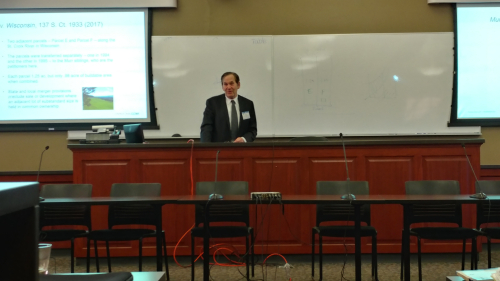
Planning Chair Frank Schnidman has assembled a great faculty including out Detroit colleague Alan Ackerman (above, talking about takings liability for flooding), and we’ll be spending the time talking inverse condemnation, public trust, planning law, homelessness, autonomous vehicles, affordable housing, RULIPA, and similar topics. We’ll be presenting on “Eminent Domain, Vested Rights, and Regulatory Takings,” “Client Representation: Developer, Government, and Citizens Groups,” and “Federal Laws Affecting Local Land Use Decision Making.” 

If you are here with us in Detroit, stop by and say hello. If you aren’t here, shame on you! This is one of the best and most affordable tuition deals in CLE.

But all kidding aside, if you are not in Detroit now, be sure to calendar these

Continue Reading Land Use Institute – Detroit

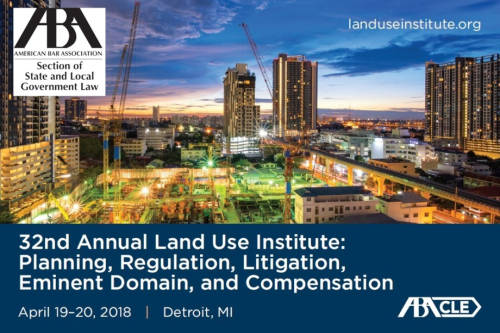
Space is filling up, but there’s still time to join us later this month in Detroit for the 32nd Annual Land Use Institute (April-19-20). 

We’ll let program Planning Chair Frank Schnidman explain all the reasons why, and we’ll add only these points: (1) it’s a very good program that won’t take much of your time (fly in for the Thursday afternoon program, stay a night, fly home on Friday evening); (2) Detroit is the place to be these days; and (3) it’s one of the best deals in CLE credits, with tuition as low as $400.

2018 Land Use Institute Brochure Detroit 5 2018

Continue Reading There’s Still Time To Join Us In Detroit: 32d Annual Land Use Institute

Here’s what we’re reading this Thursday:

Cert(s) Denied

California Wildfires and Inverse Condemnation


Continue Reading Thursday Round Up: Cert(s) Denied, Cal Wildfires, City-to-City Takings, Other Stuff

Remember the Tom Cruise/Steven Spielberg flick Minority Report? That’s the one based on Philip K. Dick’s short story in which the police force’s PreCrime unit can presage that a citizen will violate the law in the future, so they arrest him now even though he has committed no crime. 

That’s the same vibe we get from the recent oral arguments in a case in which the Hawaii Supreme Court is being asked to resolve two fundamental questions in the latest case involving the Thirty Meter Telescope up on the top of the Big Island’s Mauna Kea.  

First, whether someone can possess a cultural property interest in publicly-owned land. Flores, a native Hawaiian, asserted he had such an interest in the land on which the telescope is planned. Second, if so, whether the State land agency’s consenting to the University of Hawaii’s sublease of that land to the TMT puts Flores’ interests

Continue Reading Department Of Precrime: HAWSCT Considers Cultural “Property” In Public Land

Emotionheader

Here’s the printable brochure with the details on the 32nd Annual Land Use Institute in Detroit, April 19-20, 2018. We’ve plugged the program before so we won’t do so again, except to say that you really should attend because (1) it’s a very good program that won’t take much of your time (fly in for the Thursday afternoon program, stay a night, fly home on Friday evening); (2) Detroit is the place to be these days; and (3) it’s one of the best deals in CLE credits, with tuition as low as $400.

2018 Land Use Institute Brochure Detroit 5 2018

Continue Reading April 19-20, 2018: Land Use Institute, Detroit (Printable Brochure)