Would you pay, say $10 for an undeveloped Maui beachfront parcel that is zoned for hotel and residential purposes, but currently is not developable because the County in the past wanted to condemn the land and turn it into a public park (but then ran out of money)?

In furtherance of its acquisition plan, the County changed the parcel’s Community Plan (known as a “general plan” in most jurisdictions) designation to “park.” But it never amended the Hotel zoning, which allows lesser intensive uses such as single-family homes. But then the County didn’t have enough money — beachfront property, it turns out, was (and is) a lot more spendy than the government appraisers thought — so it never actually acquired the land. But having downplanned the parcel in order to take it, it never bothered uplanning it when it couldn’t: the County never reverted the CP designation to its former
Continue Reading New Amicus Brief In SCOTUS Hawaii Case: Takings Is About Denial Of *Use* Not Whether Property Has Value

20181002_154246_HDR (1)

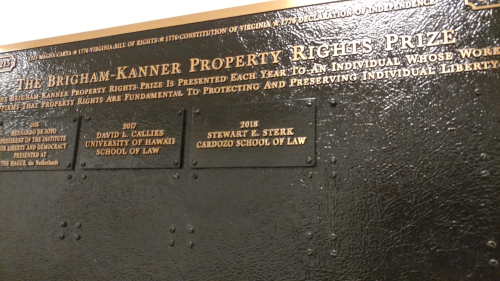
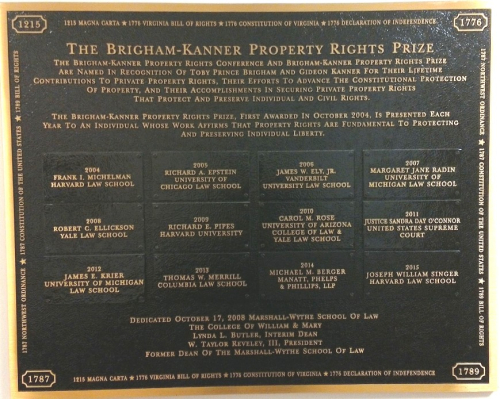
Last week, the 15th Annual Brigham-Kanner Property Rights Conference saw the gathering of legal scholars, judges, lawyers, and law students at the William and Mary Law School to award the B-K Property Rights Prize to Cardozo lawprof Stewart Sterk, followed by a day-long conference focusing on Professor Sterk’s work and the latest developments in property rights law.

Professor Sterk joins the pantheon of property law scholars (and a judge and a practitioner) who have been awarded the Prize. Pretty impressive:

WIN_20151002_13_15_51_Pro

As always, the program starts off with a candlelight dinner and award presentation in the historic Wren Building, definitely a highlight of the Conference. More about the Conference here

And there’s nothing like spending the following day addressing some of the most pressing issues in our area, along with the brightest minds in the business (below is the final panel of the day, with Professor John Echeverria

Continue Reading 2018 Brigham-Kanner Property Rights Conference Report: Emerging Issues

Here’s the latest in an issue we’ve been following closely. In the Natural Gas Act, Congress has not delegated to private pipeline companies the quick-take power. To get around that, to get immediate possession of properties which they are taking, pipeline companies use a procedural mechanism — a preliminary injunction under Fed. R. Civ. P. 65 — to get the same result. 

A preliminary injunction in these case looks like quick take, quacks like quick take (there’s a deposit, just like in quick take), and walks like quick take (the effect is the same). But it’s not really quick take because Congress has never actually approved of quick take in NGA takings. 

Of course, by the time a court gets to the actual merits of the validity of the taking — if it ever does — the pipeline is in place, and the whole thing a “done deal.” Fait accompli

Continue Reading 4th Cir Judge In Pipeline Arguments: “Condemnation is one of those monarchy things” – Is Immediate Possession Unconstitutional When Congress Has Not Delegated That Power To A Pipeline?

Here’s the video of the oral arguments held earlier today in the Iowa Supreme Court in a high-profile pipeline case. In Puntenney v. Iowa Utilities Board, the court is considering a case at the intersection of the law of public utilities, and condemnation law. The basic question the court is trying to solve is whether a finding by the IUB that the pipeline serves a “public convenience and necessity” makes a determination of the public use supporting the resulting condemnations unnecessary? 

Here’s a description of the issues from the court’s web site:

The district court denied petitions for judicial review of the Iowa Utilities Board’s (IUB) decision to grant a permit to Dakota Access, LLC, for the construction of a hazardous liquid pipeline pursuant to Iowa Code ch. 479B. On appeal, the petitioners argue the district court erred in affording the IUB the authority to define the term “public

Continue Reading Iowa Supreme Court Oral Argument Video: Does A Finding Of Public Necessity And Convenience For A Pipeline Also Solve The Question Of Public Use In Eminent Domain?

Before last week’s Judiciary Committee hearings on the nomination of Brent Kavanaugh to be an Associate Justice of the Supreme Court, we wrote that the issue of property rights and eminent domain may come up during the hearing, even though Judge Kavanaugh’s actual judicial record on that topic is pretty thin. 

We were busy during most of the hearings, and the portions we viewed did not focus on Kelo, but rather on a host of important other topics. But thanks to the efforts of our colleague Elaine Mittleman (the lawyer who argued and won the sole opinion in Judge Kavanaugh’s Public Use and Eminent Domain repertoire, Rumber v. District of Columbia, 487 F.2d 941 (D.C. Cir. 2007)), who sent us the video from the key portion of the hearings, we now have Judge Kavanaugh talking a bit about Kelo and property rights, and related (sort of) topics.  

Senator

Continue Reading Your Kelo Moments From The Kavanaugh Hearings

Come on, let’s be candid here. When we pick up an opinion filled with statutory and regulatory jargon — replete with agency acronyms — our eyes see the words, but our brains process them like they are being spoken by the adults in the Peanuts cartoons.

But then we spot the words “eminent domain” and BAM! we’re all in. 

So it is with the U.S. Court of Appeals’ opinion in Delaware Riverkeeper Network v. Secretary Pennsylvania Dep’t of Environmental Protection, No. 16-2211 (Sep. 4, 2018), which does not disappoint it the jargon department: PADEP, NGA, FERC, Water Quality Certification, EHB, &c. But this is a challenge to a pipeline and also involves eminent domain (if only peripherally), so yeah, we’re diving in despite the buzzing sound.

Short story: natural gas pipelines need Federal Energy Regulatory Commission permission before they can start taking property under the Natural Gas Act.

Continue Reading Third Circuit: Takings Challenge To Pipeline Belongs In FERC

20180126_111558_HDR

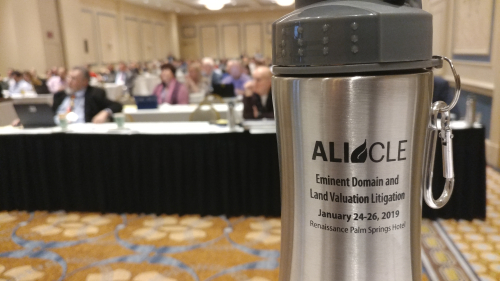
You’ve known for a while that Palm Springs, California, specifically the Renaissance Palm Springs Hotel (a resort facility, but right in town, so you will have many options for “off campus” activities like art museums, the aerial tram, golf, and whatever suits your fancy, and close-in to the Palm Springs Airport), is the venue for our 2019 ALI-CLE Eminent Domain and Land Valuation Litigation, January 24 through 26, 2019.

Of course, you also knew that the programming would be the usual spread of topical and cutting-edge topics, presented by some of the nation’s experts. But we didn’t give you the details. So here are some of the programs we’re having: 

  • Keynote Address: “Property Rights: Foundation for a Free Society” – Taylor Revley, most recently the past President of the College of William and Mary, and also former law school Dean (as well as a


Continue Reading ALI-CLE 2019 Eminent Domain And Land Valuation Litigation Conference, Palm Springs Agenda – Register Now!

Photo

One of the problems with high-public-profile cases like the multiple challenges to the “Thirty Meter Telescope” up on the top of the Big Island’s Mauna Kea, is that when the court issues an opinion, the public focuses only on the result, mostly from a policy perspective. Who won? Did the court invalidate the TMT permits? Did it side with the “right” party? 

We get that. Big cases make big headlines, and most people don’t care much about what the decision might mean for the law and future cases. And it matters in these type of cases who won. 

But those of us down here in the trenches look at these cases somewhat differently. Yes, the Hawaii Supreme Court’s long-awaited opinion in the latest phase of the multiple litigations challenging the TMT has dropped, and as you might have figured from this post’s headline, the court sided with the telescope and

Continue Reading Hawaii Telescope – Been There, Done That: Cultural Property Ownership Gets You Only A Public Hearing If You Have Other Chances To Make Your Case

Here’s what we are reading (or listening to) this Tuesday:


Continue Reading Tuesday Reading List – Flood Takings, Cuba Property, Beach Access, And … Space Aliens

Clare Trapasso has a Realtor.com piece on what a Justice Kavanaugh could mean for real estate, property, and land use issues, “What Supreme Court Nominee Brett Kavanaugh Could Mean for Real Estate,” where she correctly notes that “while commentators have been scrutinizing Kavanaugh’s record on hot-button topics like abortion and immigration, there’s been little discussion of what a more conservative court could mean for home buyers, sellers, and owners.”

She asked us for input, and here’s what we said:

“The Supreme Court has done some very interesting things on land use law that affect homeowners,” says Robert Thomas, a real estate attorney specializing in land use and eminent domain at the Honolulu-based law firm of Damon Key Leong Kupchak Hastert.

Thomas expects more property-related cases will make their way to the Supreme Court, brought by people hoping that the new bench will increase their odds of a

Continue Reading What Might A Justice Kavanaugh Mean For Takings, Land Use, And Other Issues?