Here are some upcoming events in which you may be interested, in chronological order:


Continue Reading Upcoming Events And CLE’s – Appellate, RLUIPA, Sharing Economy, And More
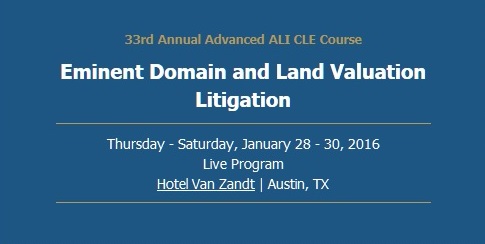
ALI-CLE-2016-masthead

Here’s the full agenda for the 2016 Eminent Domain and Land Valuation Litigation / Condemnation 101 Conference, January 28-30, 2016, in Austin, Texas. 

Together with our friend and colleague Joe Waldo, we think we’re put together a pretty good program that covers a lot of ground. This is the first time the conference has been to Austin, and we’re starting off with a talk by Austin Mayor Steve Adler, who in his former life was an eminent domain lawyer. Other highlights:

  • Professor Ilya Somin will speak about his recently-published book in a segment entitled “The Impact of Kelo and the Limits of Eminent Domain.”
  • Pipelines and Energy Corridors: Valuation Perspectives of Condemnors and Condemnees” with the lawyers on the front lines of one of the hottest topics in eminent domain law nationwide.
  • Retired Minnesota Supreme Court Justice Paul H. Anderson will give us his tips


Continue Reading It’s Here – 2016 ALI-CLE Eminent Domain Conference: Complete Agenda, Faculty, Registration Information

We visited Think Tech Hawaii’s downtown studios for a chat with Chris Lethem about Evenwel v. Abbott, the one-person-one-vote reapportionment case currently being briefed in the U.S. Supreme Court. As we’ve written, Evenwel could directly affect how Hawaii has reapportioned its legislature since statehood, and is a case to follow closely.

We also discussed Hawaii’s new Environmental Court and the recent Hawaii Supreme Court oral arguments in the “Thirty Meter Telescope” case

We didn’t know until earlier in the day that Chris would be the host. Which was a pleasant surprise because he is a former client in a successful case we took to the Hawaii Supreme Court a few years ago. Small town, no? Continue Reading From Think Tech Hawaii: SCOTUS Reapportionment, The New Environmental Court, And The TMT Oral Arguments

Oral Arguments part I

Oral Arguments part II

Three points before we get to our more involved thoughts on last week’s oral arguments in what is known as the “Thirty Meter Telescope” case, Mauna Kea Anaina Hou v. Bd. of Land and Natural Resources, No. SCAP-14-0000873: 


Continue Reading Not Quite “Where No Man Has Gone Before” – Hawaii Supreme Court Considers Mauna Kea’s 30 Meter Telescope

Here’s the latest in an issue we’ve been following, the myriad legal challenges to the EPA’s recently-adopted rules expanding the scope of the definition of “waters of the United States” under the Clean Water Act.

The U.S. District Court for the District of North Dakota, one of several District Courts considering the plethora of lawsuits challenging the rule, has issued an Opinion and Order Granting Plaintiffs’ Motion for Preliminary Injunction, holding that the arguments of the several states which sued, are likely to succeed because the rule is “likely arbitrary and capricious.”

The Rule asserts jurisdiction over waters that are remote and intermittent waters. No evidence actually points to how these intermittent and remote wetlands have any nexus to a navigable-in-fact water.

Slip op. at 12.

There’s more, of course, and you should read the entirety of the Order, if this sort of thing is your bag. And others

Continue Reading Federal Court Enjoins Implementation Of EPA’s New WOTUS Rules: Intermittent And Remote Wetlands Have No Nexus To Navigable Waters

After the Supreme Court’s decision in Horne v. Dep’t of Agriculture, 14-275 (U.S. June 22, 2015), we were waiting for this shoe to drop. And now it has.

In “Raisin ruling seen as a lifeline for endangered species,Environment & Energy writes, “[a] Supreme Court ruling that struck down an odd Depression-era raisin program may have revived a critical government defense for endangered species and other wildlife protections, legal experts say.” 

The theory is based on the Horne majority’s rejection of Leonard & Leonard v. Earle, 279 U.S. 392 (1929), the case in which the Court upheld a Maryland state tax which required oyster farmers turn over to the state 10% of the empty oyster shells which they harvested, or pay a monetary equivalent. The Horne majority concluded that Leonard was not applicable because the oysters in Leonard were government property, in contrast to raisins, which —


Continue Reading Nice Try: No, The Supreme Court Didn’t Make Wildlife Public Property In The Raisin Case

Photo

Enviro Wars Episode IV: A New Court

You may have heard that the Hawaii Legislature, after an intensive years-long effort by environmental groups, recently created a new court with specialized jurisdiction that could have a big impact on how property and business owners are treated by Hawaii’s courts. 

Known as the “Environmental Court,” this new court has been given the exclusive jurisdiction to hear most civil and criminal cases affecting the environment. Because Hawaii’s court is only just getting off the ground and is in uncharted territory (only one other state—Vermont—has a court with a similar statewide mandate), those who stand to lose the most in this new court—property and business owners—have many unanswered questions.

Here’s what you need to know.

Why A New Court?

According to its proponents, the new Environmental Court is not expressly intended to change outcomes in environmental cases, and is merely designed

Continue Reading What You Need To Know About Hawaii’s New Environmental Court

The headline of this post shouldn’t be that surprising, especially when the the property owner purchased the land already subject to a floodplain designation, and those regulations effectively prohibited development.

But the two twists in the South Carolina Supreme Court’s opinion in Columbia Venture, LLC v. Richland County, No. 27563 (Aug. 12, 2015), were (1) when Columbia Venture purchased the land, the floodplain designation didn’t encompass as much of the land as it eventually did, and the larger area was only preliminarily designated, and (2) various county agencies had informed Columbia that there was a chance it might get permission to build even if the regulations were eventually adopted.   

Those twists, however, were not enough to save Columbia’s takings claim, and the court rejected both its categorical and Penn Central arguments.  

The facts of the case are somewhat dense, but here’s what you need to know. Columbia

Continue Reading No Taking When Owner Prohibited From Developing In Floodplain

Our colleague William Wade, in addition to being an economist, is a prolific author on the topic we find fascinating, takings. He looks at the issues with an economists’ perspective, and we’ve found his articles very helpful. We’ve even posted a few over the years:

Bill has graciously sent us a guest post, a preview of what may be his next article.

He focuses on the impact of the Texas Supreme Court’s landmark decision in Edwards Aquifer Authority v. Day, 369 S.W.3d 814, 832 (Tex. 2012), in which the court held that land ownership

Continue Reading Guest Post – Liquid Gold, or Water For Pecans: Valuation of Texas Water

We’ve been remiss in updating for the past few days, caught up in the whirlwind that is the ABA Annual Meeting. But that’s now over and we can finally return to our usual blogging routine. 

First up, News of the World:


Continue Reading Takings International – Canada, Philippines … And More