Here’s the government’s Brief in Opposition in Mehaffy v. United States, No. 12-1416 (cert. petition filed June 3, 2013. 

In that case, the Federal Circuit, in an unpublished opinion, held that Mehaffy failed the Penn Central ad hoc takings test solely because he purchased the property alleged to have been taken after the governmentt adopted the Clean Water Act. As a matter of law, he could not have any “reasonable investment-backed expectations” because his land was subject to regulations that, as applied to his land, are alleged to take property.

That reasoning seems somewhat circular, and would seem to run smack-dab into the Supreme Court’s determination in Palazzolo v. Rhode Island, 533 U.S. 606, 626 (2001), rejecting a per se rule that “postenactment purchasers cannot challenge a regulation under the Takings Clause.”

But for some reason, the lower courts have applied (or, in some cases, have not
Continue Reading Govt’s BIO In Mehaffy: Preexisting Regulations Wipe Out Penn Central’s Reasonable Expectations

Worth reading: a new working paper on exactions and Koontz by a Pacific Legal Foundtion Fellow (PLF represented the prevailing property owner in Koontz).

The article, “Nollan and Dolan and Koontz – Oh My! The Exactions Trilogy Requires Developers to Cover the Full Social Costs of Their Projects, But No More,” by Christina Martin,

argues that, contrary to appalled assertions of some observers, the U.S. Supreme Court’s decision in Koontz v. St. Johns River Water Management District is a straightforward application of Nollan v. California Coastal Commission and Dolan v. City of Tigard. Nollan and Dolan established that when government requires a permit applicant to give up property in exchange for a permit, the demand must be closely related and roughly proportional to the development’s social cost. Anything that exceeds those bounds violates the unconstitutional conditions doctrine by burdening the right to just compensation for a taking. Koontz

Continue Reading New Article On Nollan-Dolan-Koontz

Today, the Hawaii Supreme Court rejected certiorari (remember that under our procedures, you “apply” for cert which is “accepted” or “rejected”), and declined to review the Intermediate Court of Appeals’ decision in In re Campbell, No. 30006 (June 13, 2013), the case involving Land Court registration (Torrens title) and mineral and metallic mining rights.

The ICA held than an encumbrance does not exist if it does not appear on a Land Court registered title. In this case, the encumbrance was mineral and metallic mining rights, which the Territory of Hawaii claimed it reserved in a Royal Patent. The ICA concluded that if the Territory did so, its rights were extinguished when in 1938 it appeared in the Land Court to assert its other rights, but failed to raise the mining claims:

We hold that the Original [1938] Decree and the Original Certificate of Title extinguished the express government reservations

Continue Reading HAWSCT Rejects Cert In Land Court Registration Case

DHM_IMLA

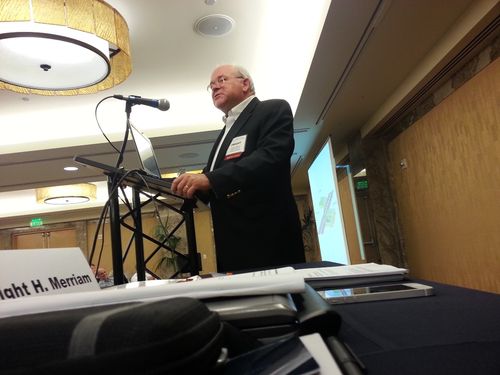
A big thanks to my Owners Counsel of America and ABA State and Local Government Law Section colleague Dwight Merriam for emceeing today’s well-attended double session on land use and takings law at the International Municipal Lawyers Association’s 2013 annual meeting in San Francisco. Dwight and I were joined by land use expert Cecily Barclay, who presented sessions on Harvey Cedars, while I covered Koontz and Dwight did the relevant parcel/Lost Tree sessions. Continue Reading IMLA Conference Session On Koontz, Harvey Cedars, Relevant Parcel

IMLA
On Monday, September 30, 2013, we’ll be speaking along with Dwight Merriam and Cecily Barclay at the International Municipal Lawyers Association’s annual meeting in San Francisco, about three important cases/issues: Koontz, Harvey Cedars, and Lost Tree.

That’s a pretty wide range of cases, but we have some time and we’re sure we’ll have a good discussion. If you are attending the IMLA conference, please be sure to join us: 2:15 – 3:15pm, Hilton San Francisco Union Square (Plaza B, Lobby Level). Continue Reading Upcoming IMLA Panel On Koontz, Harvey Cedars, And Lost Tree

A link to a story worth reading about the U.S. Supreme Court’s decision in Koontz v. St. Johns River Water Management District, No. 11-1147 (June 25, 2013).

In Developing Story at Florida Trend (“The Magazine of Florida Business”), our Owners’ Counsel of America colleague Amy Brigham Boulris is quoted along with the property owner/petitioner Coy Koontz, and two lawprofs who don’t care for the decision.

Check it out, it’s a quick read. Continue Reading Worth Reading On Koontz: “A 20-year legal battle over a water management district’s condition for development is over – sort of.”

This past term, the U.S. Supreme Court in Arkansas Game and Fish Comm’n v. United States, 133 S.Ct. 511 (2012), held that government-induced flooding could result in takings liability, even if the flooding was merely temporary. The Court remanded the case to the Federal Circuit to determine whether the flooding resulted in liability.

The Federal Circuit ordered supplemental briefing, and the parties and amici responded. Earlier this month, the court held oral arguments.

2009-5121_962013

The government’s counsel argued that the Supreme Court adopted a new test for temporary flood takings that looks like a hybrid Penn Central test, while the Commission’s counsel argued that the Court expressly did not adopt a new test, and that temporary flooding cases are to be treated just like any other physical invasion under the existing test.

With the arguments submitted, now we wait. Continue Reading But … What If Penn Central Terminal Is Flooded?

Here’s what we’re reading today:


Continue Reading Must Read Monday: RLUIPA Ripeness, “The Taking Issue,” Oysters In The Wilderness, Precondemnation Damages

In a 2-1 decision (en banc next?) in a case we’ve been following with some interest in which a Marin County oyster farming operation in the National Seashore sued the Interior Department for its decision to not renew the farm’s permit, in this opinion, a Ninth Circuit panel held that courts have jurisdiction only to review the limited question of whether the Department understood its authority to renew or not renew the permit. The majority held that the statute pretty much gives the Department total discretion whether or not to do so, and thus the courts could not review its decision that wilderness legislation prohibited any extension of the permit.

In the majority’s words, “[t]he choice was the Secretary’s to make.” Slip op. at 27 (footnote omitted). 

The panel held that the farm was unlikely to prevail on the merits, and thus affirmed the District Court’s refusal to

Continue Reading 9th Cir: Courts Have No Jurisdiction To Review Discretionary Decision To Not Issue Permit

Just over a month ago, the U.S Court of Appeals for the Fourth Circuit held that a federal takings case could actually proceed in federal court. Well yesterday, the same court issued a similar opinion in a related case, Town of Nags Head v. Toloczko, No. 12-1537 (Aug. 27, 2013).

We won’t go into detail because this post, by J. David Breemer at Pacific Legal Foundation (who also is counsel for the prevailing property owners) sets it all out very well.  But the decision involves abstention (Federal Courts law school flashback), Williamson County, and  beaches and public trust, so it’s well worth a read on its own.

If that doesn’t grab you, then nothing will!

Town of Nags Head v. Toloczko, No. 12-1537 (4th Cir. Aug. 27, 2013)


Continue Reading 4th Cir (Again): Federal Takings Claim Should Be Heard In Federal Court