Property

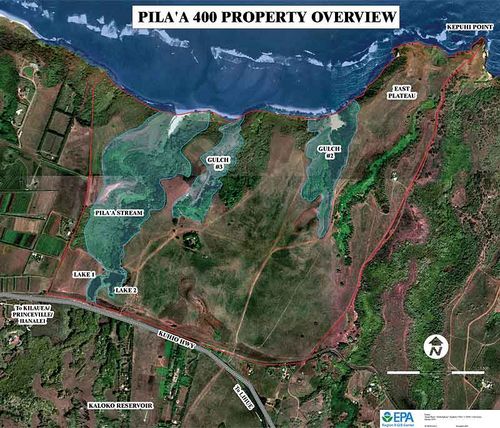
There’s not much doubt that the now-notorious large-scale unpermitted upland grading and grubbing by a Kauai property owner on its private land caused the runoff that catastrophically damaged the adjacent beach and the reef offshore. The damage was pretty bad, and resulted in the “largest storm water settlement [with the federal EPA] in the United States for violations at a single site by a single landowner.” See also the photo above (much larger version here).

The state also pursued the owner, and after a contested case, the Board of Land and Natural Resources assessed approximately $4 million in damages, and $70k for administrative costs. To reach this assessment, It did not apply a preexisting damage formula, but used a method it crafted for the case:

The value of Pilaa beach, bay and reef includes use value, option value, commodity value, existence value, bequest value, cultural values, including

Continue Reading HAWSCT: Damage To Unique Property Subject To Unique Rules

Today, the Hawaii Supreme Court issued an option in Diamond v. Dobbin, No. SCWC-30573 (Jan. 27, 2014), a case about shoreline certifications that we’ve been following.

It’s a beach case, obviously, but not about ownership. Shoreline certifications approved by the State Department of Land and Natural Resources are used as the baseline from which to measure building setbacks on littoral parcels, and do not involve the boundary between public and private property on beaches.

The DLNR certified the shoreline on a Kauai parcel, and two nearby residents who claimed the shoreline was further mauka (landward) administratively appealed to the Board of Land and Natural Resources. The Board rejected the appeal and approved the certification, and the two neighbors appealed to the circuit court under HAPA. The circuit court concluded the BLNR’s findings of fact were wrong, and vacated the certification.

The property owner who sought the certification appealed to the

Continue Reading HAWSCT: State Agency Must Consider “Historical Evidence” Of “The Upper Reaches Of The Wash Of The Waves” When Certifying Shorelines

Blog-Logo

One of the perks of attending the annual ALI-CLE Eminent Domain and Land Valuation conference (this year in New Orleans) is that in addition to 2 1/2 days of high-level CLE programming involving our favorite topic, you get to meet colleagues from across the nation (and internationally – expropriation lawyers from Canada were also with us, and gave us an update on the Antrim Truck decision). 

You also find out things that, despite the seemingly infinite resource that is the internet, you didn’t know before. And that’s how we came to find out about a new law blog, covering Wisconsin issues in eminent domain and related topics, “The Preeminent Domain” (http://thepreeminentdomain.com/). As an aside, we love that URL. 

Steve Streck, a partner at Axley Brynelson leads the blogging team, and thus far, their posts look pretty interesting (underwater mortgages, rails-to-trails, and, of course, Wisconsin-centric eminent domain

Continue Reading New Eminent Domain (And Related) Law Blog

Coy Koontz, Jr., the prevailing property owner in Koontz v. St. Johns Water Management District, No. 11-1147 (June 25, 2013) joined our Pacific Legal Foundation colleague Jim Burling for an interview on Fox and Friends.

Kudos to Jim and Mr. Koontz for getting down to the studio in the wee hours of the morning — we shared dinner last night (Mr. Koontz has joined us to accept the 2014 Crystal Eagle award from Owners’ Counsel of America on Saturday), and even after all that a New Orleans meal involves, they were able to drag themselves to the studio and look remarkably fresh. Good work, guys.Continue Reading Coy Koontz, Prevailing Property Owner In SCOTUS Victory, Interviewed

At the Hawaii Agriculture Law Conference which we just wrapped last week, perhaps the hottest topic on the agenda was the anti-GMO ordinances recently adopted by the Counties of Hawaii (Big Island) and Kauai.

Barista’s note: One advantage of having POTUS in town for a couple of weeks was that it resulted in a cohort of national reporters sitting around with nothing to write about, no doubt being pestered by their editors suffering back in the polar vortex to get off the beach and actually file a story or two. Thus, we saw a series of big league newspapers filing stories about Hawaii, including this marqee piece in the New York Times about the anti-GMO measures, “A Lonely Quest for Facts on Genetically Modified Crops.”

At the Ag Conference, we discussed the possibility of a lawsuit being filed against Kauai, since it seems to be the locus

Continue Reading The Other Shoe Drops: Kauai Anti-GMO Ordinance Challenged In Federal Court

Next Monday, January 13, 2014, from noon to 1:00 p.m., I’ll be speaking — along with my Damon Key partner Greg Kugle — to the Hawaii State Bar’s Appellate Law Section about administrative appeals, in a session entitled “Administrative Appeals: How Do You Get There And How Do You Get Out Of There?” 

Because of the areas in which we practice, we’re going to be focusing on the issues in the context of land use cases, but the principles are generally applicable to any matter in which there is the possibility of agency appeal or contested case, followed by judicial review under the Administrative Procedures Act. Because most of the recent interesting decisions have come out of the Hawaii Supreme Court, we’ll be limiting our presentations to state law. 

Details: 

Date: Monday, January 13, 2014

Time: noon – 1:00 p.m.

Location: Damon Key offices, 1003 Bishop Street

Continue Reading Upcoming HSBA Program: Administrative Appeals – How Do You Get There And How Do You Get Out Of There?

14.AGRHI

Here are links to some of the materials mentioned at our session today on the GMO issue at the Hawaii Agriculture Law Conference:

DSCF1529
My co-planning Chair, Dave Bateman (a lawyer and a coffee farmer), Continue Reading Links From Today’s Session On GMO Issues

Here’s one for you land users which details how the very broad way Hawaii Supreme Court treats claims of jurisidictional ripeness.

In Blake v. County of Kauai Planning Comm’n, No. SCWC-11-0000342 (Dec. 19, 2013), the court held that a third-party challenge to the Kauai Planning Commission’s subidivision approval was ripe for adjudication, and that the trial court should have exercised subject-matter jurisdiction. This case was not an administrative appeal under the Administrative Procedures Act, but nonetheless turned on the issue of whether a state agency had taken “final agency action” under the judicially-adopted doctrine of ripeness. The court concluded that the fact that a state agency’s approval which was necessary before a subdivision could go foward was not an impediment to a challenge to a county’s subdivision approval. 

The details of the case are set out at length in Chief Justice Recktenwald’s opinion, but here are the salient facts.

Continue Reading HAWSCT: State Agency Approval Not A Ripeness Bar To Challenge To County Approvals

Usually, in disputes about who owns oceanfront property (in Waikiki, the really nice part of Waikiki, down on the Diamond Head side), each party claims ownership. Beachfront property, after all, is pretty valuable.

But sometimes, it can be a liability. 

So maybe “hot potato” is more accurate in this case, since it involves an old seawall that is badly in need of repair, and it seems everyone is claiming they don’t own it, and that it belongs to someone else. The seawall is located partly on private property and partly on state land, and no one wants to pay to fix it. The private landowners claim the seawall is a public thoroughfare, and argue it was surrendered to the State because they had not exercised ownership for at least five years.

The trial court agreed, and issued these findings of fact and conclusions of law. The most interesting part of

Continue Reading Hawaii Trial Court: Seawall No One Wants Belongs To State

Just in: the Federal Circuit today issued an opinion in Arkansas Game & Fish Comm’n v. United States, No. 2009-5121 (Dec. 3, 2013), concluding that the government must pay just compensation for a taking, because it caused the Commission’s land to be flooded.

This is the case that was up before the U.S. Supreme Court last year (and in which we filed an amicus brief).  The unanimous Court held that government-induced flooding could be a taking (rejecting the Federal Circuit’s per se rule that temporary flooding was never a taking, only a tort). The Supreme Court remanded the case to the Federal Circuit, and in today’s opinion, that court affirmed the Court of Federal Claims’ conclusion that the flooding was a temporary taking.

We’ll have more after a chance to review the opinion in depth. 

Arkansas Game & Fish Comm’n v. United States, No. 2009-5121 (Fed. Cir. Continue Reading Fed Cir: On Remand From SCOTUS, Arkansas Game Flood Is A Taking