


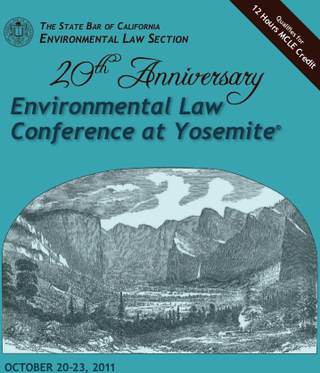
Yosemite_conference

Mark your calendars for October 20 – 23, 2011. That’s when the State Bar of California will present its 20th Anniversary Environmental Law Conference at Yosemite® (yes, it is trademarked), at the Tenaya Lodge in Fish Camp, California.

Along with U.C. Berkeley law professor Joseph Sax and Deputy California Attorney General Daniel L. Siegel, I will be speaking about “Regulatory Takings: Looking Back and Looking Forward.”

We will be discussing the seminal regulatory takings cases from the past 20 years. “The panelists, who have been involved in several of the most significant takings cases since even before the founding of the annual Yosemite Environmental Law Conference twenty years ago, will highlight key decisions, offer their views on the evolution of takings law, and discuss cutting-edge issues raised by more recent court decisions.”  E. Clement Shute will moderate the panel discussion.

The Yosemite program, sponsored by the CSB’s

Continue Reading “Regulatory Takings: Looking Back and Looking Forward” At The Cal Bar’s Yosemite Conference

Not the California Court of Appeals, Second District. Edna Valley Watch v. County of San Luis Obispo, No. B223653 (Aug 2, 2011), slip op. at 2, n.2 .

Oh yeah, the holding: administrative proceedings are “actions” thus entitling parties — opponents of the building of a church — who participated in those proceedings and in the subsequent lawsuit to attorney’s fees. Continue Reading “The numbers are from [the appellants’] motion for attorney’s fees. Their mathematics appears to be incorrect. But who is going to care about a few dollars?”

One of the very first things we addressed in the first year Property class (wonderfully taught by Allen Smith, visiting from Michigan Law) was the ownership of animals: when do wild animals become someone’s “property?” And the very first Latin phrase we incorporated into our new legal lexicon was ferae naturae, the law of wild animals.

In that vein, we introduce you to Ferae Naturae, a new law blog (to us, at least) on the law of animals, wild and otherwise. The blog is authored by our ABA State and Local Government Law colleague Amy Lavine, and although she posts on a wider scope of issues than the property law aspects of wild animals, it’s still an informative and worthwhile read.

Recent posts include “How to fight criminal charges when you get caught with a crocodile in your bathtub,” “Raccoons are not ‘cuddly

Continue Reading New Law Blog To Follow: Ferae Naturae

On this Monday we bring you these stories, all with an international flavor:

  • More from India, on Kelo-style takings issues: the Wall Street Journal reports that “India Grapples With Land Acquisition Rules” (“Indian government ministers are vowing to bring legislation to overhaul the country’s ancient land acquisition laws when Parliament begins again next month, and everyone agrees that’s a good thing. Unfortunately, that’s where agreement ends. The biggest dilemmas are over figuring out who should get compensated when land is taken, what constitutes a fair price, and, most difficult of all, when exactly the government should use its


Continue Reading International Monday

DK_greenbag_1 Notice: This post is worth reading. There’s the possibility of a prize if you do. Read on.

Here’s the latest in a case we’ve been following with mild amusement, if only because the Court of Appeal decision seemed so ironic.

In Save the Plastic Bag Coalition v. City of Manahattan Beach, No. B215788 (Jan. 27, 2010), the Fourth District concluded the city needed to undertake environmental review under CEQA before it could adopt an ordinance banning grocery store plastic bags. The resultant increase in the use of paper bags might cause environmental harm, you see.

Whether you agreed with that conclusion or not, the decision certainly entertained. A putatively “green” measure struck down because it might be bad for the environment? But with a 2-1 panel decision and review granted by the California Supreme Court, it wasn’t hard to see the handwriting on the wall.

Yesterday the other shoe

Continue Reading Cal Supremes: You Don’t Need Environmental Review Before Choosing Paper Or Plastic – “Common Sense” Dictates No EIR Needed For City’s Plastic Bag Ban

Here’s how the California Court of Appeal, Third District began today’s opinion in a case involving the California Environmental Quality Act:

This is a case where CEQA worked. The City of Rocklin (the City) in 2007 approved a residential development project for an undeveloped area of the City known as Clover Valley. The approval culminated more than 10 years of planning and environmental review for the site’s development. Since 1981, zoning authorized nearly 1,000 homes for the site. The site’s owners applied to develop a project for that size in 1991, and environmental review began in earnest in 1995. As a result of environmental concerns analyzed since then, the approved project is roughly half the size it could have been. The amount of open space has increased by a factor of five. The project owners have already paid millions of dollars to the City to construct needed infrastructure. The approved

Continue Reading “This Is A Case Where CEQA Worked”

In case you were not paying attention on this fine Thursday, here comes the Federal Circuit’s opinion in Mildenberger v. United States, No. 2010-5084 (June 30, 2011). It’s an interesting opinion because it deals with the mildly metaphysical question of when the six year statute of limitations for inverse condemnation claims against the federal government commences in cases where the taking and damage to the property is gradual, and nearly imperceptible.

In many cases, inverse condemnation claims are not like straight condemnation where the property owner knows when her property is being condemned, because in an inverse claim the owner doesn’t get served with a complaint, but instead must institute the suit after her property is taken or damaged, and it is often not clear when property has been taken or damaged to such an extent that a claim must be brought. The general rule is that a property

Continue Reading Federal Circuit On The Metaphysics Of Takings Claim Accrual

It’s a well-worn refrain, heard often in the environmental context: “The property owner wouldn’t be in this fix if she just ___________.” Fill in the blank with “commissioned an Environmental Assessment” — or “Environmental Impact Statement,” or “applied for a development permit,” or similar.

At first blush, it’s an appealing argument — “Just follow the law.” But like other facile arguments, it often fails in the details department: doing so can delay a development for years, and it can cost thousands of dollars — or hundreds of thousands — to put together an application for environmental review or for a permit, or even to seek a government determination that a proposal is exempt from review or otherwise outside the regulatory jurisdiction of a permitting agency.  In those situations, not only are the costs unnecessary, the time and money involved can kill the plans, especially for small property owners. “Death by

Continue Reading SCOTUS Agrees To Hear Wetlands Case: Immediate Judicial Review, Or Death By A Thousand Days?

We predicted the Supreme Court wasn’t finished with judicial takings or judicial takings-like issues after its decision (or, more accurately, non-decision) in Stop the Beach Renourishment v. Fla. Dep’t of Envt’l Protection, 130 S. Ct. 2592 (2010). It looks like we might have more grist for the mill, because today, the Court agreed to review the Montana Supreme Court’s ruling in PPL Montana, LLC v. State of Montana, 229 P.3d 421 (Mont. 2010), a case we previewed here.

The issue in the case is who owns the land under certain Montana rivers. For more than 100 years, there wasn’t any doubt: the riverbeds were private property, or were federal property. The Montana Supreme Court concluded otherwise, and held that the state owns that property, and that PPL Montana, a power company, owed $50 million in rent. The (now former) property owner filed a cert petition, asking

Continue Reading State Court’s Land Grab To Be Reviewed – Cert Granted In Montana Navigability Case

Civil Beat‘s recent report on the mayor’s plan to demolish the Waikiki Natatorium War Memorial, a salt-water swimming pool erected to honor those who served in “the Great War,” not only brought back some childhood memories (I swam there as a kid) but reminded us of the cost of preservation. When the thing or property sought to be preserved  — or, to use the bumper-sticker vernacular, “saved” — is public property like the Natatorium, the discussion usually involves the cost of doing so balanced against the desire to keep it.

But when the property involved is private property, you usually hear very little about the burdens placed on the owner, or the cost to the public of preservation. Which brings us to the tile of this post, which was inspired by a recent column by Howard Dicus “What do you want to save in Honolulu that’s old?

Continue Reading What Do You Want To Save In Honolulu (And How Much Will It Cost?)