


Honolulu attorney Jay Fidell (who also produces Think Tech Hawaii) writes a regular column in the Honolulu Star-Advertiser. This week, he focuses on eminent domain in “Governor must insure wind farm moves forward,” where he writes about the proposed wind farm on Molokai, and urges the state to use eminent domain aggressively to take the needed land:

When Abercrombie threatened eminent domain against Molokai Ranch, he unleashed the genie, and the possibility of condemnation is now in play. He gave us a glimpse of a powerful solution to our energy security predicament, and we can’t let it pass.

In our state of islands, land is scarce, and NIMBY is in every back yard. Large landowners want to hold on to their land in hopes of appreciation and because it’s so difficult to find other parcels. So they refuse to sell.

Hawaii has traditionally been reluctant to

Continue Reading “Make Eminent Domain Imminent” – Fidell On Wind Power
As we’ve mentioned here before, the City & County of Honolulu has given the green light to a new public railway, described as “a 20-mile elevated rail line that will connect West O`ahu with downtown Honolulu and Ala Moana Center. The system features electric, steel-wheel trains capable of carrying more than 300 passengers each. Trains can carry more than 8,000 passengers per hour in each direction.”

This evening, I spoke to the Waikiki Rotary about some of the legal issues that the rail project will involve, including eminent domain, environmental questions, and the relationship between the newly-created Honolulu Authority for Rapid Transit (HART), an agency within city government to oversee the project.

Here are some links on the topics I spoke about:


Continue Reading All Aboard? Honolulu Rail Is Coming

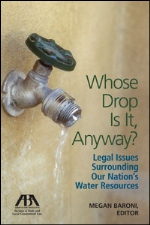
5330213_big The ABA State & Local Government Law Section has just published a new book, Whose Drop Is It Anyway? Legal Issues Surrounding Our Nation’s Water Resources, edited by Megan Baroni. I just received my copy.

Skimming through the chapters, it looks worthy of a place on the bookshelf as a practical guide to a very wide range of issues related to water.

Here are the details:

Whose Drop Is It, Anyway? Legal Issues Surrounding Our Nation’s Water Resources, is a valuable resource and practical tool discussing the legal issues surrounding water resources and the current issues and trends that are influencing the legal regimes. Practical in use, this book can be used as a tool for developing effective water management strategies in your own jurisdictions.

As scarcity issues become more common and threats like global climate change loom with uncertainty over our water resources, water only stands to

Continue Reading New Book On Water Law And Water Resources

As we predicted in a recent article, the Supreme Court’s latest takings decision in Stop the Beach Renourishment, Inc. v. Florida Dep’t of Environmental Protection, No. 08-11 (June 17, 2010) has been “a boon for academics who may continue the search for the ‘takings quark’ (if not woodchucks) in the pages of law journals.” Adding to the growing list of scholary takes on the case — sorry, we could not resist the pun — is Georgetown lawprof J. Peter Byrne who has posted Stop the Stop the Beach Plurality!, a forthcoming article to be published by the Ecology Law Quarterly.

Comparing Stop the Beach Renourishment to Bush v. Gore, the article — the tone of which is worthy of a Scalia dissent and is entertaining reading even if you don’t buy his analysis — makes no effort to hide his disdain for the plurality opinion. Professor

Continue Reading Article: “Plainly, the plurality’s textual argument is so much lipstick on a pig.” (Don’t Hold Back – Tell Us What You Really Think About Stop The Beach Renourishment)

Beginning at 9:00 a.m. Central Time today, the Texas Supreme Court heard oral arguments in Severance v. Patterson, No. 09-0378 (Nov. 5, 2010), the case in which the court held 6-2 that Texas does not recognize a “rolling” public beachfront access easement, without proof of prescription. In March, the court agreed to rehear the case.

Launch the archived video feed in a separate window by clicking this link, then follow the live blog archive below, where we added our thoughts and background. Our Damon Key colleague Rebecca Copeland provided Texas background (she practiced in the Texas appeals courts before joining our firm, so knows what “writ ref’d n.r.e.” means).

Background on the case, including the briefs the the court’s original opinion, are posted here.

Continue Reading Live Blog of Texas Supreme Court Argument In Severance (Beach “Rolling Easement” Case)

On Tuesday, April 19, 2011 starting at 9:00 a.m. Central Time, the Texas Supreme Court will hear oral arguments in Severance v. Patterson, No. 09-0378 (Nov. 5, 2010), the case in which the court held 6-2 that Texas does not recognize a “rolling” public beachfront access easement, without proof of prescription. Thus, the public does not gain an easement over private property upon sudden changes in the shoreline. In March, the court agreed to rehear the case. [Disclosure: my colleagues at Pacific Legal Foundation represent the property owner.]

St. Mary’s law school will be live streaming the arguments here.

Texas is one of those states (like Hawaii) that under common law now treats the vegetation line as the public-private boundary on beaches. (Technically, in Hawaii it isn’t the veg line, but rather the upper reaches of the high wash of the waves, as evidenced by the

Continue Reading Argument Preview: Texas Supreme Court To Hear Arguments In Severance – Private Beaches, “Rolling” Easements

What we are reading today:

  • Should the Courts Help Los Angeles Commit Fiscal Suicide? – Gideon Kanner’s takedown of the recent California Court of Appeal decision in City of Los Angeles v. Superior Court, No. B225082 (Apr. 12, 2011), which held that in order to make out a claim for inequitable precondemnation activities, the city must actually have filed (or be contemplating filing) an eminent domain action. Because it hadn’t, the property owner could not get summary judgment on the Klopping claim. But as one colleague noted, if the city was not buying up these properties around LAX for a public purpose, just what was it doing? Also worth reading is Brad Kuhn‘s summary and analysis of the case here.


Continue Reading Monday Round-Up

On a day that our attention is elsewhere, comes this important notice: the Texas Supreme Court has granted the State’s motion for rehearing in Severance v. Patterson, No. 09-0378 (Nov. 5, 2010), the case in which the court held 6-2 that Texas does not recognize a “rolling” public beachfront access easement, without proof of prescription.Thus, the public does not gain an easement over private property upon sudden changes in the shoreline.

The case is once again set for oral argument, on April 19, 2011 at 9:00 a.m.

Thanks to our colleagues at the ABA State & Local Government Law Section for the heads-up, and to How Appealing for the links to the order.

More about the case here (the Texas Supreme Court’s decision on certified questions from the Fifth Circuit), and here (the Fifth Circuit’s earlier opinion holding that the owner’s claim for an illegal Fourth Amendment seizure

Continue Reading Private Beaches, “Rolling” Easements – Texas Supreme Court To Rehear Severance

Honolulu attorney Jay Fidell (who also produces Think Tech Hawaii) writes a regular column in the Honolulu Star-Advertiser. This week, he focuses on land use in “Labyrinthine land-use law suffocating isle economy,” where he writes:

Everyone knows our state, like others, is in a fiscal and economic crisis. We need to revitalize our sagging economy, and fast. The governor has made this an absolute priority, and he’s right — we all have to work together to improve the economy, and that frankly includes all three branches of government.

The elephant in the room is land use, which was clear at a recent Hawaii land-use law seminar. Developers have to run a backbreaking gantlet before they can build anything. Environmental laws are increasingly used to stop projects, even if the real motivation isn’t environmental but just NIMBY (“not in my backyard”). The result: Projects have become prohibitively

Continue Reading Fidell: “Labyrinthine land-use laws suffocating isle economy”

At yesterday’s debate (video archived here) sponsored by Honolulu Civil Beat, “Knowing the Past, Shaping the Future” about the problems that have arisen in Hawaii in the time since the publication of the book The Price of Paradise 20 years ago, U. Hawaii lawprof David Callies revealed a stunning statistic. He noted that the Hawaii Supreme Court “has managed to find in favor of Sierra Club, Friends of the Earth, Earthjustice … 90% of the time, 70% of those decisions overturning the [Hawaii] Intermediate Court of Appeals.”

Whoa.

Callies began by questioning the conclusion reached by most of the book’s essayists that Hawaii is not regulated enough — and that even more government is called for:

I don’t think that’s the problem, folks. The notion that the problems that have arisen over the past 35 or 40 years — or the last 20 years since The Price

Continue Reading What Advantage Do Environmental Plaintiffs Have In The Hawaii Supreme Court? According To UH Lawprof, A 90% Win Rate