PASH symposium

Back in February, we were honored to be part of the University of Hawaii Law Review’s symposium “25 Years of PASH,” a retrospective of one of the Hawaii Supreme Court’s most famous (or infamous) decisions, Pub. Access Shoreline Haw. v. Haw. Cnty. Plan. Comm’n, 79 Haw. 425, 903 P.2d 1246 (1993), cert. denied sub nom., Nansay Haw. v. Pub. Access Shoreline Haw., 517 U.S. 1163 (1996) (PASH).

At the conference, we spoke on the panel about “PASH and the Changing Coastal Environment” (see video here at the 2:02:25 mark if you want to watch our panel’s summations). The Law Review has now published the symposium, and here’s our contribution, Takings PASH and the Changing Coastal Environment, 43 U. Haw. L. Rev. 525 (2021).

For those of you not totally tuned in, in the PASH case the Hawaii Supreme Court
Continue Reading New Article: “Takings, PASH, and the Changing Coastal Environment,” 43 U. Haw. L. Rev. 525 (2021)

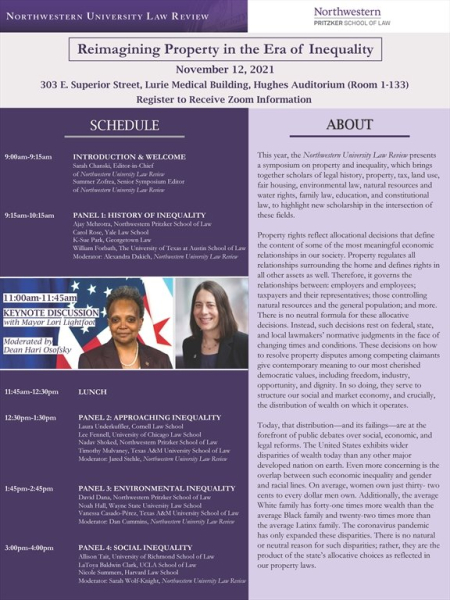
“This year, the Northwestern University Law Review presents a symposium on property and inequality, which brings together scholars of legal history, property, tax, land use, fair housing, environmental law, natural resources and water rights, family law, education, and constitutional law, to highlight new scholarship at the intersection of these fields.”

More information, as well as registration to attend remotely, here.

Nulr_symposium_posterContinue Reading Still Time To Sign Up For Northwestern L. Rev.’s Symposium: “Reimagining Property Rights in the Era of Inequality” (Friday, Nov. 12, 2021)

Check out the U.S. Court of Appeals’ opinion in F.P. Development, LLC v. Charter Twp. of Canton, No. 20-1147 (Oct. 13, 2021), in which the court affirmed the district court’s grant of summary judgment to the property owner on its unconstitutional conditions takings claim. 

Short story: Canton’s tree ordinance prohibits property owners from removing trees on their land without Canton’s permission, and also requires owners to either replace any trees removed, or pay between $300 – $450 into the tree fund.

In the course of developing its property, the owner cleared a county drainage ditch of trees and debris after the county refused to do so. But it didn’t get a permit, “someone” dropped dime, and Canton issued a NOV.

The owner sued, alleging all theories of takings: (1) a per se Horne-type taking, (2) a regulatory Penn Central taking, and (3) an unconstitutional conditions Nollan/Dolan taking. After

Continue Reading City’s Tree-Preservation-And-Mitigation Scheme Is A Dolan Taking

PXL_20210920_195630876

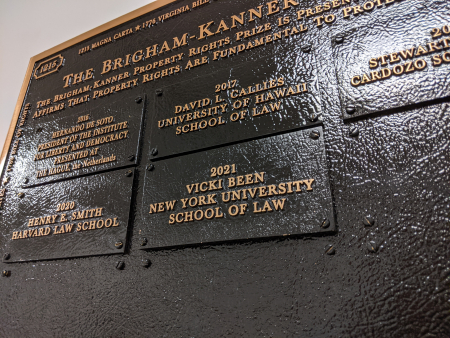
There’s still plenty of time to register and join us for the 18th Annual Brigham-Kanner Property Rights Conference at the William and Mary Law School, Thursday and Friday, September 30 and October 1, 2021.

Yes, you may attend in-person, or remotely. The registration fees are very reasonable, ranging from $0 (yes, free!) to $200 (go here, and click “Tickets” for the details).

This year’s Brigham-Kanner Property Rights Prize winner is Professor Vicki Been (NYU Law). The Conference includes presentations on:

  • Remembering Toby Brigham
  • The Role of Empirical Research in Defining the Scope of Constitutionally Protected Property Rights: A Tribute to Been
  • The Relationship between Eminent Domain and Social and Racial Injustice (this is the panel on which we’ll be presenting)
  • Just Compensation Issues, Changing Public Uses, and Other Recent Developments
  • The Interdependence of Property and First Amendment Rights
  • The Distributional Implications of Land Use Regulation

Details on

Continue Reading 2021 Brigham-Kanner Property Rights Conference (Sep. 30 – Oct. 1, 2021) – Still Time To Join Us

All the topics you want to know about, presented by top-notch faculty from across the nation. Sessions include:

  • Keynote: Do Animals Have Property Rights?
  • Did the Supreme Court Signal a New Direction in Property Rights in Cedar Point Nursery?
  • Maximizing Relocation Benefits: Understanding the Law and Regulations to Ensure Fairness
  • Challenging Public Use: Lessons From a 67-Day Trial
  • COVID Takings
  • Property Rights as Civil Rights
  • Eminent Domain National Update
  • Federal Court and the Daubert Challenge: How to Prepare
  • How to Position Your Client for the Fallout When Projects Don’t Get Built
  • Rural Broadband and the Emerging Constitutional Challenges
  • Are Precondemnation Entry Statutes Still Valid After Cedar Point Nursery?
  • How Condemnor and Property Owners’ Counsel Prepare the Battlefield
  • How Will the Trillion Dollar Infrastructure Bill Impact Your Practice?
  • Ethics
  • …and more, including a full slate of networking and social events!

We’ve sold out the last few years, so don’t Continue Reading Registration Open Now: ALI-CLE Eminent Domain & Land Valuation Litigation Conference, Jan 26-29, 2022, Scottsdale

Screenshot 2021-08-11 at 14-56-53 Constitutional Litigator Property Rights (two openings) Pacific Legal Foundation

You’ve got big dreams, you want fame…

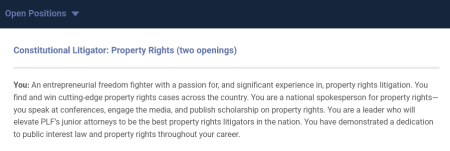
If so, here’s your chance: two (2!) Takings Maven Dream Jobs® are now available.

Pacific Legal Foundation requesting applications for positions as a Property Rights Constitutional Litigator. Job description includes “You will find and win the next important Supreme Court property rights case.”

Oh, have we got your attention now?

You: An entrepreneurial freedom fighter with a passion for, and significant experience in, property rights litigation. You find and win cutting-edge property rights cases across the country. You are a national spokesperson for property rights—you speak at conferences, engage the media, and publish scholarship on property rights. You are a leader who will elevate PLF’s junior attorneys to be the best property rights litigators in the nation. You have demonstrated a dedication to public interest law and property rights throughout your career.

You will be a leader in PLF’s

Continue Reading Takings Maven Dream Job® (x2): Property Rights Constitutional Litigator at Pacific Legal Foundation

All the topics you want to know about, presented by top-notch faculty from across the nation. Sessions include:

  • Property Rights as Civil Rights
  • Eminent Domain National Update
  • Just Relocation: Understanding the Law and Regulations to Ensure Fairness
  • Challenging Public Use: Lessons From a 67-Day Trial
  • COVID Takings
  • Federal Court and the Daubert Challenge: How to Prepare
  • Did the Supreme Court Signal a New Direction in Property Rights in Cedar Point Nursery?
  • How to Position Your Client for the Fallout When Projects Don’t Get Built
  • Rural Broadband and the Emerging Constitutional Challenges
  • Are Precondemnation Entry Statutes Still Valid After Cedar Point Nursery?
  • How Condemnor and Property Owners’ Counsel Prepare the Battlefield
  • How Will the Trillion Dollar Infrastructure Bill Impact Your Practice?
  • Ethics
  • …and more, including a full slate of networking and social events!

We’ve sold out the last few years, so don’t miss out. Room block now taking reservations. Continue Reading Join Us For The 39th Annual ALI-CLE Eminent Domain & Land Valuation Litigation Conference, Jan 26-29, 2022 (Scottsdale, AZ)

Floodsfiresarticle

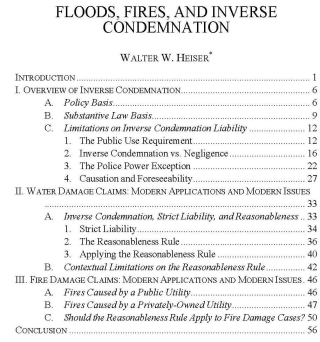
Here’s what we’re reading today (inter alia): Walter W. Heiser, Floods, Fires, and Inverse Condemnation, 29 N.Y.U. Envtl. L. J. 1 (2021).

From the Introduction:

This Article examines the proper application of the doctrine of inverse condemnation in two important areas: flood damage to private property caused by a public improvement (e.g., a flood control, storm drain, or sewer project), and wildfire damage to private property caused by a project (e.g., electricity or telephone lines) undertaken by either a public or privately-owned utility. Under the doctrine of inverse condemnation, a plaintiff may recover for a physical injury to private property caused by a public improvement as deliberately designed, constructed, or maintained.

….

How courts define the standard of liability in inverse condemnation cases will become increasingly important in both the flooding and wildfire contexts. The continuing nature of climate States and more wildfires in others. This Article examines

Continue Reading New L Rev Article: “Floods, Fires, and Inverse Condemnation”

Our thanks to our friends and colleagues at the ABA Section of Real Property, Probate & Trust Section’s Land Use and Environmental Group for inviting us to a discussion of the latest and greatest decisions of interest.

We only had an hour together, so naturally could not cover everything of interest (indeed, we reserved a big discussion of the biggest item, the Supreme Court’s decision in Cedar Point, assuming that the Group will schedule a full session on that decision alone). So here is our curated list of what we think are the most interesting recent decisions in areas of interest to the Group:


Continue Reading Links From Today’s ABA RPTE Session

When the relief sought in a lawsuit is to compel the State to enact legislation a particular way, you have to know that in most courts that dog won’t hunt. Separation of powers, political question, et cetera, et cetera

So even though it isn’t about takings or compensation, you should check out the Iowa Supreme Court’s opinion in Iowa Citizens for Community Improvement v. State of Iowa, No. 19-1644 (June 18, 2021), because in that case, the court rejected the claims of “[t]wo social justice organizations” in a lawsuit that asked the court to order the legislature “to enact legislation that will compel Iowa farmers to take steps that will have the effect of significantly reducing levels of nitrogen and phosphorus in the Raccoon River.” Slip op. at 4.

Hold on, you say, on what basis might a court order another co-equal branch to do something like this?

Continue Reading Iowa: No Standing To Ask Court To Rule That Public Trust Doctrine Requires Legislation To Regulate Farmers