In Protect and Preserve Kahoma Ahupuaa Ass’n v. Maui Planning Comm’n, No. SCWC-15-0000478 (June 16, 2021), the Hawaii Supreme Court reaffirmed the idea that all members of the public have a right under the Hawaii Constitution to a “clean and healthful environment,” and that this is a “property” right entitled to due process protection under the state constitution. We say “reaffirmed” because this is merely the latest case so holding (see here for the first).

Like a lot of important Hawaii cases, this one came up in the context of standing to participate in the administrative review process. A Maui developer sought a permit under the Hawaii Coastal Zone Management Act from the Maui Planning Commission for an affordable housing project near Lahaina. Members of the Association, all of whom asserted they owned property adjacent to the project, asked the Planning Commission to intervene in the
Continue Reading HAWSCT: Anyone Claiming That An Affordable Housing Project Might Impact Their Property Interests In A “Clean And Healthful Environment” Has Standing To Object

Here’s the latest in a case we’ve been following. It’s not exactly a “new” cert petition, but one which we missed when it was filed back in February.

This one comes up via the Court of Federal Claims and the Federal Circuit, with the latter vacating the CFC’s award of partial compensation, concluding that the petitioner did not have a compensable property interest in the entire property it alleged was taken.

The petitioner bought some of a steel mill’s assets in bankruptcy. Those assets included piles of some of what is known as slag, scrap, and kish. EPA later determined that the piles were leaching contaminants. And you know what that means: remediation. EPA reduced the size of some of the piles and left others in place. The owner sued for a taking of the kish, slag, and scrap the EPA recovered from the site. 

After trial

Continue Reading New(ish) Cert Petition: Kish, Scrap, And Slag Takings From Environmental Remediation

Screenshot_2021-05-15 18th Annual Brigham-Kanner Prize Recipient

Mark your calendars for September 30 – October 1, 2021, and join us at the William and Mary Law School in Williamsburg, Virginia for the 18th Annual Brigham-Kanner Property Rights Conference. It’s planned to be in-person, so when we mean “join us” we really mean join us.

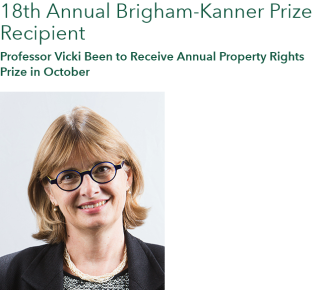
This year the Conference will recognize the lifetime work of Professor Vicki Been (NYU Law) with the Brigham–Kanner Property Rights Prize. As noted in the Law School’s press release:

The Brigham-Kanner Property Rights Prize is named in honor of the lifetime contributions to property rights of Toby Prince Brigham, founding partner of Brigham Moore, LLP, and Gideon Kanner, professor of law emeritus at Loyola Law School in Los Angeles. Brigham died earlier this month in Miami. A true legend in the law, he was esteemed by colleagues for the invaluable counsel, knowledge and skills he possessed and shared so generously. The prize

Continue Reading Mark Your Calendars: 2021 Brigham-Kanner Property Rights Conference, Williamsburg, Virginia, Sept 30-Oct 1 (in-person)

Order

This In Chambers Order recently issued by a federal district judge may just be the most unusual, flat-out wild judicial opinion we have ever read.

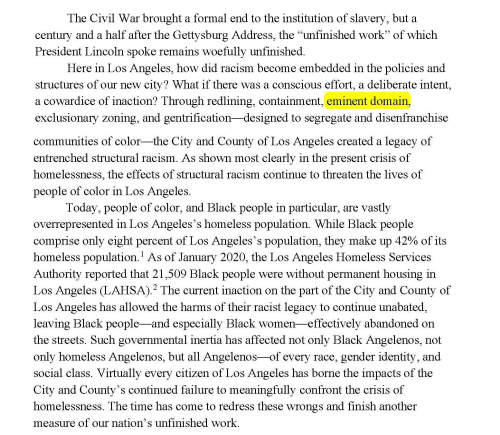
Citing the Gettysburg Address, Brown v. Board of Education, systemic racism (including eminent domain) systemic sexism, and a slew of newspaper articles, the Central District of California (without even holding a hearing), issued a preliminary injunction ordering Los Angeles to immediately address the homeless problem, including ordering that “$1 billion, as represented by Mayor Garcetti, will be placed in escrow forthwith, with funding streams accounted for and reported to the Court within 7 days.” Order at 107.

The city is also ordered to halt any public land sales, figure out how to use said land for the homeless, and report to the court how to address “structural barriers (including but not limited to redlining, highway construction, eminent domain, and health exposure)[.]” Id. at 108.

Continue Reading A Federal Court’s Extraordinary Shot Across The Bow: LA’s Massive Homeless Problem Is Caused (In Part) By Eminent Domain

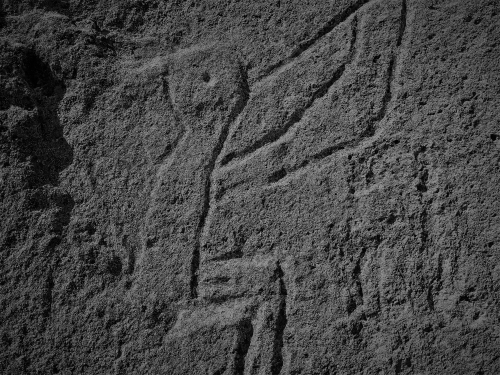
PXL_20210329_222643947This is either a petroglyph of an alien astronaut who visited Earth and gave
ancient peoples wonderful space technology like how to build
the Pyramids, or it’s a guy playing a flute.

(I’ll go with ancient astronaut.)*

When an opinion starts off by characterizing your complaint as asserting “a bevy of claims,” you know you are probably not going to be happy with the outcome.

So it is with the U.S. Court of Appeals’ opinion in Santa Fe Alliance for Public Health and Safety v. City of Santa Fe, No. 20-2066 (Mar. 30, 2021), a case in which the Alliance challenged the federal Telecommunications Act, the the New Mexico statute, and the city’s ordinance that foster the installation of cell towers on public rights-of-way. Collectively, these statutes impede or bypass the usual land-use process, which results in these (alleged) effects:

The Alliance’s membership consists of Santa Fe residents concerned


Continue Reading CA10: Plaintiffs Lacked Standing To Assert Cell Towers Took Their Property

In which we join the Pendulum Land Podcast (again, thank you hosts!) to talk about the Virginia Supreme Court’s recent opinion in Johnson v. City of Suffolk, the case we label the “oyster takings” case in which Hampton Roads oystermen claimed that their property was taken when the City of Suffolk and the Sanitation District dumped sewage into the river and declared a “condemnation zone” (i.e., no oyster harvesting).

Short story: the court concluded that the leases of Commonwealth-owned bottomlands in the Nansemond River did not confer a property interest. Or at least not a property interest worthy of constitutional protection. Thus, no takings claim when Suffolk and the Sanitation District dumped sewage into the river and pretty plainly interfered with some kind of right the plaintiffs owned in the lease. Just not enough of a right to require compensation.  

Our thoughts on the court’s decision

Continue Reading We Join Pendulum Podcast To Debate Oysters, Property Rights, Takings

You remember that Seventh Circuit case challenging (as, inter alia, a no-public-use taking) the location of the Obama Center in Chicago’s Jackson Park under the public trust (from the home of the American public trust doctrine, Chicago)? We wrote about it in “Friends Without Benefits: CA7 Rejects Takings Claim For Obama Center Because Citizen’s Group Lacks Property Interest In Public Park.”

This was then-Seventh Circuit Judge Amy Barrett’s first (and only) takings or property rights opinion she authored prior to her promotion to the Supreme Court.

A citizen’s group asserted it has a property interest in Jackson Park by virtue of being the beneficiary of the public trust, and that the handing over of the Park to the Obama Foundation was a private benefit regulatory taking. The plaintiff sought an injunction stopping the transfer, and did not seek just compensation.

The district court and the

Continue Reading New Cert Petition: Judge Barrett’s (Sole) CA7 Takings Opinion Is Wrong

When we hear “Pennsylvania” and “coal,” our ears perk up and we naturally think of this case and regulatory takings.

But the Pennsylvania Supreme Court (Western District)’s opinion in DPBS Coals, Inc. v. Penn. Dep’t of Transportation, No. 41 WAP 2019 (Jan. 20, 2021) isn’t a regulatory takings case, but dealt with more traditional inverse condemnation. We’ve been meaning to post about the case for some time, but in the interim a colleague has written it up on his blog, so our own post shall be short. Check it out: “Coal Companies in Pennsylvania Fail to Make Out Inverse Condemnation Claim” by Matt Hull. (PS – don’t feel bad if you are sometimes a procrastinator; delay can be rewarding and could save you some work.)

Matt’s post summarized the facts:

The companies held the mineral rights to a large tract in southwestern Pennsylvania. A portion of the

Continue Reading A Pennsylvania Coal Takings Case (No, Not That One)

Goofus-gallant

Yes, it starts tomorrow, Thursday, January 28, 2021, but we’re “remote” this year, so it is not too late to register to join us for the 38th Annual ALI-CLE Eminent Domain & Land Valuation Litigation Conference. This is the “big one” where the nation’s best practitioners, scholars, jurists, and other industry professionals gather to talk shop about the subjects we know and love.

Details here (ALI-CLE’s page with faculty, agenda, and times), or here (a recent episode of Clint Schumacher’s Eminent Domain Podcast, where we preview the Conference). Here’s your chance to be a part of what is the best conference on these topics.

We have set it up to take advantage of the remote format, and tuition has been reduced (thank you to ALI-CLE for recognizing this, and for our sponsors for being so generous). We’re seeing a lot of first-time registrations, and this is a great opportunity

Continue Reading Still Time To Join Us: ALI-CLE Eminent Domain & Land Valuation Litigation Conference (Online!) This Thursday & Friday. Tuition Deals! #EminentDomain2021

25 Years of PASH_Schedule

Mention the term “PASH” to any dirt lawyer in the 50th State, and they’ll nod in understanding. It’s an 808 shibboleth — a kind of local property password — that signals that you’ve been around the block and know your stuff.

On one hand, it is simply an acronym for Public Access Shoreline Hawaii, the plaintiff/petitioner in the (in)famous case Public Access Shoreline Hawaii v. Hawaii Cnty. Planning Comm’n, 903 P.2d 1246 (Haw. 1995). On the other, however, it has evolved into shorthand for a number of things: from the technically accurate – native Hawaiian customary and traditional rights and practices under the Hawaii Constitution (“I was chasing a pua’a on private property, so I cannot be convicted of trespass because I was exercising my PASH rights”); to generically and cheekily – the ability to access the beach and shoreline (“Surf’s up today, let’s go practice some PASH rights!”)

Continue Reading PASH Bash: U. Hawaii Law Review Symposium – “25 Years of PASH” (Feb. 5, 2021)