Goofus-gallant

Yes, it starts tomorrow, Thursday, January 28, 2021, but we’re “remote” this year, so it is not too late to register to join us for the 38th Annual ALI-CLE Eminent Domain & Land Valuation Litigation Conference. This is the “big one” where the nation’s best practitioners, scholars, jurists, and other industry professionals gather to talk shop about the subjects we know and love.

Details here (ALI-CLE’s page with faculty, agenda, and times), or here (a recent episode of Clint Schumacher’s Eminent Domain Podcast, where we preview the Conference). Here’s your chance to be a part of what is the best conference on these topics.

We have set it up to take advantage of the remote format, and tuition has been reduced (thank you to ALI-CLE for recognizing this, and for our sponsors for being so generous). We’re seeing a lot of first-time registrations, and this is a great opportunity
Continue Reading Still Time To Join Us: ALI-CLE Eminent Domain & Land Valuation Litigation Conference (Online!) This Thursday & Friday. Tuition Deals! #EminentDomain2021

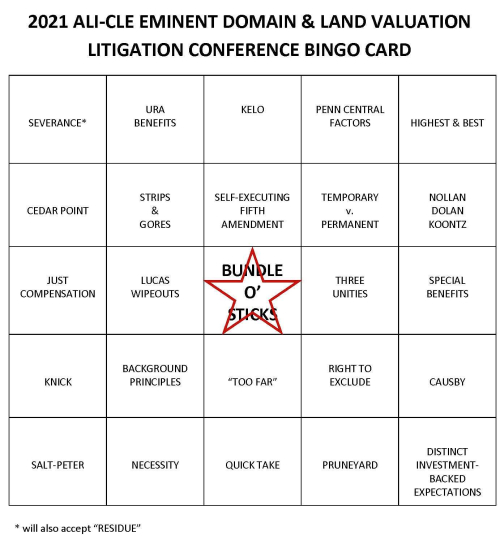
ALI-CLE 2021 Bingo card

If you “get” this, you should be registered for the 38th Annual Eminent Domain & Land Valuation Litigation Conference, to be held remotely on Thursday and Friday, January 28-29, 2021.

The list is growing rapidly, and you need to join us!

This is the “big one” where the nation’s best practitioners, scholars, jurists, and other industry professionals gather to talk shop about the subjects we know and love. We’re having programs with intriguing subjects such as “Planning to Win: Practical Strategies for a Successful Inverse Condemnation Case,” “How Do I Keep My Firm’s Doors Open When the Courthouse Doors Are Closed? Making Your Practice More Efficient When You Can’t Try Cases,” “Where Is the Supreme Court Headed on Takings Cases? Regulatory Takings Update and Cedar Point Preview,” “No Show and All Tell: Breaking News in Property Rights and Takings,” “More Than the Fifth Amendment: Other Tools for Upholding

Continue Reading Your 2021 ALI-CLE Eminent Domain & Land Valuation Litigation Conference (Jan 28-29, Remote) BINGO Card

1o 11 ALI-CLE

Are you a law student interested in takings, eminent domain, land use, environmental, and other dirt-lawyering related topics? If so, good news: thanks to the generosity of ALI-CLE, you can register gratis (free!) for the upcoming 38th Annual Eminent Domain & Land Valuation Litigation Conference, to be held remotely on Thursday and Friday, January 28-29, 2021.

This is the “big one” where the nation’s best practitioners, scholars, jurists, and other industry professionals gather to talk shop about the subjects we know and love. We’re having programs with intriguing subjects such as “Planning to Win: Practical Strategies for a Successful Inverse Condemnation Case,” “How Do I Keep My Firm’s Doors Open When the Courthouse Doors Are Closed? Making Your Practice More Efficient When You Can’t Try Cases,” “Where Is the Supreme Court Headed on Takings Cases? Regulatory Takings Update and Cedar Point Preview,” “No Show and All Tell:

Continue Reading Law Students: Register Free For The 38th Annual ALI-CLE Eminent Domain & Land Valuation Litigation Conference (Jan 28-29, 2021)

Often, the dispositive question in many takings cases tuns on whether the plaintiff owns “property,” and if so, what rights does that recognize. If you define the property in such a way that ipse dixit excludes the “stick” the owner claims was taken, then the answer is always going to be no property, no taking. To us, this is largely a question of definitions and policy: is this interest, in a judge’s view, worthy of constitutional protection?

And that’s the wrong approach, because this analysis often seems more like a semantic exercise, undertaken by the wrong party. Instead of concluding, for example, that the property in a case is a lease (a recognized property interest) and then going on to ask whether there’s been a sufficient interference with an owner’s distinct investment-backed expectations, the question shifts from what we think is the proper focus (a fact question of the impact

Continue Reading Surf And Turf (Our Beef With The Virginia Oyster Takings Case): Although Leases Are “Property,” They Don’t Confer A Right To Exclude Government Sewage

We listened live last week, but the court has now made the recording available in Johnson v. City of Suffolk.

This is what we call the “oyster takings” case in which Nansemond River oystermen claim that their property was taken when the City of Suffolk and the Sanitation District dumped sewage into the river and declared a “condemnation zone” (i.e., no oyster harvesting).

This is a case at the intersection of property and takings law, and environmental protection. And the public trust concept of jus publicum. The oystermen own a lease from the State of Virginia for the riverbed, which among other things, allows them to harvest some of the oysters that Virginia is so well known for. But they were forced to bring an inverse condemnation claim in state court, asserting that the City’s dumping of wastewater in the river — and prohibiting the

Continue Reading Recording Now Available In Virginia Supreme Court Oral Arguments In Takings, Property, And Public Trust Case

Property owners sued the State of Ohio Department of Transportation’s Director (in his official capacity) in federal court after ODOT’s highway project resulted in flooding of their land. They raised two claims: the first, a taking under the Fifth (and Fourteenth) Amendments, and the second a claim under 42 U.S.C. § 1983. The relief sought: a declaration that this is a taking along with just compensation, and damages for the section 1983 violation.

If you are thinking “what about the Eleventh Amendment?,” you would be thinking like the U.S. Court of Appeals for the Sixth Circuit. In Ladd v. Marchbanks, No. 19-4136 (Aug. 20, 2020), the appeals court affirmed the district court’s dismissal of the complaint. No federal court lawsuits against a state is the general rule. There are exceptions, of course, most notably when Congress abrogates the states’ immunity, but the Supreme Court has held that section 1983

Continue Reading Sixth Circuit: You Still Can’t Sue States In Federal Court For Takings, Even After Knick

It’s been a long week, and it’s Friday with a filing coming up. So we’re not going to spend a lot of time digesting the Federal Circuit’s opinion in Alford v. United States, No 19-1678 (June 19, 2020). Plus, it is a short one (11 pages) that makes one major point.

Short story: after an unusual amount of rain, to save a levee from a predicted 95% chance of breach, the Corps of Engineers decided to raise the normal levels of Eagle Lake, causing damage to the plaintiffs’ lakefront properties. Their land was flooded for three months. The CFC agreed this was a taking, and awarded $168,000 in just compensation.

The Federal Circuit reversed (opinion by Judge Dyk, are you that surprised?). The court held that on the whole, the property owners should be grateful that the Corps flooded their lands, because the “relative benefits” doctrine. If the government

Continue Reading Federal Circuit: Be Grateful Your Property Was Flooded (It Could Have Been Worse)

0fcc0c09-ff44-4f8c-bb01-c2455719ae6d

Next Wednesday, June 17, 2020, at 5:30pm Hawaii Time, we’ll be speaking for the King Kamehameha V Judiciary History Center about “Constitutional Law and States of Emergency: Lessons from the COVID-19 Pandemic.”

This is a one-hour program, open to the public, where we will take a dive into Hawaii’s emergency preparedness and response laws, how Hawaii’s courts have treated emergencies, plagues, pandemics, and quarantines in the past (we have a long history there), and respond to (moderated) audience questions.

Space limited to 100 attendees, although it will be recorded and posted on the Center’s YouTube channel. Here’s the program description:

The King Kamehameha V Judiciary History Center invites you to join our live webinar with attorney Robert H. Thomas as he shares his expertise about constitutional rights and civil liberties during the COVID-19 pandemic. He will share lessons from Hawaiʻi’s history of public health laws during

Continue Reading Upcoming Judiciary History Center Program: “Constitutional Law and States of Emergency: Lessons from the COVID-19 Pandemic” – Wed., June 17, 2020, 5:30pm HST

Screenshot_2020-05-12 William Mary Law Review

Looking for some property and takings scholarly reading while you cool your heels at home? Well, the William and Mary Law Review has recently published no less than three worthy pieces, all available for download.


Continue Reading Three New Property And Takings Articles From William & Mary Law Review