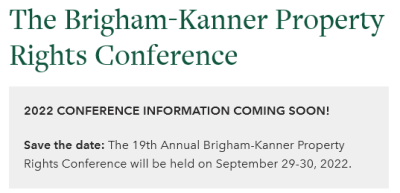
Screenshot 2022-07-07 at 13-44-38 The Brigham-Kanner Property Rights Conference

By now, you know that the 19th Brigham-Kanner Property Rights Conference is set for September 29-30, 2022, at the William and Mary Law School in Williamsburg, Virginia (register here – space is limited – fee ranges from free to $195 – a bargain!). And you know that our colleague Jim Burling is this year’s B-K Prize winner.

But now you know who is speaking at the Conference, and the topics: here’s the full agenda. The list of speakers is too long to list here but check out these topics:

  • Panel 1: The Importance of Property Rights: A Tribute to James S. Burling
  • Panel 2: Reshaping the Framework Protecting Property Under the Roberts Court (that’s the panel we’re speaking on)
  • Roundtable: Emerging Issues in Takings and Property Rights Litigation
  • Panel 3: Choosing A Property Regime
  • Panel 4: Property Rights in Times of Scarcity and Crisis

Who can
Continue Reading Here’s The Full Speaker And Topic List For The Brigham-Kanner Property Rights Conference (Sep 29-30, 2022)

We’ve been meaning to post the U.S. Court of Appeals for the Sixth Circuit’s opinion in Barber v. Charter Twp of Springfield, No. 20-2298 (Apr. 11, 2022) for a while because it emphasizes an important point about “final decision” ripeness, and the sometimes ridiculous arguments made to support an argument that a takings claim isn’t ripe.

In many situations a takings claim is backwards looking, and seeks compensation or some other remedy for something the government has already done. You flooded my property, or your project encroached on my land, or you designated my property for future acquisition and prevented me from using it in the interim are good examples. But not always. Sometimes takings claims are forward looking. Your regulations require me to allow a cable TV company to install a box on my building’s roof, or you are threatening to open my private marina

Continue Reading CA6: Dammed If You Do – Takings Claim Is Ripe When Govt Decides To Physically Invade And You Don’t Need To Wait ‘Til It Actually Invades

The Cass County Water Resource District wanted to acquire the Sauvageau property for a flood control project. That means flooding the property, removing all trees and vegetation, and taking dirt. Putting the land underwater, permanently. Cutting off the public access road. And removing the Sauvageau home.

The District offered to buy the fee interest from the Sauvageaus for $460,000, the appraised value of the fee interest. They declined. So the District offered $460,000 for a permanent easement. Also declined.

Next up, eminent domain, with the District seeking a “permanent right of way easement” by quick take. We’re taking it now, so you have a few months to get out of your home and get off the land. The Sauvageaus objected. You might be able to take our property for a flood control project, but you can’t take our property by quick take. Under the North Dakota Constitution, quick take is

Continue Reading It Isn’t An “Easement” When Condemnor Is Taking Everything, Permanently

PXL_20220127_144224442

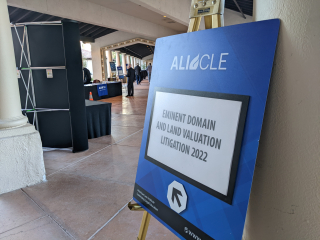
After a two-year absence in which we went remote, in the last week of last month (our usual spot on the calendar, between the playoffs and Super Bowl), we once again met in-person for the American Law Institute-CLE Eminent Domain and Land Valuation Litigation Conference.

Approximately 200 lawyers, judges, legal scholars, appraisers, law students, right-of-way agents, relocation experts, property owners, and other related professionals gathered in-person–yes, in-person–at the Scottsdale (Arizona) Resort at McCormick Ranch, to get reacquainted, learn stuff, and renew ties last made in-person in Nashville in 2020. In addition to the live attendance, we also welcomed about 50 remote colleagues, who joined the live webstream.

This was the 39th edition of the Conference, one of the most-established and successful conferences in the ALI-CLE stable of programs.

To those who joined us – thank you. This conference reminded us of why this program is so

Continue Reading 2022 ALI-CLE Eminent Domain And Land Valuation Litigation Conference, Scottsdale: You Should Have Been There!

All the topics you want to know about, presented by top-notch faculty from across the nation. Sessions include:

  • Keynote: Do Animals Have Property Rights?
  • Did the Supreme Court Signal a New Direction in Property Rights in Cedar Point Nursery?
  • Maximizing Relocation Benefits: Understanding the Law and Regulations to Ensure Fairness
  • Challenging Public Use: Lessons From a 67-Day Trial
  • COVID Takings
  • Property Rights as Civil Rights
  • Eminent Domain National Update
  • Federal Court and the Daubert Challenge: How to Prepare
  • How to Position Your Client for the Fallout When Projects Don’t Get Built
  • Rural Broadband and the Emerging Constitutional Challenges
  • Are Precondemnation Entry Statutes Still Valid After Cedar Point Nursery?
  • How Condemnor and Property Owners’ Counsel Prepare the Battlefield
  • How Will the Trillion Dollar Infrastructure Bill Impact Your Practice?
  • Ethics
  • …and more, including a full slate of networking and social events!

We’ve sold out the last few years, so don’t Continue Reading Registration Open Now: ALI-CLE Eminent Domain & Land Valuation Litigation Conference, Jan 26-29, 2022, Scottsdale

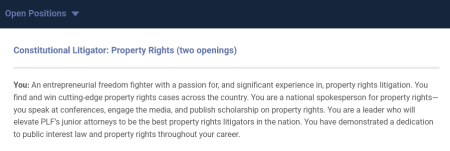
Screenshot 2021-08-11 at 14-56-53 Constitutional Litigator Property Rights (two openings) Pacific Legal Foundation

You’ve got big dreams, you want fame…

If so, here’s your chance: two (2!) Takings Maven Dream Jobs® are now available.

Pacific Legal Foundation requesting applications for positions as a Property Rights Constitutional Litigator. Job description includes “You will find and win the next important Supreme Court property rights case.”

Oh, have we got your attention now?

You: An entrepreneurial freedom fighter with a passion for, and significant experience in, property rights litigation. You find and win cutting-edge property rights cases across the country. You are a national spokesperson for property rights—you speak at conferences, engage the media, and publish scholarship on property rights. You are a leader who will elevate PLF’s junior attorneys to be the best property rights litigators in the nation. You have demonstrated a dedication to public interest law and property rights throughout your career.

You will be a leader in PLF’s

Continue Reading Takings Maven Dream Job® (x2): Property Rights Constitutional Litigator at Pacific Legal Foundation

A short one from the South Carolina Supreme Court. In Ray v. City of Rock Hill, No. 28045 (Aug. 4, 2021), the court held that the city’s re-connecting its pipe that had previously flooded Ray’s property qualified as the “affirmative, positive, aggressive act” required by S.C. law as an essential element of a new inverse condemnation claim.

Short version of the facts. The city ran a stormwater pipe under Ray’s property. No record of any easement for the pipe. Ray’s property had “a history of sinking and settling[,]” and this went on for many years. Slip op. at 2. Eventually she sued for inverse. The lawsuit alleged that the flooding and damage to her property and home was caused by the deterioration of the city’s pipe.

Apparently unrelated to this, at about the time of the filing of the lawsuit, the city began maintenance work on a sewer line.

Continue Reading South Carolina: City Reconnecting Stormwater Pipes That Previously Flooded Land Is The “Affirmative, Positive, Aggressive Act” Triggering Inverse

All the topics you want to know about, presented by top-notch faculty from across the nation. Sessions include:

  • Property Rights as Civil Rights
  • Eminent Domain National Update
  • Just Relocation: Understanding the Law and Regulations to Ensure Fairness
  • Challenging Public Use: Lessons From a 67-Day Trial
  • COVID Takings
  • Federal Court and the Daubert Challenge: How to Prepare
  • Did the Supreme Court Signal a New Direction in Property Rights in Cedar Point Nursery?
  • How to Position Your Client for the Fallout When Projects Don’t Get Built
  • Rural Broadband and the Emerging Constitutional Challenges
  • Are Precondemnation Entry Statutes Still Valid After Cedar Point Nursery?
  • How Condemnor and Property Owners’ Counsel Prepare the Battlefield
  • How Will the Trillion Dollar Infrastructure Bill Impact Your Practice?
  • Ethics
  • …and more, including a full slate of networking and social events!

We’ve sold out the last few years, so don’t miss out. Room block now taking reservations. Continue Reading Join Us For The 39th Annual ALI-CLE Eminent Domain & Land Valuation Litigation Conference, Jan 26-29, 2022 (Scottsdale, AZ)

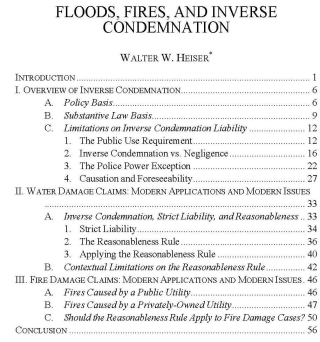
Floodsfiresarticle

Here’s what we’re reading today (inter alia): Walter W. Heiser, Floods, Fires, and Inverse Condemnation, 29 N.Y.U. Envtl. L. J. 1 (2021).

From the Introduction:

This Article examines the proper application of the doctrine of inverse condemnation in two important areas: flood damage to private property caused by a public improvement (e.g., a flood control, storm drain, or sewer project), and wildfire damage to private property caused by a project (e.g., electricity or telephone lines) undertaken by either a public or privately-owned utility. Under the doctrine of inverse condemnation, a plaintiff may recover for a physical injury to private property caused by a public improvement as deliberately designed, constructed, or maintained.

….

How courts define the standard of liability in inverse condemnation cases will become increasingly important in both the flooding and wildfire contexts. The continuing nature of climate States and more wildfires in others. This Article examines

Continue Reading New L Rev Article: “Floods, Fires, and Inverse Condemnation”

20160126_164144

Here’s one we’ve been waiting to drop. In San Jacinto River Authority v. Medina, Nos. 19-0400, 19-0402 (Apr. 16, 2021), the Texas Supreme Court held that “statutory takings” under the Texas Government Code include both physical invasion takings as well as regulatory takings.

This case stems from flooding allegedly caused in part by the San Jacinto River Authority’s release of water in response to Hurricane Harvey. The property owners whose land was flooded sued, asserting takings and inverse claims under both the Texas Constitution, and the “Private Real Property Rights Preservation Act.” The Authority sought dismissal of the statutory claim arguing that it covers only regulatory takings, not physical takings like the takings here.

In case you are not familiar with the statute, it is a waiver of governmental immunity for lawsuits “to determine whether the government action of a political subdivision results in a taking under this chapter.

Continue Reading Texas’ Takings Statute Allows Claims For Both Physical And Regulatory Takings