FedCtsTakingsArticlepage1

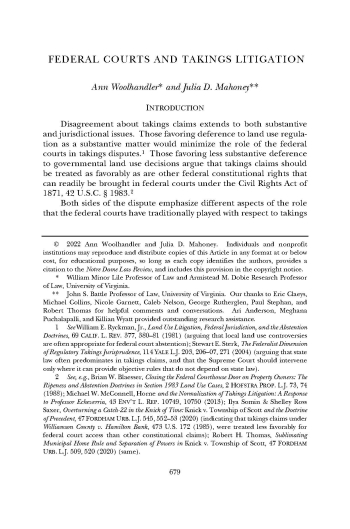
A new article on takings from U. Virginia Law School profs Ann Woolhandler and Julia Mahoney in the Notre Dame Law Review, “Federal Courts and Takings Litigation.” Get the pdf here.

Rather than try and summarize the piece, we’re just going to cut-and-paste the highlights from the article’s Introduction:

While Knick clearly expands the lower federal court role in takings claims, many questions remain. We do not know how federal courts will respond to the increase in claims—whether they will embrace a robust federal role in land use cases, or use various abstention doctrines to rein them in. While pro-regulatory and pro-property rights scholars have predictably taken sharply contrasting positions as to the appropriate federal court role post-Knick, this Article will recommend a middle-of-the-road approach, based partly on history and partly on an assessment of where the lower federal courts may most usefully contribute to the

Continue Reading New Article: Woolhandler & Mahoney, Federal Courts and Takings Litigation, 97 Notre Dame L. Rev. 679 (2022)

Another takings challenge to a Co-19 shutdown, another “no taking” result.

This time, it is from the Florida District Court of Appeal (Fifth District). In Orlando Bar Group, LLC v. Desantis, No.5D21-1248 (Apr. 8, 2022), the court affirmed dismissal of takings challenges to the governor’s emergency order that barred certain alcohol sales, and limited the service in bars. Orlando-area bar owners sued for inverse condemnation.

The Fifth District concluded that this did not result in a taking. First, the court held that it would not apply a categorical physical rule, because Cedar Point Nursery is not applicable. In that case, the owners were asserting their right to exclude the public, but here the bar owners claimed that the restrictions abrogated their right to include patrons and others. Slip op. at 7 (“The COVID orders at issue here did not permit third parties to access Appellants’ property; they did

Continue Reading Fla App: No Taking, Because COVID Is A Really Good Reason To Shut Bars Down

Here’s the latest case challenging a pandemic-related eviction moratorium, this one from Minnesota and the U.S. Court of Appeals for the Eighth Circuit.

In Heights Apts, LLC v. Walz, No. 21-1278 (Apr. 5, 2022), the court reversed the district court’s dismissal of a property owner’s takings claims. The owner challenged the Minnesota governor’s residential eviction moratorium and later extensions. Like a lot of these things, the Minnesota version was not a rent “holiday” (tenants were still, technically speaking, on the hook for the rent, and there were several limited exceptions under which the property owner could evict). But for the most part, the Minnesota measure, like a lot of these things, effectively left property owners holding the economic bag (good luck collecting thousands in back rent), and turned their units into public pandemic housing. 

The owner’s complaint raised Contract Clause, Petition Clause, and Takings claims.

Before we get to

Continue Reading CA8: Yee v. Escondido Doesn’t Save Eviction Moratorium From Takings Review

When you are building a sewer, grading is important. Otherwise, the stuff might not “flow” correctly, if you get our drift. Okay Public Works Authority built a sewer, and guess what? “The work performed by OPWA caused extensive damage” to private property, and the “lines installed by OPWA had not been properly graded.”

Not good. The jury in the inverse condemnation lawsuit that followed awarded $73k in compensation. The court of appeals, however, tossed the verdict because OPWA did not possess the power of eminent domain to take property for sewage lines. And to be liable for inverse in Oklahoma, the defendant must possess the eminent domain power.

In Barnett v. Okay Public Works Authority, No. 117792 (Mar. 8, 2022), the Oklahoma Supreme Court concluded that the utility possesses the eminent domain power to take property for sewer lines. The decision turned on the language in the statute delegating

Continue Reading OK: Inverse Is A Two-Way Street – Utility Has Eminent Domain Power, So Is On The Hook For Inverse

Here’s a really short one from the U.S. Court of Appeals for the Fourth Circuit. Not published, so even shorter than you might expect.

In Virginia Hospital & Healthcare Ass’n v. Kimsey, No. 20-2176 (Mar. 1, 2022), the court rejected the Commonwealth’s argument that the sole remedy for a takings claim is just compensation.

The plaintiff challenged a statute which limited their ability to obtain reimbursement for medical services rendered to Medicaid patients, which instead keys reimbursement to the patients’ diagnoses. According to the plaintiffs, this scheme leaves them holding the financial bag in situations were they render services that the statute deems avoidable because of the final diagnosis. 

The complaint alleges a regulatory taking, because the statute “denies just compensation for federally-mandated emergency services by predicating reimbursements on the final diagnosis only – and not on the services actually provided,” and for reimbursing at only 1/2 the usual

Continue Reading CA4: Just Comp Isn’t The Only Remedy For A Taking

CedarpointPRELcoverpage

Thank you to the editors over at The Practical Real Estate Lawyer for publishing my missive on Cedar Point Nursery v. Hassid, the U.S. Supreme Court’s recent blockbuster regulatory takings decision (and for letting me post a copy of the article here so it is available even if you are not a PREL subscriber). And you know this, but I’m going to disclose it again: my law firm represented the property owner in that case, so yes, I do have a viewpoint; take that into account while reading. 

By the way, you might consider becoming a subscriber. The journal publishes just what the title suggests it does – practice-oriented articles about dirt lawyering. Good stuff.

Thomas, Common Sense and Common Law: Defining “Property” in Cedar Point v. Hassid, 38 Prac. Real Estate Law…

Continue Reading New Article: Common Sense and Common Law: Defining “Property” in Cedar Point v. Hassid

IMG_20170323_142813

Sorry about the headline, but come on, man! We have to use clickbaity headlines every now and then to get your attention. Here’s the latest in a case we’ve been following.

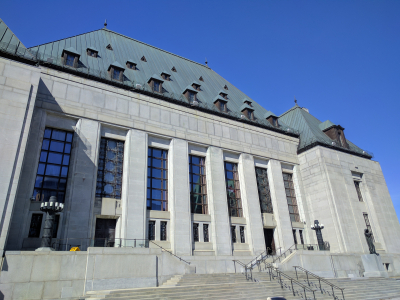
Yesterday, the Supreme Court of Canada heard oral arguments in Annapolis Group Inc v. Halifax Regional Municipality, a case involving “de facto expropriation,” or what we in the U.S. might think of as a regulatory taking.

We watched the livestream (along with a few of our northern colleagues), and if you missed it, the recording of the (2-hours and 30-minutes!) arguments can be found here — in English, with simultaneous French translation, if you want to have some extra fun.

Screenshot 2022-02-17 at 07-50-43 Supreme Court of Canada - SCC Case Information - Webcast of the Hearing on 2022-02-16 - 3[...]

Yes, there really are that many Justices
and lawyers on the argument

The Supreme Court is considering whether Halifax’s refusal to approve Annapolis Group’s development applications (consistent with its residential zoning, more specifically “future serviced development”) on

Continue Reading Important Developments In Canada (No, Not That!): Supreme Court Hears Argument In “Takings” Case

PXL_20220127_144224442

After a two-year absence in which we went remote, in the last week of last month (our usual spot on the calendar, between the playoffs and Super Bowl), we once again met in-person for the American Law Institute-CLE Eminent Domain and Land Valuation Litigation Conference.

Approximately 200 lawyers, judges, legal scholars, appraisers, law students, right-of-way agents, relocation experts, property owners, and other related professionals gathered in-person–yes, in-person–at the Scottsdale (Arizona) Resort at McCormick Ranch, to get reacquainted, learn stuff, and renew ties last made in-person in Nashville in 2020. In addition to the live attendance, we also welcomed about 50 remote colleagues, who joined the live webstream.

This was the 39th edition of the Conference, one of the most-established and successful conferences in the ALI-CLE stable of programs.

To those who joined us – thank you. This conference reminded us of why this program is so

Continue Reading 2022 ALI-CLE Eminent Domain And Land Valuation Litigation Conference, Scottsdale: You Should Have Been There!

A short one from the Oklahoma Supreme Court.

In Rocket Properties, LLC v. LaFortune, No. 120000 (Jan. 18, 2022), the court issued an order that, in effect, reverses the trial court’s dismissal of an inverse condemnation case (we say “in effect” because the Supreme Court was considering a writ of prohibition, not an appeal). The trial court concluded that the inverse claim was governed by the procedural requirements of the Oklahoma Governmental Tort Claims Act.

The Oklahoma Supreme Court has long held that “[c]ondemnation proceedings do not involve a tort.” Oklahoma City v. Wells, 91 P.2d 1077 (Okla. 1939). But recently, the legislature amended the statute to change the definition of “tort” to include a legal wrong or violation of a “duty imposed by general law, statute, the Constitution of the State of Oklahoma …[,]” to specify that the tort claims statute governs “tort suits alleging constitutional rights.”

Continue Reading Inverse Condemnation Isn’t Tort, OK

If you ever get the opportunity to teach in a law school — either as a full-time legal scholar, or part-time as an expert adjunct practitioner — take it if you can. You might think you know a lot about a particular subject, but there’s nothing like spending time at the lectern in a law classroom in front of sharp and eager lawyers-in-training to sharpen your thoughts, and get you to truly understand a subject.

And folks calling you “professor” can evoke a smile.

Sensei

But if there’s one downside to the law school experience from the teacher’s side of the lectern, it’s grading. Especially at a law school like William and Mary that has a pretty strict mandatory curve. In upper-division courses that we handle like Eminent Domain and Property Rights Law and Land Use — where we’re dealing with some very high-level stuff and the quality of the

Continue Reading The Circle Is Now Complete: A Sampling Of Final Paper Topics From William and Mary Law’s Eminent Domain & Property Rights, And Land Use Courses