It’s already settled in Michigan (Rafaeli) that a homeowner has a property interest in the equity in her home, and that if she fails to pay the full amount of her property taxes and the government forecloses, the government can’t keep the proceeds in excess of the amount of the tax delinquency.

But that case didn’t account for those tax foreclosures already underway when the Michigan Supreme Court issued its decision in July 2020. Nor did the case account (obviously) for the subsequent legislative amendments providing a limited procedure by which the former homeowner may claim the excess proceeds.

Thus, we get Proctor v. Saginaw County Bd. of Comm’rs, No. 349557 (Jan. 6, 2022), which involves plaintiffs who

Skip over the court’s discussion of the immunity argument (unless that interests you, of course), and go to page 9 where it gets to our stuff: the takings and
Continue Reading Michigan: Legislature Can’t Abrogate Long-Existing Property Rights Without Compensation

A short trial court decision. But because it deals with an interesting question, we’re posting it.

Check it out: in this order, the U.S. District Court for the District of Minnesota denied the city’s motion to dismiss in a case alleging, inter alia, a Fifth Amendment taking.

The property owners’ complaint alleged that their property, located in Tonka Bay, Minnesota, was taken by the neighboring city of Shorewood. The back of the property, you see buts up against the Shorewood border, and the owners have an unpaved driveway to access Timber Lane. The owners have used the driveway for a dozen years. 

But Shorewood neighbors “took issue with the [plaintiffs’] use of the unpaved driveway.” Slip op. at 3. (Thank goodness for neighbors, what would we do without them?). They asked Shorewood to install a barrier along the city boundary to prevent drivers from using Timber

Continue Reading A Tale Of Two Cities: A City’s Road Barriers Might Be A Taking, Even Though The Property Taken Is In A Neighboring City

Here’s how the Pennsylvania Supreme Court stated the issue in Hughes v. UGI Storage Co., No.J-69A-2021 (Nov. 29, 2021):

In these consolidated appeals, we consider the Commonwealth Court’s holding that, to be held liable for damages under Pennsylvania’s inverse condemnation statute, an entity must be clothed with the power of eminent domain – not only in a general sense, in that it must be a governmental or quasi-public entity to which condemnation powers may be delegated – but also, the entity must be invested with eminent domain authority specific to the property in issue.

Slip op. at 1.

If all you need to know is “what did the court answer?” you can stop right here: the court held that UGI Storage did not need to have been delegated the power of eminent domain, nor must it be delegated the power to take the property at issue, in order to

Continue Reading Pennsylvania: To Be Liable For Inverse Condemnation, Taker Need Not Have Eminent Domain Power

Screenshot 2021-11-17 at 13-11-12 The Realities of Takings Litigation

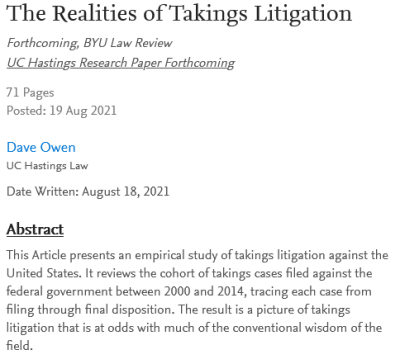
Another law review article worth reading. This one from lawprof Dave Owen, is about “The Realities of Takings Litigation” (forthcoming BYU Law Review). That title certainly got our attention – any time a law journal article is about ‘reality’ and takings, and includes empirical research, we’re going to read it.

Here’s the abstract:

This Article presents an empirical study of takings litigation against the United States. It reviews the cohort of takings cases filed against the federal government between 2000 and 2014, tracing each case from filing through final disposition. The result is a picture of takings litigation that is at odds with much of the conventional wisdom of the field.

That conventional wisdom suggests that most takings cases will involve alleged regulatory takings; that the most intellectually challenging issues will arise within the field of regulatory takings; and, more broadly, that takings litigation will play an

Continue Reading New(ish) Article: “The Realities of Takings Litigation” (Dave Owen)

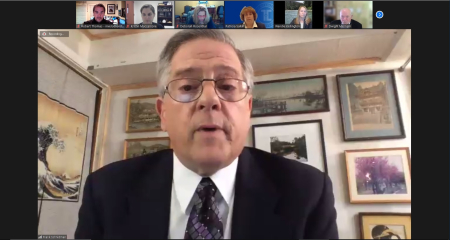
FrankLUI Co-Chair Prof. Frank Schnidman introducing the faculty
Here are the links to the cases and issues that we just finished speaking about at the 35th Annual Land Use Institute (more information on the LUI here). Today was day 1 of a multi-day remote program and the sessions are available ala carte, so there’s still time to join in and learn.

Supreme Court

  • Cedar Point Nursery: the Supreme Court affirms the “keep out” vibe in property law. Yes, there are three “exceptions” to the presumption that any physical intrusion into property is a taking (torts, entries allowed under “background principles,” and legal exactions), but overall a very strong affirmation of property rights.
  • Pakdel v. San Francisco: the “final decision” ripeness requirement in takings cases is “relatively modest” and turns on “de facto” readiness. Yes, it’s a technical requirement, but let’s not get too technical about it.
  • PennEast Pipeline


Continue Reading Links And Materials From Today’s Land Use Institute Takings/Eminent Domain Session

It’s already the law in Georgia that the Georgia Constitution’s Takings Clause waives whatever sovereign immunity the government may enjoy when it comes to monetary relief in a takings claim. See Ga. Dept. of Nat. Res. v. Center for a Sustainable Coast, 755 S.E.2d 184 (2014).

But it remained an open question whether the Georgia Constitution also allows property owners to seek injunctive relief for a taking (in this case, a claim of inverse condemnation). In Dep’t of Transportation v. Mixon, No. S20G1410 (Oct. 5, 2021), the Georgia Supreme Court gave us an answer.

There, the DOT’s road project allegedly caused flooding on Mixon’s land. Mixon brought an inverse condemnation claim, seeking both just compensation and a permanent injunction to prevent future flooding and trespass. The trial court and the court of appeals rejected DOT’s claim of immunity (based on the 2014 decision noted above). The Georgia Supreme

Continue Reading Georgia SCT To Govt: If You Take Or Damage Property, The Court May Order You To Fix The Problem Until You Pay Compensation

Untitled Extract Pages

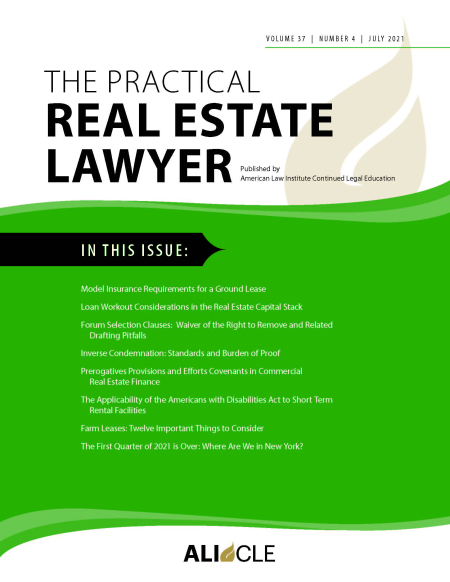
Worth reading: an article in ALI-CLE’s Practical Real Estate Lawyer, authored by our friends and colleagues Steve Clarke, Justin Hodge, Jeremy P. Hopkins, and Christian Torgrimson, “Inverse Condemnation: Standards and Burden of Proof.”

A subscription to PREL costs, but for this issue the good people at ALI have made it available for free. Lucky you. But you really should get a subscription — PREL publishes useful articles like this frequently.

And since we’re on the subject of ALI-CLE, we can’t resist reminding you that registration for the 2022 ALI-CLE Eminent Domain & Land Valuation Litigation Conference is underway (including reservations for the limited room block at the Scottsdale Resort). Please register and make your plans to join your colleagues (including the authors of the article!) in January in Scottsdale.Continue Reading New Article: “Inverse Condemnation: Standards and Burden of Proof” (ALI-CLE Practical Real Estate Lawyer)

IS WM

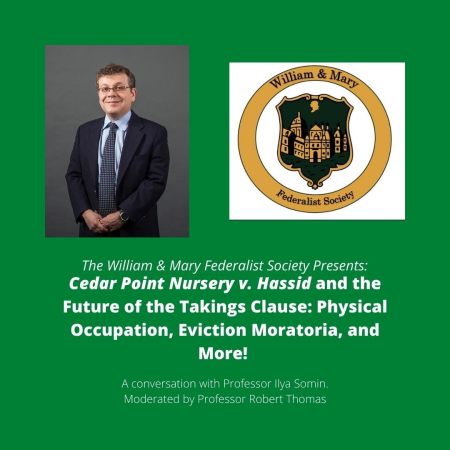
Next Tuesday, September 28, starting at 12:50pm ET, we’ll be moderating a talk sponsored by the William and Mary Law School chapter of the Federalist Society.

Professor Ilya Somin, a nationally-recognized expert in eminent domain, takings, and related topics, is zooming in to speak about “Cedar Point Nursery v. Hassid and the Future of the Takings Clause: Physical Occupation, Eviction Moratoria, and More.”

And guess what? You can Zoom in too. It’s open to the public, and it’s free.

So mark your calendars and join us for Prof Somin’s thoughts on the cutting-edge issues in property rights. Here’s the Zoom link: https://us02web.zoom.us/j/89365248145. See you on Tuesday!Continue Reading Join Us (For Free!): Lawprof Ilya Somin On “Cedar Point Nursery v. Hassid and the Future of the Takings Clause: Physical Occupation, Eviction Moratoria, and More” (Tues. Sep. 28, 2021, 12:50pm ET)

PXL_20210920_195630876

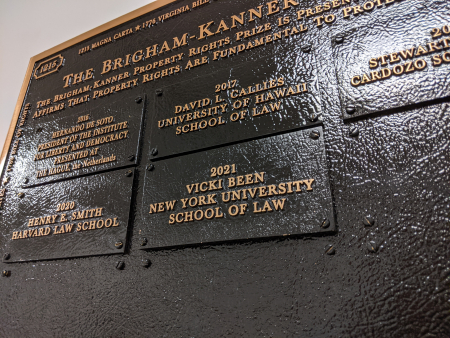
There’s still plenty of time to register and join us for the 18th Annual Brigham-Kanner Property Rights Conference at the William and Mary Law School, Thursday and Friday, September 30 and October 1, 2021.

Yes, you may attend in-person, or remotely. The registration fees are very reasonable, ranging from $0 (yes, free!) to $200 (go here, and click “Tickets” for the details).

This year’s Brigham-Kanner Property Rights Prize winner is Professor Vicki Been (NYU Law). The Conference includes presentations on:

  • Remembering Toby Brigham
  • The Role of Empirical Research in Defining the Scope of Constitutionally Protected Property Rights: A Tribute to Been
  • The Relationship between Eminent Domain and Social and Racial Injustice (this is the panel on which we’ll be presenting)
  • Just Compensation Issues, Changing Public Uses, and Other Recent Developments
  • The Interdependence of Property and First Amendment Rights
  • The Distributional Implications of Land Use Regulation

Details on

Continue Reading 2021 Brigham-Kanner Property Rights Conference (Sep. 30 – Oct. 1, 2021) – Still Time To Join Us

DqyzrckX0AIhgpM

Check this out, the latest from lawprof Lee Anne Fennell, her thoughts on the Supreme Court’s Cedar Point decision, “Escape Room: Implicit Takings After Cedar Point,” forthcoming in the Duke Journal of Constitutional Law & Public Policy.

Here’s the abstract:

In the June 2021 case of Cedar Point Nursery v. Hassid, the Supreme Court held that a California regulation that gave union organizers limited access to agricultural worksites (three hours a day, 120 days a year) amounted to a per se taking. The Court further opined that any governmental grant of physical access, no matter how time-limited or functionally constrained, similarly works a per se taking—unless one of the Court’s exceptions applies. This essay argues that Cedar Point is best understood as part of an ongoing campaign by the Court to selectively apply heightened scrutiny to property-facing governmental acts in ways that broadly entrench the status quo.

Continue Reading New Article: Lawprof Lee Anne Fennell – “Escape Room: Implicit Takings After Cedar Point”