This has been a pretty good week for my St. Louis colleague Thor Hearne.

First, he obtained summary judgment in the Court of Federal Claims for the property owners in a rails-to-trails case, Dana R. Hodges Trust v. United States, No. 09-289 L (Oct. 25, 2011). Next, his Cardinals come back from the edge to take the World Series. And now comes Rogers v. United States, No. 07-273L (Oct. 31, 2011), another good decision for property owners from the CFC. 

Rogers involves the appraisal standard applied in a partial takings case. As Thor writes:

The case involves a partial taking of an easement. Under the National Trails Act the federal government converted an abandoned railroad easement into a public recreational trail. Under Florida law the owner of the fee estate had the right to exclusive and unencumbered use and possession of their land. But, the federal law

Continue Reading Another Good Decision From The Court Of Federal Claims
IMG_6999

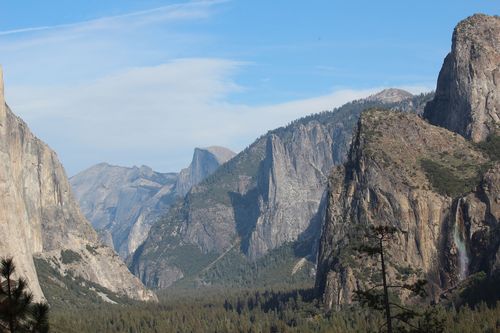
“Yosemite,” according to California Place Names, Erwin Gudde’s seminal work on the origins of (surprise) California place names, means “they are killers.” It was “[e]vidently a name given to the Indians of the valley by those outside it.”

I raise this historical tidbit because I must admit to feeling a little like “those outside it” when I was invited to speak about regulatory takings at the California State Bar’s Environmental Law Conference at Yosemite. I figured as a conference devoted to environmental law, it was a going to be a decidedly skeptical audience, given my advocacy for property owners and property rights. I accepted the invitation nonetheless, heartened that this conference wasn’t going to be an echo chamber and that they were at least open to hearing competing ideas.

It turns out that my prediction about “they are killers” was not accurate — the audience, while not exactly

Continue Reading Yosemite Seminar Summary – Regulatory Takings: Looking Back And Looking Forward

Here’s the latest in the lengthy West Linn Corporate Park tale from Oregon. After having bounced from federal court, to the Oregon state courts, then back to federal court, the case is now in the hands of the U.S. Supreme Court.

The issue in the case is whether the Ninth Circuit was correct when it held in an unpublished memorandum opinion that “[t]he Supreme Court has not extended Nollan and Dolan beyond situations in which the government requires a dedication of private real property. See Lingle v. Chevron USA, Inc., 844 U.S. 528, 547 (2005). We decline to do so here.” Slip op. at 4-5.

Weak, Ninth Circuit, weak. Is the issue of whether Nollan and Dolan‘s nexus and rough proportionality requirements apply only to exactions of land — but do not govern exactions of other types of property such as money — so settled that you blow

Continue Reading New Cert Petition: Are Nollan And Dolan Limited To Exactions Of Land?

Yosemite_conference Here are the links to the cases and other items discussed today at the session Regulatory Takings – Looking Back and Looking Forward at the Cal State Bar’s Environmental Law Section’s Environmental Law Conference at Yosemite.

These cases are also in your written materials.


Continue Reading Links From “Regulatory Takings: Looking Back And Looking Forward” (Cal. State Bar Yosemite Conference)

Yosemite_conference One conference down, one to go.

We’re on the way back from the Brigham-Kanner Property Rights Conference in Beijing, and on our way to the California State Bar Environmental Law Section’s annual conference at Yosemite N.P., which begins later this week. More information about the conference here.

Along with U.C. Berkeley law professor Joseph Sax and Deputy California Attorney General Daniel L. Siegel, I will be speaking about “Regulatory Takings: Looking Back and Looking Forward.” E. Clement Shute will moderate the panel discussion.

We will be discussing the seminal regulatory takings cases from the past 20 years. “The panelists, who have been involved in several of the most significant takings cases since even before the founding of the annual Yosemite Environmental Law Conference twenty years ago, will highlight key decisions, offer their views on the evolution of takings law, and discuss cutting-edge issues raised by more recent

Continue Reading California Bar’s Yosemite Conference: “Regulatory Takings: Looking Back and Looking Forward”

Here is the Petitioner’s Reply Brief in Colony Cove Properties, LLC v. City of Carson, No. 11-189 (cert. petition filed Aug. 11, 2011). We posted the cert petition and the amici and BIO here

The cert petition is asking the Supreme Court to revist and discard the ripeness rules of Williamson County Regional Planning Comm’n v. Hamilton Bank of Johnson City, 473 U.S. 172 (1985). It poses two Questions Presented:

1. Should Williamson County be overruled, to the extent that it arbitrarily denies a federal forum to regulatory takings claimants seeking just compensation for the violation of their rights under the Fifth Amendment, contrary to the intention of Congress in enacting Section 1983?

2. Should this Court recognize an exception to Williamson County’s “state procedures” requirement for takings claimants like Petitioner, whose Fifth Amendment claims will otherwise be relegated to a California state court system that

Continue Reading Final Cert Brief In Williamson County Challenge

Climatechangemongraphpage

“There is strong consensus in the international scientific community that climate change is occurring and that greenhouse gas emissions from human activities contribute to climate change.”

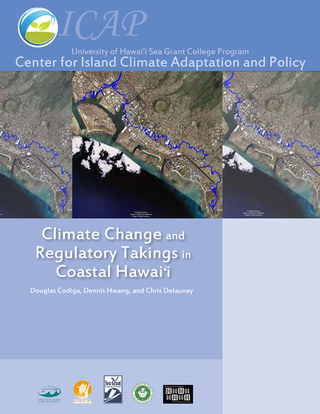
So begins Climate Change and Regulatory Takings in Coastal Hawaii, a monograph by Douglas Codiga, Dennis Hwang, and Chris Delaunay, published by the University of Hawaii Sea Grant College Program’s Center for Island Climate Adaptation and Policy

We’re not entering into the debate about whether global warming/climate change is or isn’t happening. But the one certain thing is that every regulatory entity from the U.N. on down to your local neighborhood board believes it is real, and seems to want to do something about it. Thus, the question is how property owners may be affected by those actions, and what they can do in response. This report doesn’t really resolve anything, but it does establish the framework and makes some recommenations. From

Continue Reading Climate Change And Regulatory Takings In Coastal Hawaii

Wade-front-page-small Thanks to the folks at the Environmental Law Institute, who have allowed us to reprint an article from a recent Environmental Law Reporter by William W. Wade, Ph.D., a resource economist with the firm Energy and Water Economics (Columbia, Tennessee). Bill is a frequent author and speaker on the Penn Central issue, and he’s brought much needed clarification to an often confusing issue.

In Sources of Regulatory Takings Economic Confusion Subsequent to Penn Central, Mr. Wade writes:

The Federal Circuit Cienega X decision imposes insufficient financial analysis of Penn Central’s two economic prongs to satisfy either economic practice or the Penn Central test. The decision’s imposed change in value measurement evaluates only one prong of the Penn Central test. Change in value satisfies the economic impact prong but does not establish severity of the economic impact vis-à-vis frustration of distinct investment-backed expectations (DIBE). Mere diminution is well-known

Continue Reading Article: Sources of Regulatory Takings Economic Confusion Subsequent to Penn Central

cert petition has been filed by the property owners in a case we’ve been following about what the takings ripeness doctrine of Williamson County Regional Planning Comm’n v. Hamilton Bank of Johnson City, 473 U.S. 172 (1985) requires.

In Downing/Salt Pond Partners v. Rhode Island, 643 F.3d 16 (1st Cir. 2011), the U.S. Court of Appeals for the First Circuit concluded that because Rhode Island state law might allow an inverse condemnation remedy andthe burden is on the property owner to show that the remedy is unavailable, and thus the case was not ripe for review in federal court.

The petition poses these Questions Presented:

Does the ripeness doctrine of Williamson County Reg’l Planning Comm’n v. Hamilton Bank of Johnson City, 473 U.S. 172, 194 (1985), require a property owner to litigate in state court to show a taking of property is “without just compensation,” and

Continue Reading New Cert Petition: Why Can’t A Federal Court Determine The State Has Not Provided Compensation?

5330215_big The American Bar Association’s Section of State & Local Government Law has just published a new book on eminent domain fundamentals: Eminent Domain – A Handbook of Condemnation Law (available for preorder here).

I was privileged to author two chapters (Prelitigation Process and Flooding & Erosion), and my Damon Key colleagues Mark Murakami and Christi-Anne Kudo Chock co-authored the chapter Damages Resulting from a Taking: An Overview.   

The price is $89.95 with the price of $69.95 for members of the Section of State and Local Government Law (discounts on books and CLE: another good reason to join the Section). There are also discounts for purchase of multiple copies. More details here.

Here’s what the book offers, from the Introduction by my colleague Dan Dalton:

Eminent domain has a long and distinguished legal history, dating from the first limits on sovereign power in the Magna

Continue Reading New Book: Eminent Domain – A Handbook of Condemnation Law (ABA 2011)