


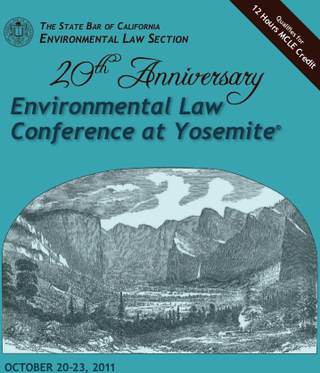
Yosemite_conference

Mark your calendars for October 20 – 23, 2011. That’s when the State Bar of California will present its 20th Anniversary Environmental Law Conference at Yosemite® (yes, it is trademarked), at the Tenaya Lodge in Fish Camp, California.

Along with U.C. Berkeley law professor Joseph Sax and Deputy California Attorney General Daniel L. Siegel, I will be speaking about “Regulatory Takings: Looking Back and Looking Forward.”

We will be discussing the seminal regulatory takings cases from the past 20 years. “The panelists, who have been involved in several of the most significant takings cases since even before the founding of the annual Yosemite Environmental Law Conference twenty years ago, will highlight key decisions, offer their views on the evolution of takings law, and discuss cutting-edge issues raised by more recent court decisions.”  E. Clement Shute will moderate the panel discussion.

The Yosemite program, sponsored by the CSB’s

Continue Reading “Regulatory Takings: Looking Back and Looking Forward” At The Cal Bar’s Yosemite Conference

Many of the cases we cover on this blog present unusual fact patterns and cutting-edge legal claims. But they may not present an accurate view of the typical cases that cross the desk of lawyers who have chosen this line of work, as much of the work of eminent domain and property lawyers involves issues such as access, street widening, parking, and the like.

For an example of that, look no further than today’s short opinion by the South Carolina Supreme Court holding that the loss of left turn access to the plaintiff’s property as a result of the State’s widening of a highway did not result in an inverse condemnation of property. Hilton Head Automotive LLC v. S.C. Dep’t of Transportation, No. 27026 (Aug. 15, 2011). The property owner claimed a physical take of its access easement.

The court concluded:

The gravamen of HHA’s claim is that its

Continue Reading South Carolina: No Taking By Cutting Off Left Turns, Because Property Is Still Accessible By Right Turns And U Turns

Here’s what we’re reading this fine summer Monday:

  • Land Use Institute – Although we won’t be able to attend the upcoming annual ALI-ABA program in Boston due to a scheduling conflict, we have attended several times in the recent past, and can highly recommend it. The faculty, as usual, is stellar, and includes colleagues Michael Berger,  Amy Brigham Boulris, Bob Foster, Patricia Salkin, Julie Tappendorf, and Gideon Kanner. 
  • 2011 Takings Conference – Another law conference (November 19, 2011), this one devoted (mostly) to how to defeat regulatory


Continue Reading Monday Round-Up: Vested Rights, Land Use Institute, And More

Another drive-by blog post today because we’re still at the ABA Annual Meeting in Toronto, and between meetings of the State and Local Goverment Law Section and scooping up as many CLE credits as possible, haven’t had much down time to detail the latest cases. But here’s one that’s worth reviewing on your own, if only because it was authored by Judge Jay Bybee, who is becoming quite the takings maven on the Ninth Circuit.

The Takings Clause, as the Supreme Court has reminded, is “self-executing,” which means that the obligation to pay compensation for a taking is not completeley dependent on an enabling statute, nor is it subject to every claim of sovereign immunity.

That thought played central role in Jachetta v. United States, No. 10-35175 (Aug. 1, 2011), in which a three-judge panel of the Ninth Circuit held that a property owner’s inverse condemnation claim

Continue Reading Ninth Circuit: Takings Claims Must Have A Forum … Somewhere

Barista’s note: We’re on the road today at the ABA Annual Meeting, so don’t have the time to set this one out in detail. But a quick review of a rather longish opinion (65 pages) makes it seem interesting enough.

In Dep’t of Fish and Game v. Superior Court, No. C066158 (Aug. 2, 2011), the California Court of Appeal (Third District) held that a case in which property owners challenged DFG’s efforts to eradicate the invasive northern pike from lakes in the Sierra Nevada should not have been certified as a class action. The property owners sued under an inverse condemnation theory (among other things). The court held:

In their inverse condemnation claim, plaintiffs allege defendants’ conduct “in attempting to eradicate the Northern Pike for a public purpose has caused a substantial impairment to Plaintiffs’ property rights and Plaintiffs were denied all economically beneficial uses of their property

Continue Reading Cal App: Inverse Condemnation And Class Actions

Here’s the latest in a case we’ve been following. In Bridge Aina Lea, LLC v. State of Hawaii Land Use Comm’n, the plaintiff filed its complaint in state circuit court alleging that the LUC violated state and federal law (due process, takings, vested rights, and more) when it reclassified “urban” land on the Big Island to “agriculture.” 

The defendants then removed the case to federal court, and have now filed a motion to dismiss that contains a host of defenses: immunity, the unavailability of prospective injunctive relief, whether certain defendants are “persons” under 42 U.S.C. § 1983, abstention on the federal takings claim, the lack of a state damage remedy for deprivation of constitutional rights, and zoning estoppel, among others.

Just the thing to give you flashbacks to your Federal Courts class.

Update: here‘s the errata filed just after the motion to dismiss.

Motion to Dismiss, Bridge at

Continue Reading Latest In Big Island Takings And Vested Rights Challenge To LUC Reclassification

California, if you weren’t already aware, produces raisins. Lots of raisins. It accounts for 99.5% of the U.S. crop and 40% of the world crop.

Since the 1920’s, supply has exceeded demand by 30 to 50 percent. Since the 1940’s, the USDA has regulated the raisin industry to even out the fluctuation in supplies and prices by creating “annual reserve pools” that remove extra raisins from the market. Those regulations, in the form of “marketing orders,” require raisin “handlers” (those who process and pack agricultural goods for distribution) to set aside a certain percentage of raisins from the domestic open market, upon pain of civil and criminal penalties if they do not. The reserve raisins can only be sold for resale in export or secondary markets, with the proceeds used to pay for administration of the regulatory program (naturally), and any balance being distributed among raisin “producers.”

In Horne

Continue Reading 9th Cir: California Raisins Were Not Taken

In Edwards v. City of Jonesboro, No. 10-2405 (July 14, 2011), the U.S. Court of Appeals for the Eighth Circuit held that a takings claim brought in federal court after the property owner prevailed on the same claim in state court was not barred by the Rooker-Feldman doctrine, but that the state court judgment was final and precluded relitigation of the owner’s federal claims.

Methane gas, released by decomposing waste in the the city’s landfill, invaded adjacent land, rendering it undevelopable, so the owner sued the city. He filed an action in state court; alleging violations of his rights under state law (inverse condemnation, trespass, violations of the state constitution, and the like), and under federal law (takings, etc). With his third amended complaint, however, he filed an England reservation, withholding his federal claims from resolution in state court.

After a trial, the state court ordered the city

Continue Reading 8th Cir: No Rooker-Feldman, But San Remo Hotel Precludes Federal Takings Claim

Today’s Ninth Circuit opinion in Vandevere v. Lloyd, No. 09-35957 (July 11, 2011), raises a couple of interesting questions having little to do with the merits of whether Alaska’s commercial fishing regulations worked a taking or a due process violation because they shortened the fishing season and limited the number of fish that can be harvested under the plaintiff’s entry permits and fishery leases.

First of all, what’s the Ninth Circuit doing reviewing a federal takings claim at all? As we’ve discussed repeatedly (most recently here), we thought that under Williamson County, federal courts could only review takings claims for compensation after a property owner has sought (and been denied) compensation in state procedures, which include an inverse condemnation claim in state court. A search of the Vandevere opinion reveals no citation to Williamson County. But check out page 9226 of the slip opinion, which references

Continue Reading Judicial Takings Overtones In The Ninth Circuit

Synchronicity. Serendipity. Yin and Yang. Sometimes things just seem to work out.

Exhibit A: No sooner do we post a case about when inverse condemnation cases are filed too late (see Federal Circuit On The Metaphysics Of Takings Claim Accrual), what comes across our desk? A case about when inverse condemnation cases are filed too soon, of course. In Pembroke Center, LLC v. Fla. Dep’t of Transportation, No. 4D10-1737 (June 29, 2011), the District Court of Appeal (4th District) held that a declaratory judgment action initiated by a property owner was ripe, and that more was needed to determine whether an inverse condemnation action was ready for review.

The DOT has plans to widen the road next to the plaintiff’s shopping center, but the widening “was put on hold due to economic circumstances, but its website indicted the project will resume once funding is

Continue Reading Florida Court Of Appeals Brings Balance To The Force: A Project That Isn’t Quite “Shovel Ready” May Be Ripe For Review