In case you were not paying attention on this fine Thursday, here comes the Federal Circuit’s opinion in Mildenberger v. United States, No. 2010-5084 (June 30, 2011). It’s an interesting opinion because it deals with the mildly metaphysical question of when the six year statute of limitations for inverse condemnation claims against the federal government commences in cases where the taking and damage to the property is gradual, and nearly imperceptible.

In many cases, inverse condemnation claims are not like straight condemnation where the property owner knows when her property is being condemned, because in an inverse claim the owner doesn’t get served with a complaint, but instead must institute the suit after her property is taken or damaged, and it is often not clear when property has been taken or damaged to such an extent that a claim must be brought. The general rule is that a property

Continue Reading Federal Circuit On The Metaphysics Of Takings Claim Accrual
Yesterday, we reported on the South Carolina Supreme Court’s opinion in Brown v. Howard, No. 26991 (S.C. June 21, 2011), holding that “the Takings Clause of the Fifth Amendment to the United States Constitution is implicated when an attorney is appointed by the court to represent an indigent litigant. In such circumstances, the attorney’s services constitute property entitling the attorney to just compensation.”

The opinion is generating some buzz (see the Legal Profession blog and John Blackman’s blog), so we thought we’d post the South Carolina Bar’s amicus brief since the opinion focused on the Bar’s arguments:

The South Carolina Bar appears Amicus Curiae. The Bar contends that the appointment of attorneys to represent indigent litigants implicates the Takings Clause of the Fifth Amendment to the United States Constitution. See U.S. Const. amend. V (“[N]or shall private property be taken for public use without just compensation.”). We agree

Continue Reading Amicus Brief In S. Carolina Case: “The State may not require a lawyer to spend office overhead or render his services on an appointed case without providing just compensation.”

We hold today that the Takings Clause of the Fifth Amendment to the United States Constitution is implicated when an attorney is appointed by the court to represent an indigent litigant. In such circumstances, the attorney’s services constitute property entitling the attorney to just compensation.

Brown v. Howard, No. 26991 (S.C. June 21, 2011).*

Brown was appointed as defense counsel in a case in which Howard was charged with serious felonies “including first degree criminal sexual conduct, two counts of kidnapping, two courts of armed robbery, and possession of a weapon during the commission of a crime.” South Carolina law limits attorneys fees in indigent criminal defense matters to $3,500, S.C. Code Ann. §17-3-50(A), and Brown asked the court to withdraw, “stating that his obligations to an appointed capital case were taking up substantial amounts of time.”

The court declined Brown’s repeated “belligerent” requests. When Brown refused to

Continue Reading South Carolina: “Court-Appointed Attorneys’ Service Is Property For Purposes Of The Takings Clause”

“Hard cases make bad law” goes the cliché.* But in the case of the Williamson County ripeness requirement in federal takings cases, the bad law is an entirely self-inflicted wound and cannot be blamed on lousy facts or hard cases. Others have done a much better job of deconstructing Williamson County‘s faulty history and rationale and the “bad law” the opinion has wrought (see here and here for examples), but we’ve taken our share of shots too.

But for an example of Williamson County unfairness, look no further than the case behind this order entered by the U.S. District Court for the Eastern District of Michgan in Oakland 40, LLC v. City of South Lyon, No. 10-14456 (May 18, 2011).

The case started out as a rather typical land use dispute, with a property owner who wanted to use its industrial zoned land for homes, and who

Continue Reading Williamson County: An Absurdity Wrapped In A Fallacy Inside A Contradiction

A new case worth watching has been filed in Hawaii state court (Third Circuit, the Big Island) that involves allegations of vested rights and estoppel, Nollan/Dolan exactions, state and federal due process and takings, inverse condemnation, and equal protection.The

See below, the Complaint in Bridge Aina Le’a v. State of Hawaii Land Use Comm’n, No 11-1-1145-06 (KKS), filed last week, in which the plaintiff asserts that the Land Use Commission changed the land use boundaries from “urban use to agricultural use while affordable housing was being constructed on the property.”

More here, from West Hawaii Today.

Complaint, Bridge Aina Le’a v. State of Hawaii Land Use Comm’n, No. 11-1-1145-06 (KKS) (filed 6-7-2011)Continue Reading New Lawsuit To Watch: Land Use Commission, Vested Rights, Civil Rights

Civil Beat‘s recent report on the mayor’s plan to demolish the Waikiki Natatorium War Memorial, a salt-water swimming pool erected to honor those who served in “the Great War,” not only brought back some childhood memories (I swam there as a kid) but reminded us of the cost of preservation. When the thing or property sought to be preserved  — or, to use the bumper-sticker vernacular, “saved” — is public property like the Natatorium, the discussion usually involves the cost of doing so balanced against the desire to keep it.

But when the property involved is private property, you usually hear very little about the burdens placed on the owner, or the cost to the public of preservation. Which brings us to the tile of this post, which was inspired by a recent column by Howard Dicus “What do you want to save in Honolulu that’s old?

Continue Reading What Do You Want To Save In Honolulu (And How Much Will It Cost?)

We don’t usually cover unpublished decisions. They are usually cryptic, and depending on local court rules, can’t be cited. But as we explained before, there are exceptions. The Ninth Circuit’s memorandum decision in Molony v. Crook County, No. 09-35624 (May 27, 2011) is one that raises some interesting issues.

First, what’s a takings claim doing in federal court? Like another recent opinion from the Seventh Circuit, the opinion notes it is a “state-law taking claim” meaning that the district court’s jurisdiction was based either on diversity (in which case, the court could consider stand-alone state law claims), or on the presence of a federal question (in which case, the court has the discretion to consider “supplemental” state law claims — what we used to call “pendent” or “ancillary” jurisdiction). We’re not sure which applied here, but the jurisdictional basis is worth noting since it may reveal a

Continue Reading 9th Circuit (Unpublished): State Taking Claim Ripe, No Economic Use

Any regular reader of these pages knows about the Williamson County/San Remo Hotel “ripeness” Catch-22: try vindicating a property owner’s federal constitutional right in federal court in the first instance, and the federal court will tell you that you are too early — a regulatory taking is of no constitutional moment until the state regulators have made a final decision, and the state courts have denied compensation (even if this means the state hasn’t offered compensation and in state court denies it owes any). But bring a federal action after a state court inverse condemnation case, and the federal court will tell you that you are too late — you already litigated your federal claim, even if you expressly didn’t.

The Catch-22 nature of this prompted four Justices to note in San Remo Hotel that the Williamson County experiment may have run its course and is due

Continue Reading First Circuit: RI’s Inverse Condemnation Remedy Satisfies Williamson County

PICT0408
Last week, after we concluded the spring meeting of the ABA’s Section on State and Local Government Law in Portland, Oregon (more about that in a subsequent post), we could not resist paying a brief visit to the neighboring City of Tigard.

Yes, that City of Tigard.

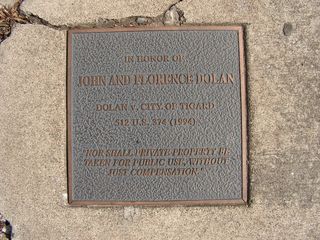
In the early 1990s, the city was home to John and Florence Dolan, who owned A-Boy Plumbing & Electrical Supply. They asked the city for a permit to expand their store and pave their parking lot. The city saw this as an opportunity to expand its network of bike paths, and conditioned its approvals on the Dolans “dedicating” (giving) the city land for a public “greenway” along the adjacent Fanno Creek, totaling approximately 10% of the parcel.

PICT0407

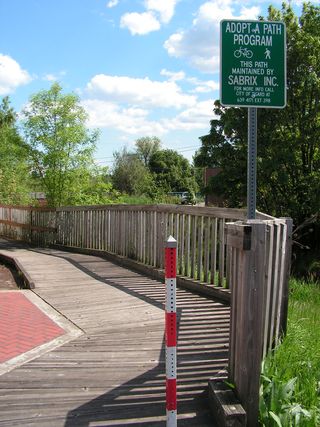
            The entrance to the “greenway” from the street.

The Dolans objected, arguing that requiring them to donate land as a condition of land use

Continue Reading Regulatory Takings Pilgrimage, Part II

The U.S. Supreme Court has denied the petition for a writ of certiorari in Guggenheim v. City of Goleta, No. 10-1125. Property owners asked the Court to review the Ninth Circuit’s sharply divided en banc opinion, which held that the City’s mobile home rent control ordinance did not work a regulatory taking because the fact that the Guggenheims purchased their property subject to a rent-control regime was “fatal” to their investment-backed expectations under Penn Central Transportation Co. v. New York City, 438 U.S. 104 (1978).

The petitioners asserted the Ninth Circuit”s conclusion contradicted Palazzolo v. Rhode Island, 533 U.S. 606 (2001), the case in which the Supreme Court held the fact that restrictive regulations predated the property owner’s acquision of the property did not forclose his challenging the regulation as a taking. Will the cert denial mean that the lower courts will continue to ignore Palazzolo or

Continue Reading Cert Denied In Guggenheim