A very short one from the Oregon Court of Appeals.

In Walton v. Neskowin Reg. Sanitary Auth., No. A168358 (Sep. 1, 2021), the court concluded that the trespass statute of limitations of six years applied to a physical takings (inverse condemnation) claim. The Sanitary Authority installed a main sewer line on the plaintiffs’ property in 1995. When the plaintiffs’ septic system failed in 2014, the Authority required them to connect to the sewer system. The plaintiffs asserted that they were entitled to a “no fee” connection, in accordance with an agreement with the Authority to allow the 1995 installation in exchange for a no fee connection. The Authority denied the existence of any agreement.

So in 2017 the plaintiffs sued for inverse condemnation. The Authority argued the statute of limitations on such a claim had expired. The statute began running when the invasion took place, and not when
Continue Reading Oregon App: Six Year Statute Of Limitations For Physical Invasion Takings Begins To Run When Property Occupied, Not When Compensation Is Denied

Check this out. A short online comment at the Yale Journal on Regulation by Judge Thomas Griffith, “A New Test Or Merely A New Name For Some Regulatory Takings?

The comment addresses the notion that the Supreme Court in Cedar Point shuffled up takings doctrine:

Much of the commentary about the Supreme Court’s recent decision in Cedar Point Nursery v. Hassid, 141 S. Ct. 2063 (2021), has focused on its implications for labor law. Yet some of the Chief Justice’s language in the majority opinion suggests a substantial reworking of the Court’s approach to “regulatory takings”—an area that the Court has acknowledged to be “a problem of considerable difficulty.” A close read of the opinion, however, suggests that even though Court may have reshuffled the categories it has used in the past to analyze takings claims, the law remains largely unchanged, if not slightly more obscure.

Continue Reading New Comment: Cedar Point – “A New Test Or Merely A New Name For Some Regulatory Takings?”

Untitled Extract Pages

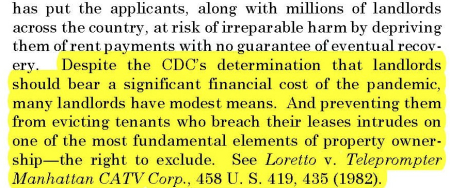
The other shoe — perhaps the most predictable shoe drop in legal history — dropped yesterday, and the Supreme Court vacated the stay on appeal in one of the cases challenging the CDC’s renewed eviction moratorium, meaning that the district court’s judgment vacating the moratorium can go into effect. Alabama Ass’n of Realtors v. Dep’t of Health and Human Svcs, No. 21A23 (Aug. 26, 2021) (per curiam).

The six-Justice majority, in an unsigned opinion, held that “”[i]t strains credulity to believe that this statute grants the CDC the sweeping authority that it asserts.” Slip op. at 1-2. Now remember, this is one of the cases challenging the CDC moratorium on non-takings grounds, primarily asserting that the CDC’s authorizing statute does not authorize this sweeping an action (or if it does, the statute is unconstitutional). For a complete analysis of the opinion, see lawprof Ilya Somin’s hot take: “

Continue Reading SCOTUS Strikes Down CDC Eviction Moratorium And Leaves Tantalizing Clues About Takings

On one hand, the U.S. Court of Appeals’ opinion in Buending v. Town of Redington Beach, No. 20-11354 (Aug. 20, 2021) is not a big deal, at least in terms of the issue in the case: did the Town take the plaintiffs’ private beach property when it adopted an ordinance allowing the public to use it? Maybe it did, maybe it didn’t. The opinion simply vacates the district court’s grant of summary judgment to the property owners because there are disputed issues of fact on the Town’s affirmative defense of customary use. The district court concluded the Town could not raise the customary use defense.

The Eleventh Circuit, however, held that the Town was not precluded from raising the defense that the property the plaintiffs claimed was exclusively private was also subject to the public’s use under longstanding custom, and that the Town’s opposition to the plaintiff’s motion for

Continue Reading CA11: No Summary Judgment For You On Takings Claim When Town Provided Some Evidence Of Public Customary Use Of Beach

All the topics you want to know about, presented by top-notch faculty from across the nation. Sessions include:

  • Keynote: Do Animals Have Property Rights?
  • Did the Supreme Court Signal a New Direction in Property Rights in Cedar Point Nursery?
  • Maximizing Relocation Benefits: Understanding the Law and Regulations to Ensure Fairness
  • Challenging Public Use: Lessons From a 67-Day Trial
  • COVID Takings
  • Property Rights as Civil Rights
  • Eminent Domain National Update
  • Federal Court and the Daubert Challenge: How to Prepare
  • How to Position Your Client for the Fallout When Projects Don’t Get Built
  • Rural Broadband and the Emerging Constitutional Challenges
  • Are Precondemnation Entry Statutes Still Valid After Cedar Point Nursery?
  • How Condemnor and Property Owners’ Counsel Prepare the Battlefield
  • How Will the Trillion Dollar Infrastructure Bill Impact Your Practice?
  • Ethics
  • …and more, including a full slate of networking and social events!

We’ve sold out the last few years, so don’t Continue Reading Registration Open Now: ALI-CLE Eminent Domain & Land Valuation Litigation Conference, Jan 26-29, 2022, Scottsdale

Screenshot 2021-08-11 at 14-56-53 Constitutional Litigator Property Rights (two openings) Pacific Legal Foundation

You’ve got big dreams, you want fame…

If so, here’s your chance: two (2!) Takings Maven Dream Jobs® are now available.

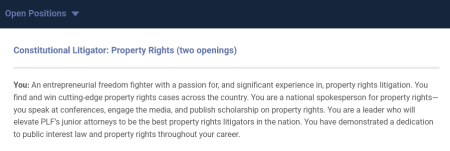
Pacific Legal Foundation requesting applications for positions as a Property Rights Constitutional Litigator. Job description includes “You will find and win the next important Supreme Court property rights case.”

Oh, have we got your attention now?

You: An entrepreneurial freedom fighter with a passion for, and significant experience in, property rights litigation. You find and win cutting-edge property rights cases across the country. You are a national spokesperson for property rights—you speak at conferences, engage the media, and publish scholarship on property rights. You are a leader who will elevate PLF’s junior attorneys to be the best property rights litigators in the nation. You have demonstrated a dedication to public interest law and property rights throughout your career.

You will be a leader in PLF’s

Continue Reading Takings Maven Dream Job® (x2): Property Rights Constitutional Litigator at Pacific Legal Foundation

The U.S. Court of Appeals for the Fourth Circuit’s opinion in Zito v. N.C. Coastal Resources Comm’n, No. 20-1408 (Aug. 9, 2021) is just the latest in a growing list of decisions about an issue we’ve been following (see here, here, here, here, and here for example), including the District Court’s decision in this very case.

That issue is whether a property owner can sue a state for just compensation for a taking in federal court.

You know how that works. Knick held that local governments and officials can be sued in federal court for violating the federal constitution and for civil rights violations. Check. But it didn’t expressly say anything about whether there’s something different about a state or a state official (in their official capacity) that prohibits the same thing. After all, the Eleventh Amendment has been interpreted, it prohibits federal court

Continue Reading CA4 Tells Landowner To Beat It (From Federal Court): 11th Amendment “Sovereign Immunity” Bars Suing State For Fifth Amendment Compensation In Federal Court

According to that trustworthy source Wikipedia, in drama, the term deus ex machina (“God from the machine”) “is a plot device whereby a seemingly unsolvable problem in a story is suddenly and abruptly resolved by an unexpected and unlikely occurrence. Its function is generally to resolve an otherwise irresolvable plot situation, to surprise the audience, to bring the tale to a happy ending, or act as a comedic device.” It is mostly considered a “lazy or cheap” trope.

And that takes us to the various federal, state, and local eviction moratoria that are (or were) in effect at various points in the covid epidemic. To us, those have mostly seemed like cases of kicking the can down the road (to use another overworn trope) because although couched as merely temporary withholding of the usual eviction remedy for nonpayment of rent, in a great number of cases the practical effect

Continue Reading What The Deus Ex Machina? – Federal Court Complaint: California’s Eviction Moratorium Is A Taking

A short one from the South Carolina Supreme Court. In Ray v. City of Rock Hill, No. 28045 (Aug. 4, 2021), the court held that the city’s re-connecting its pipe that had previously flooded Ray’s property qualified as the “affirmative, positive, aggressive act” required by S.C. law as an essential element of a new inverse condemnation claim.

Short version of the facts. The city ran a stormwater pipe under Ray’s property. No record of any easement for the pipe. Ray’s property had “a history of sinking and settling[,]” and this went on for many years. Slip op. at 2. Eventually she sued for inverse. The lawsuit alleged that the flooding and damage to her property and home was caused by the deterioration of the city’s pipe.

Apparently unrelated to this, at about the time of the filing of the lawsuit, the city began maintenance work on a sewer line.

Continue Reading South Carolina: City Reconnecting Stormwater Pipes That Previously Flooded Land Is The “Affirmative, Positive, Aggressive Act” Triggering Inverse

Programming note: as we noted here, we’ve recently moved our email subscribers to a new service. If you are already subscribed to our email updates you should not need to do anything, except look for the emails coming from Feedblitz, not Feedburner. If you want to sign up for email updates anew, go here. If you experience technical issues, or receive duplicate email notifications, please let me know.

Now back to your regularly scheduled programming…

20151205_150106

Check out this Complaint, filed last week which asks the U.S. Court of Federal Claims to award property owners an unspecified amount (noted as $26 billion in the cover sheet) in just compensation for the taking of the plaintiffs’ property by the Center for Disease Control’s order temporarily halting residential evictions.

The Complaint alleges a physical invasion taking because it precludes “property owners from excluding [tenants] and leasing

Continue Reading New Takings Complaint: $26 Billion For CDC’s Eviction Moratorium