


Some interesting items have crossed my desk on Friday and Saturday:

  • From the Grand Theft: Property blog, Jim Mattson posts his thoughts about Monks v. City of Rancho Palos Verdes, 67 Cal. App. 4th 263 (Cal. Ct. App. 2008), the case in which a California Court of Appeals held that a municipality’s development moratorium was a Lucas taking.
  • From the New York Zoning and Municipal Law blog comes a summary and analysis of the recent oral arguments in the latest phase of the Atlantic Yards eminent domain fight from Brooklyn. 
  • More on AmeriSource v. United States, No. 08-497 (cert. petition filed Oct. 15,

Continue Reading Weekend Round-Up

Your first reaction to this post’s title may be “well, duh!”

But wait, there’s more.

In Empress Casino Joliet Corp. v. Giannoulias, 896 N.E.2d 277 (Ill., June 5, 2008),the Illinois Supreme Court held that a regulation that imposes a 3%”surcharge” on Illinois casinos with gross receipts over $200 million per year, and then gives the money to horse racing tracks is not a taking of property.  Several casinos challenged the law asserting, among other arguments, that the redistribution of their money to tracks was a taking.  The Illinois Supreme Court rejected the argument; the court’s taking analysis begins at page 14 of the slip opinion. The court held that the regulation was a tax, and not subject to takings analysis:

[W]e conclude that the surcharge at issue here is not subject to a takings challenge. The Act does not involve an interest in physical or intellectual property, nor does


Continue Reading New Cert Petition: The Government Can “Take” Money

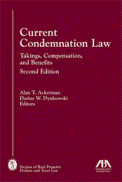
5430464_big A recent book of interest to condemnation lawyers, Current Condemnation Law: Takings, Compensation & Benefits (2d ed.).

The book is co-edited by my Owner’s Counsel of America colleague Alan T. Ackerman. (He also has a blog about eminent domain issues.)

From the blurb:

Condemnation of property is an especially topical subject after the U.S. Supreme Court’s controversial decision in Kelo v. City of New London. This completely revised edition of Current Condemnation Lawexamines the many complexities involved in the practice of eminentdomain law in order to assist lawyers in best protecting the clients’interests in these cases. The book brings together experts in thespecialty to provide analysis of both major and specialty areas ofcondemnation law, providing “how to” tips along with currentdiscussions of case law and theory.

The chapters in Current Condemnation Lawprovide a thought-provoking mix of articles covering the key topics ofbusiness valuation, contamination issues, the right

Continue Reading New Eminent Domain Book: Current Condemnation Law: Takings, Compensation & Benefits (2d ed.)

Thanks to Columbia lawprof Ronald Mann for forwarding his reply brief in AmeriSource Corp. v. United States, No. 08-497 (cert. petition filed Oct. 15, 2008). Responding to the arguments in the federal government’s brief in opposition, the reply argues:

The Government’s brief in opposition to the petition underscores the need for review by this Court. It declines to defend the reasoning of the court below. It offers a new rationale that is neither consistent with the reasoning of the lower court nor defensible on its own terms. Finally, despite the Government’s efforts to minimize the importance of the decision, it remains undisputed that the decision below grants the Federal Government a blank check to confiscate tangible property without any duty of compensation, from the only court in which such actions can be challenged.

Brief at 1. In AmeriSource, a pharmaceutical company whose legalprescription drugs were seizedas evidence

Continue Reading Reply Brief In AmeriSource: Is Destruction of Evidence Seized From Innocent Third Party A Taking?

Thanks to James Lawlor of the Land Use Legal Report for letting us know that the U.S. Supreme Court has declined to review Ocean Harbor Homeowners Ass’n v. California Coastal Comm’n, 163 Cal. App. 4th 215, 77 Cal. Rptr. 432 (2008). In that case, the California Court of Appeals held that the California Coastal Commission properly conditioned a permit to build a seawall to protect property from erosion on the landowner’s payment of a $5.3 million “mitigation fee.” The fee was to be used to purchase other beach property since Commission claimed the construction of the seawall would result in the loss of beach fronting the property. The property owner challenged the exaction under the nexus and proportionality requirements of Nollan v. California Coastal Commission, 483 U.S. 825 (1987), and Dolan v. City of Tigard, 512 U.S. 374 (1994).

A denial of a petition for writ of

Continue Reading Cert Denied In California Nollan/Dolan $5.3 Million Seawall “Mitigation Fee” Case

It’s easy to blog a case when you or your colleagues win it, and we’ve had plenty to talk about lately in that department in eminent domain and zoning law.

On the other hand, it’s not so easy to write about a case when you don’t prevail. Today is one of those days. The U.S. Supreme Court declined to review the California Court of Appeal’s decision in Charles A. Pratt Const. Co. v. California Coastal Comm’n, 76 Cal. Rptr. 2d 466 (Cal. Ct. App. 2008) (the California court’s slip opinion available here). The Supreme Court’s Order List denying review is posted here.

We blogged about the lower court decision here, the rehearing petition here, and the cert petition here. We (and others) filed amicus briefs, urging the Court to review the case. Our brief is posted here. The two Questions Presented

Continue Reading Cert Denied In Ripeness And Penn Central Case

Here are the links to the cases that I spoke about in my session in today’s seminar “Supreme Court, Regulatory Takings and Eminent Domain Update.”  Not all of the cases we discussed today are included below, so if you would like a link or more information about a case that is not listed, please email me at rht@hawaiilawyer.com and I will send it to you.

The majority opinion by Justice Acoba, joined by Justices Nakayama and Duffy is posted here:

We hold that (1) a landowner in a condemnationaction is entitled to damages under HRS § 101-27 where the property atissue is not finally taken in the context of a particular condemnationproceeding, irrespective of whether the government attempts to take theland through subsequent condemnation proceedings; (2) abatement doesnot apply where the relief sought in two concurrent actions is not thesame; and (3) although our courts afford substantial deference to thegovernment’s asserted public purpose for a taking in a condemnationproceeding, where there is evidence that the asserted purpose ispretextual, courts should consider a landowner’s defense of pretext. Therefore, (1) automatic denial of statutory damages under HRS §101-27in Condemnation 1 is vacated and the case remanded for a determinationof damages, (2) the court’s conclusion that Condemnation 2 was notabated by Condemnation 2 is vacated and the case remanded for adetermination of whether the public purpose asserted in Condemnation 2was pretextual.

Slip op. at 5. Here’s the concurring and dissenting opinion by Chief Justice Moon joined by Justice Levinson. The briefs in the case are available here:  Opening Brief, Answering Brief of the County of Hawaii, Reply Brief. Disclosure: we represent the property owner.

  • No private right of action to enforce zoning – The Hawaii Intermediate Court of Appeals, in Pono v. Molokai Ranch, Ltd.,119 Haw. 163, 194 P.3d 1126 (2008), held that a private party had nostanding to enforce the state’s land use laws. The Hawaii Supreme Courtrejected certiorari review of the case.  Disclosure: we represent thelandowner. More here.

Continue Reading Materials From 2/20/2009 Land Use Seminar

Head’s up on an interesting case from the Court of Federal Claims, Resource Investments, Inc. v. United States, No. 98-419L (Court of Federal Claims, Jan. 23, 2009), a massive opinion (84 single-spaced pages) with what at first glance seems to delve into just about every regulatory takings theory known: temporary takings, categorical takings, partial takings, parcel-as-a-whole, Mahon, Penn Central, First English, Lucas, Tahoe-Sierra, Seiber, delay, and ripeness. And those are just the subjects listed on the caption.

We’re not going to digest the entire opinion here, just hit some of the highlights. The short story is that the U.S. Army Corps of Engineers wrongfully asserted jurisdiction over property in Washington state proposed to be used for a landfill, and asserted that until the owner procured a section 404 Clean Water Act permit, it could not construct the landfill. The Ninth Circuit ultimately agreed

Continue Reading CFC: Trial Needed On Whether Wrongful Assertion Of Clean Water Act Jurisdiction Is “Extraordinary Delay”

Florida’s appellate courts have been active lately in the regulatory takings arena.  Here are links to summaries and analysis of the decisions.

First, from the Florida Land Use Law blog:

Next, from Grand Theft: Property

Continue Reading PING: Well HatchedURL: http://livepress.in/kickstart-your-career/IP: 219.234.82.86BLOG NAME: Well HatchedDATE: 02/09/2013 03:34:47 PMinversecondemnation.com: Florida Regulatory Takings Links

In Zaid v. United States, No. 08-020C (Jan 22, 2009), the Court of Federal Claims held that an attorney who had a one-third contingent fee arrangement with his client did not have a claim for a taking when Congress placed a 10% fee limitation in two private bills.

Attorney Zaid represented two FBI informants who infiltrated the American Communist Party and assisted the FBI for 22 years. The were promised payment but received none. After unsuccessfully representing themselves, they retained Zaid and agreed that he would take 1/3 of any recovery as his fee.

The attorney was ultimately successful, procuring from Congress two private bills to pay the informants $1 million each. A private bill is special legislation providing some benefit to a specific individual. More about private bills here. Unfortunately for the attorney, in the private bills, Congress included a provision that capped his fee at 10%

Continue Reading CFC: No Taking Of Attorney’s Contingency Fee Agreement By Congressional Limitation Of Fees