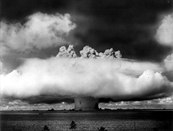
Boom How’s this for a raw deal: not only does the federal government seize both your land and your home, but it also takes your entire country with the intention of detonating multiple thermonuclear weapons where you once lived. Meaning you won’t be able to return to the homeland you loved for oh, let’s just say a very long time

Thirty years pass, and after you sue the government for a taking, it settles the dispute by entering into an agreement which creates a tribunal to settle all claims, payable from a trust fund. The trust fund, however, is woefully underfunded and could not possibly satisfy your claims and those of your compatriots (of the money in the trust fund, only 1/3 is designated to actually pay the victims; the other 2/3 is set aside to support the tribunal’s operations). Nonetheless, the tribunal awards you and your neighbors nearly $1


Continue Reading Federal Circuit To Bikini Islanders: Get In Line Behind The Auto Companies, The Banks, And Executive Bonuses

The Honolulu Advertiser reports “Lingle wants Ka Iwi coast free of development,” about the Governor’s efforts “paving the way for the final step in preserving the most accessiblewild coastline on O’ahu for generations to come.”

And just how is the Governor proposing to “preserve” this privately-owned and urban-zoned land from the “threat of development,” you ask? “[B]y asking the stateLand Use Commission to reclassify the Ka Iwi shoreline from urban toconservation,” that’s how.  In other words, downzone it.

As the article notes, this area has long been a battleground between the right to make reasonable use of private property and at least one segment of the public’s desire to prohibit development. Several cases have arisen from the area, the most well-known of which was the “Sandy Beach” case involving the “5” and “6” parcels down the road from the : 

The land, while zoned preservation by the county

Continue Reading Here’s A Novel Proposition: How About Paying For It?

The property owner has filed its Reply in Support of Petition for a Writ of Certiorari in Charles A. Pratt Const. Co. v. California Coastal Comm’n, No. 08-668 (cert. petition filed Nov. 18, 2008) (SCOTUS docket report here). The petition seeks review of the California Court of Appeal’s opinion reported at 76 Cal. Rptr. 2d 466 (Cal. Ct. App. 2008), available here.

The issues presented in the case involve the Penn Central ad-hoc test for regulatory takings, and the “final determination” prong of the Williamson County ripeness rule. The Reply brief argues:

The Brief in Opposition is liberally salted with Respondent California Coastal Commission’s assertions of what it refers to as the “facts” (e.g., pp. 5, 11) as well as disparagement of the presentation in the Petition as having “no evidence” (e.g., pp. 7, 11) behind it.

The Brief in opposition thus highlights the problem that call for

Continue Reading Reply In Support Of Petition In Pratt v. Cal. Coastal Comm’n – Penn Central And Williamson County

Smokey [Update: wildlandfire readers, see the bottom of the post.]

In a case we first analyzed here when the lawsuit was dismissed by the Court of Federal Claims, the U.S. Court of Appeals for the Federal Circuit in Cary v. United States, No. 2008-5022 (Jan. 16, 2009) held that the federal government was not liable in inverse condemnation for taking property damaged by Southern California wildfires in 2003.

The Federal Circuit affirmed the CFC’s judgment on the pleadings, holding that the owners of the damaged property did not allege — and could not show — that the government intended to invade a property interest when it failed to control the “Cedar Fire,” which began when “a deer hunter lost in the forest lit a signal fire to aid his rescue.” Slip op. at 2. It was a tragedy of immense proportions as fifteen people were killed, more than

Continue Reading Federal Circuit: No Taking For Forest Fire

In a lengthy (70 page) opinion, the California Court of Appeals (Sixth District), in Shaw v. County of Santa Cruz, No. H031108 (filed Dec. 19, 2008, ordered published Jan. 16, 2009), held that the government’s denial of a ministerial permit did not amount to a regulatory taking.

The opinion sets forth a long factual and procedural history of the case, so we won’t repeat it here. The discussion of takings begins on page 34 of the slip opinion, with a good short summary of regulatory takings law, and the various situations when the regulation of land will be deemed to have gone “too far” and requires the payment of just compensation. See slip op. at 34-39. Footnote 39 is particularly interesting, as it correctly notes that Lingle did not wipe out the Agins substantially advance test, but merely relocated it to due process:

The court’s holding [in Lingle

Continue Reading Cal. Court of Appeals Revisits (Sort of) Landgate: Of Regulatory Takings, Means-End Analysis, and Due Process

The California Coastal Commission has filed its Brief in Opposition to the cert petition in Charles A. Pratt Const. Co. v. California Coastal Comm’n, No. 08-668 (cert. petition filed Nov. 18, 2008) (SCOTUS docket report here).  The California Court of Appeal’s opinion, reported at 76 Cal. Rptr. 2d 466 (Cal. Ct. App. 2008) is available here). 

The issues presented involve the Penn Central ad-hoc test for regulatory takings, and the “final determination” prong of the Williamson County ripeness rule.

We filed an amicus brief in the case, available here. The cert petition and the other amici briefs supporting it are posted here.Continue Reading California Coastal Commission’s Brief In Opposition In Charles A. Pratt Construction Co. Cert Petition (Penn Central and Williamson County)

In 2008, we continued to castigate the Williamson County ripeness rules, culminating in December when we filed an amicus brief urging the Supreme Court to take a harder look at how the “final determination” aspect of the rule is being applied. The rule has two parts.

First, the state-litigation rule requires a regulatory takings plaintiff to pursue — and lose — their claim in state court before asserting their federal constitutional claims in federal court. In San Remo Hotel, L.P. v. City & County of San Francisco,545 U.S. 323 (2005) four Justices agreed Williamson County produces absurd results and denies federalcourt review of federal constitutional rights, and argued that in an “appropriate case,” the Court should reconsider Williamson County. At least two cert petitions were filed suggesting they were the appropriate case. See Braun v. Ann Arbor Charter Township, No. 08-250 (cert. denied Dec. 1, 2008), and

Continue Reading 2008 Land Use In Review: Ripeness Games In Regulatory Takings

OCA_logo I’m honored to have been designated as the Hawaii member of the Owners’ Counsel of America. OCA is “a voluntary network of experienced eminent domain attorneys from every state of the nation, representing property owners facing condemnation or other infringement on their constitutional rights to own property, and dedicated to advancing the cause of property rights.”

OCA membership is byinvitation only and is open to only one attorney from every state.

I attended the OCA annual meeting this past weekend in conjuction with the ALI-ABA conference on Eminent Domain and Land Valuation Litigation, and the depth of knowledge and experience in the room was truly amazing.  Just about every major reported federal and state eminent domain and regulatory takings case or judgment had been litigated by OCA members or honorary members, and it is a real privilege to count them as my colleagues.

OCA also publishes a blog

Continue Reading Owners’ Counsel Of America

09.LULHI It’s not too late to register to attend the Hawaii Land Use Law Conference, taking place January 15 and 16, 2009, in Honolulu. 

Items on the agenda include eminent domain, environmental law, transit-oriented development, subdivision requirements, and cultural impact statements. The program co-chairs are Professor David Callies and land use lawyer Ben Kudo.

This conference takes place only once every two years, so this is your last chance for a while to learn of the latest information and updates, and what issues are on the horizon.

I’m on the faculty, presenting a session on Emerging Water Issues: Coastal Zone Management Permits, and Hawaii’s Floodway, Floodplain and Coastal Inundation Zone Requirements.  The complete agenda and faculty listing is posted here.

Hope you can attend, and if you do, please stop by and say hello.Continue Reading Upcoming: Hawaii Land Use Law Conference

In a development that began in November 2007 (2005 actually, if the starting point is seen as the U.S. Supreme Court’s decision in Lingle v. Chevron, U.S.A., Inc., 544 U.S 528 (2005)), the Ninth Circuit finally ditched Armendariz v. Penman,75 F.3d 1311 (9th Cir. 1996) (en banc), and recognized that property owners are not limited to regulatory takings claims when challenging land use regulation, and the government can violate substantive due process as well.  In 2008, the Ninth Circuit issued a number of decisions in which it recognized that Armendariz‘s forced election of a regulatory takings remedy has been truly overruled. 

Rather than plow through multiple posts, it would be easier to just download a recently published article I wrote on the subject, collecting all the cases, The Ninth Circuit Rediscovers Substantive Due Process In Land Use Cases (31 Zoning and Planning Law Report (Thomson | West

Continue Reading 2008 Land Use In Review: The Ninth Circuit Rediscovers Substantive Due Process