With our tongues firmly planted in cheeks, the Planning Chairs for the upcoming 42d edition of this popular and venerable Conference bring you this “breaking news” report from San Diego!

As you know, in addition to being the best nationally-focused conference on the subjects that we love and a venue that is nearly certain to have some of the warmest winter weather in the continental United States, and we went on-location from some of the local highlights: the beaches, Torrey Pines, the Zoo, Balboa Park, the Gaslamp Quarter, and Coronado to name but a few.

More about the Conference here, including registration information.

Here are some of the highlights:

  • Property Rights at the Supreme Court: DeVillier and Sheetz and What’s Next
  • Slow Take: Possession, Rent, Relocation, and Offset
  • The Jury’s View: How Jurors See Your Case
  • From Penn Coal to Penn Central: How to

Continue Reading Breaking News: Come Join Us For The 42d ALI-CLE Eminent Domain & Land Valuation Litigation Conference, San Diego, Jan 30-Feb 1

The owner’s land is a peninsula most of the time, but when Flathead Lake, Montana, rises a few months each year, it needed a bridge to access. So it asked the County “How about a bridge? We will only use it when the water rises.” County said yes, issued a permit.

NIMBY neighbors, however, had another idea, They sued the County to void the permit: “What about the Montana Lakeshore Protection Act?” they asked. Trial court agreed, declared the permit void, and ordered the owner to restore the area to its natural state. Montana Supreme Court affirmed.

Next up: the owner’s inverse claim against the County. We got a vested property interest, and “removal of the bridge by court order amounted to a taking[.]” Slip op. at 3. Trial court agreed with the County that the permit was void ab initio, and thus no vested property right. Moreover, the owner

Continue Reading Montana: It Doesn’t Take Much To Allege An Inverse/Takings Claim (Nor Should It)

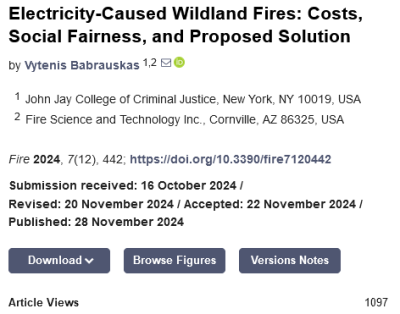
Screenshot 2024-12-30 at 10-16-00 Electricity-Caused Wildland Fires Costs Social Fairness and Proposed Solution

For those of you who follow the wildfire/inverse cases (centered in, although not exclusively, California and Hawaii), you might want to check out this article by a fire engineer: Vytenis Babrauskas (aka “Dr. Fire“), “Electricity-Caused Wildland Fires: Costs, Social Fairness, and Proposed Solution.”

As the title suggests, the article is an analysis of the situation, including the legal liability (see Section 5: “Tort Laws, Strict Liability, and Inverse Condemnation”). Dr. Babrauskas argues for abrogation of a lawsuit-based system, and replacement with a compensation scheme akin to worker’s comp.

Here’s the Abstract:

If electric power is distributed by an overhead network of cables, the ignition of wildland fires is unavoidable, although prudent management efforts can reduce the losses. The economic aspects of these fires are driven by tort litigation, which tends to create serious problems of social fairness. The present system does not contain adequate incentives

Continue Reading New Article: “Electricity-Caused Wildland Fires: Costs, Social Fairness, and Proposed Solution”

2025 San Diego

Get ready to join your colleagues and friends in San Diego for the 42d ALI-CLE Eminent Domain & Land Valuation Litigation Conference.

The 41st Conference was in New Orleans. Here’s a report of that event, and here are our reports from prior conferences in Austin and Scottsdale.

Here are some of the highlights of the upcoming Conference:

  • Property Rights at the Supreme Court: DeVillier and Sheetz and What’s Next
  • Slow Take: Possession, Rent, Relocation, and Offset
  • The Jury’s View: How Jurors See Your Case
  • From Penn Coal to Penn Central: How to Prove “Too Far”

  • Leveraging Expertise in Eminent Domain Litigation: Working with Land Planners, Engineers, and Other Predicate Experts
  • Kelo at Twenty: What Changed, What Didn’t, and What’s on the Horizon
  • Viva Las Vegas: How the Nevada Judiciary Upheld Property Rights in 180 Land’s Inverse Condemnation Taking
  • Ethics: Guiding the Trolley: Perspectives on Professional Ethics in


Continue Reading Registration For The 42d ALI-CLE Eminent Domain & Land Valuation Litigation Conference Is Underway (Don’t Miss Out!)

On the surface, the Virginia Court of Appeals’ opinion in Town of Iron Gate v. Simpson, No. 1588-23-3 (Sep. 17, 2024) deals with a straightforward issue in a straightforward way: the property owner’s inverse complaint adequately alleged that the Town’s flooding of her property was for a public use, and thus properly survived the Town’s demurrer.

As the Virginia Supreme Court has held, one of the elements of pleading a legally-adequate inverse condemnation complaint for flooding is an allegation that the flooding was for some public use. The court of appeals rejected the Town’s argument that Simpson failed to allege public use, holding that the complaint’s allegation that the Town “used her ‘property as a ‘makeshift storage site for excess stormwater,’ which was accomoplished for the public use of maintaining and operating the Town’s stormwater system[,]'” was certainly good enough:

She alleged that the Town “purposefully uses, operates

Continue Reading Va App: It Doesn’t Take Much To Allege Public Use In Inverse Condemnation

Just compensation

Just a few posts ago, we put up the Louisiana Supreme Court’s opinion in a case where property owners obtained a final inverse condemnation judgment ordering the New Orleans Sewer Board to pay just compensation.

Then…crickets. The sewer board did not satisfy the judgment. It relied on a provision in the Louisiana Constitution that says that the state and local governments don’t need to pay civil judgments except when they want to.

The Louisiana Supreme Court didn’t see it that way, and held that just compensation is “self executing” and that paying it is a ministerial duty, meaning that no statutory authorization is needed, and mandamus to compel payment is an available remedy for non-payment.

Now, the sewer board has asked the court for a do-over. In its motion for rehearing, it asserts that that earlier federal litigation is res judicata and already resolved the issue (although that

Continue Reading Govt: We Were Really Really Really About To Pay…Until You Forced Us To Pay! Sewer Board Seeks Rehearing In Self-Executing Just Comp Case

The line between negligence torts and inverse condemnation can be a fine one. In Roman Realty, LLC v. City of Morgantown, No. 220587 (June 11, 2024), the West Virginia Supreme Court came down on the tort side.

Now before we go on, a caution: technically speaking the claimant did not assert an inverse condemnation claim. Rather, after the city removed trees and altered the slope of land such that surface water increased on the owner’s land, it brought a petition for mandamus to compel the city to institute eminent domain proceedings. There are places that approach it that way.

Here’s the gravamen of the petition:

In its verified petition for writ of mandamus to compel eminent domain proceedings, Petitioner alleged that during project construction, eleven trees were removed from its property and “approximately 1,000 square feet of Petitioner’s property was excavated and used as a dump site.” Additionally

Continue Reading WVa: Tort, Not Inverse (At Least Where Municipalities Are Involved)

In Simple Avo Paradise Ranch, LLC v. So. Cal Edison Co., No. B320948 (May 23, 2024), the California Court of Appeal (Second District) held that a complaint adequately alleged a claim for inverse condemnation by asserting a privately-owned public utility’s actions substantially caused a wildfire.

The court rejected the utility’s argument that alleging that the utility knew its infrastructure was old and improperly maintained and it failed to remediate these known risks was not enough to show substantial causation, and that this negligence shows only that its actions were a concurrent (and therefore not substantial) cause of the wildfire.

The court’s analysis turned on the California Supreme Court’s Oroville decision in which the court refined the “substantial causation” requirement where a secondary concurrent cause may be enough to absolve the government from inverse liability.

A large part of the opinion is about whether a stipulated judgment is appealable (yes

Continue Reading Cal App: Inverse Complaint Alleged That Wildfire Was Substantially Caused By Inherent Risk, And That’s Good Enough

The Texas DOT had an easement over a portion of the Self property. The Selfs rebuilt a fence a few feet inboard of the easement (in other words, well into the part of the land not burdened by the easement). On the TxDOT side of the fence — but still outside the TxDOT easement area — grew some old trees.

As part of a highway maintenance project, TxDOT worked with a private contractor which it hired to remove brush and trees from the easement. The trees to be removed were supposed to be marked with an “X,” but the instructions to the contractor said to “clear everything between the fences.” Whoops.

The contractor did as instructed and “cut all trees up to the Selfs’ fence line.” TxDOT acknowledged that the trees were cut at its direction and that it has not undertaken a survey, but asserted that the trees were

Continue Reading Texas: If TxDOT Intentionally Cut Down Trees Outside Of Easement Area…You Have An Inverse Claim

Before we go on, a disclosure: this is one of ours (we filed an amicus brief in support of the property owners).

In Walton v. Newkowin Regional Sanitary Authority, No. S069004 (May 23, 2024), the Oregon Supreme Court held that the six-year state statute of limitations applicable to physical invasion inverse condemnation claims (under both the Oregon and U.S. Constitutions) begins to run at the time of the invasion, and not when subsequent events show that the invasion was adverse to the owner’s property rights. 

This case went up the appeals chain after the trial court granted the Authority’s motion for summary judgment. The background of the case is that back in the day (1995, although some of us actually remember that far back), the Authority installed two sewer lines on land belonging to the plaintiffs’ father. This was done without the owner’s permission. Slip op. at 3. 

But

Continue Reading Oregon: Statute Of Limitations On Physical Inverse Claim Runs From The Occupation, Even If It Was Permissive