IMG_20170323_143119 (Medium)

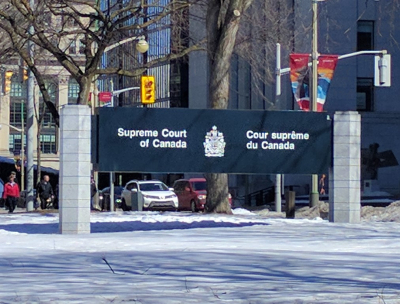
Readers know that from time-to-time, we like to cover the going’s on in the courts of our neighbors to the north. See here and here, for example. Although property rights are not a constitutional principle in Canada (the people did not include property as a fundamental constitutional right when the Constitution was amended last), there’s a lot for U.S. lawyers to learn from the way Canada law treats those from whom the government must expropriate property (either directly, or in what they call “de facto” or constructive takings (i.e., regulatory takings and inverse condemnation). In some ways, their system treats property owners slightly better than our constitutional system.

Well, here’s the latest in a case we’ve been following.

In St. John’s (City) v. Lynch, 2024 SCC 17 (May 10, 2024), the Supreme Court held that compensation in a de facto taking is calculated by excluding
Continue Reading La Cour suprême du Canada: In Constructive Takings, Compensation Calculated Without Reference To “The Scheme”

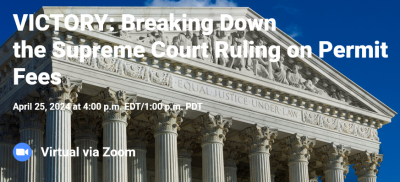
Screenshot 2024-04-24 at 10-12-17 VICTORY Breaking Down the Supreme Court Ruling on Permit Fees

Be sure to join our Pacific Legal Foundation colleagues Brian Hodges and Larry Salzman, and Paul Beard (arguing counsel) and Chance Weldon (Texas Public Policy Foundation) tomorrow, Thursday, April 25, 2024, at 4pm ET for a free webinar on Sheetz v. El Dorado County, the Supreme Court’s recent decision holding that all permit conditions are subject to the nexus and proportionality tests of Nollan and Dolan.

Here’s the description:

Pacific Legal Foundation just won its 18th Supreme Court victory! Join us for a virtual discussion to learn more about the case, Sheetz v. County of El Dorado, and how it helps secure property rights (and lower housing costs) for everyone. 

When George Sheetz wanted to build a modest manufactured home on the property he bought in El Dorado Country, California, the government told him he was going to have to pay a “traffic impact fee” of more than


Continue Reading “Breaking Down the Supreme Court Ruling on Permit Fees” (Thursday, Apr. 25, 2024, 4pm ET/1pm PT)

The winner takes it all
The loser’s standing small
Beside the victory
That’s her destiny

Note: this is the first of a short series of posts on the U.S. Supreme Court’s recent decision in Devillier v. Texas.

In Part II, we’ll cover the case, the procedural path that Texas dragged everyone through, only to abandon it at the Supreme  Court), and what the Court actually decided, if anything,

Three Common Questions for Lawyers

In the classroom, I often ask students to use their intuition to guess the three most common questions that lawyers almost always get from potential clients. Put yourself in a client’s shoes: what would you want to know?

The students mostly get it right. “What’s this going to cost?” Check. “How long will this take?” Check. And perhaps most obviously, “What are my chances of winning?

That last

Continue Reading In Devillier v. Texas, The Winner Takes It All (Part I)

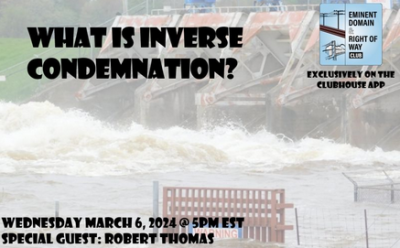
Screenshot 2024-02-27 at 16-35-17 Post Feed LinkedIn

Save the date (and time): next Wednesday, March 6, 2024, at 5:00 p.m., Eastern Time, as we rejoin our friends and colleagues Patrick McAllister and Beth Smith, as they co-host the Eminent Domain and Right of Way Club.

We’ll be joining them to try and answer that question, “What is Inverse Condemnation?” As Patrick and Beth note, “[w]e will find out what it is, how it works and when does it happen….and probably a lot more.” Sounds intriguing.

For those of you who may not have participated in one of these sessions before, you may be wondering “what is this ‘Clubhouse’ thing?” Here’s the description, straight from their site:

The Eminent Domain & Right of Way Club is on the Clubhouse Drop in audio app. This Club is geared toward right of way professionals & anyone interested in the acquisition of land rights for infrastructure projects.

In short, it

Continue Reading “What is Inverse Condemnation?” Join Us In the EDROW Clubhouse, March 6, 5pm, To Find Out (And More)

ALI-CLE brochure cover page

When it comes to the longstanding ALI-CLE American Law Institute-CLE Eminent Domain and Land Valuation Litigation Conferences, we’re always ready to go. You know that. But this year’s version — the 41st — was buzzing like no other in recent memory.

Maybe it was the New Orleans venue with its atmo, food, and music for our after-class activities, or even the timing (the second-to-last week on the Mardi Gras parade season, and our conference hotel was right on the routes). It might have been the nice weather (oh, it rained buckets one evening, but there wasn’t an ice storm like we experienced in Austin in 2023). Or maybe it was the capacity crowd, and new topics and speakers on the agenda. Or maybe it was just the prospect of seeing our friends and colleagues again after a year.

Here’s a photo essay of some of the Conference highlights.

And

Continue Reading Pass A Good Time: Our Report From The 41st ALI-CLE Eminent Domain & Land Valuation Litigation Conference, Feb 1-3, 2024, New Orleans

DSCF3357

If you dream such dreams as this photo, read on.

My law firm, Pacific Legal Foundation, is on the hunt for lawyer to join our Property Rights group (yours truly is the Director of Property Rights Litigation, so you will be working with me and the other takings and con law mavens in our practice). Here’s the full description of the spot:

You: An entrepreneurial freedom fighter with a passion for property rights litigation. You work with more senior-level attorneys to find and win cutting-edge property rights cases in trial and appellate across the country. You work as a part of a collaborative team, but are also self-motivated and able to work independently with minimal supervision. You are eager to learn, relentless, and a focused lawyer.

Them: Bureaucrats, city councils, mayors, governors, and federal agencies stripping Americans of their rights every day. There’s a lot of government overreach out there

Continue Reading Dig Property Rights? Join Our Firm As A Courtroom Property Rights Lawyer

Don’t miss out!

We promise: this is the last time we’re going to try to entice you to the upcoming ALI-CLE Eminent Domain & Land Valuation Litigation Conference in New Orleans. We are getting close to capacity, but there is still room. In recent years, we have standing room only in the Conference halls, and have sold out the hotel block. After all, this is a pretty niche area of law. So what gives?

When we were in Austin last year, we thought it might be nice to try and answer that question. We asked Conference participants why they come, year-after-year (and in Austin, despite massive travel disruptions). Yes, it is the various venues (Nashville, Austin, Scottsdale, Palm Springs, to name a few recent locations), and yes, it is the excellent and useful programming.

But as we suspected it is more than that.

Continue Reading No FOMO: There’s Still Room For You To Join Us In New Orleans Feb 1-3, 2024 For The 41st ALI-CLE Eminent Domain & Land Valuation Litigation Conference

Conf-2024-flyer
Bismarck in January is looking pretty good.

Here’s what we’re reading today:

  • Christian Britschgi, Court’s Wild Zoning Decision Blocks ‘Montana Miracle’, Reason (Jan. 2, 2024) (“In an eyebrow-raising decision, a Montana judge has halted the implementation of two laws legalizing duplexes and accessory dwelling units on residential land across the state, writing that they’d likely do ‘irreparable’ damage to residents of single-family neighborhoods.”).
  • Richard Frank, The U.S. Supreme Court & Environmental Law in 2024, LegalPlanet (Jan. 3, 2024) (“First up before the Court in 2024 is this “regulatory takings” case from California…. Over the past four decades, U.S. Supreme Court decisions have developed the so-called ‘unconstitutional conditions’ sub-doctrine of regulatory takings law, but to date have only applied it to individually-negotiated land use permit conditions and fees. California state courts–including in the Sheetz case–have consistently refused to extend the doctrine to broadly-applicable fees and conditions imposed on landowners


Continue Reading What We’re Reading Today, Property Rights Edition

Here are the cases that Michael Berger and I discussed in today’s presentation to the ABA State and Local Government Law Section’s Land Use group. It was good seeing everyone, even virtually:


Continue Reading Cases And Links From Today’s ABA State & Local Govt Law Land Use Presentation

PXL_20230223_024826759

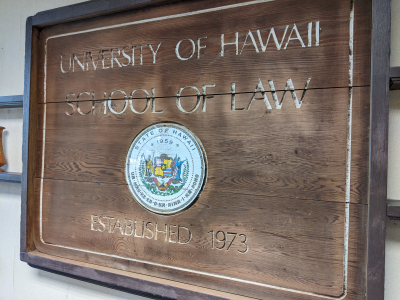
Starting in January, we’ll be helping our friend and former law partner Mark M. Murakami with the venerated and oh-so-important Land Use course (Law 580) at the University of Hawaii’s Law School.

We’re temporarily stepping into some mighty big slippers (this is Hawaii, so we don’t always wear shoes), as this is the course that our mentor Professor David Callies taught for decades. And is there a better venue in which to teach and study land use law and regulation, and its limits? After all, Hawaii may be the most heavily-regulated land on the planet, and is a focal point for every issue you can think of, from zoning to environmental restrictions to takings to public trust to subdivision to admin law to … well, you get the drift.

We’ll cover those topics, as well as the fundamentals. And we have a few surprises up our sleeves — some impressive

Continue Reading Hawaii Five-80: More Land Use (Law 580) At The University Of Hawaii