A super short one (a hair over 4 pages) from the Massachusetts Supreme Judicial Court.

In Gentili v. Town of Sturbridge, No. SJC-12810 (Feb. 24, 2020), the court made short work of a property owner’s claim that an earlier Land Court verdict concluding that the town had obtained a prescriptive easement to discharge storm water on the property was a taking requiring compensation. The Land Court concluded that the fact that the town had been discharging the water since 1987 meant that it had gained an easement to do so (think public adverse possession). Instead of appealing the Land Court’s conclusion about the prescriptive easement, the owners sued in state court for compensation. 

No deal, held the SJC. The Land Court’s order recognizing the easement wasn’t a statutory “order of taking.” Nor did the easement itself amount to a taking — even though a discharge of water on someone’s land

Continue Reading Mass: No Takings Claim For Flooding Because Owner Let It Happen For A Long Time
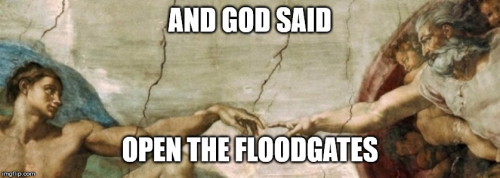
We were all set to take a deeper dive into the Court of Federal Claims’s recent opinion in the “downstream” Harvey flooding cases (we could not do so at the time the opinion was issued last week because we were tied up doing real lawyer stuff), when our Reno, Nevada colleague Steve Silva (who most recently was on the faculty at the ALI-CLE Conference in Nashville) beat us to the punch.

On his Taking Nevada blog, Steve has posted “Major flood decision in Texas turns on Divine Intervention” —

Analyzing and comparing tort to taking is difficult. A tort is generally seen as something wrongful. A private injury committed by one person against another. A classic “taking” by exercising the power of eminent domain in direct condemnation to acquire land and pay compensation is not a wrongful act. It merely is.

Further complicating things, the clearest

Continue Reading Steve Silva (Taking Nevada) On Flood Takings, Torts, And Tortes

They’re coming so fast, we can hardly keep up.

Today, in Castillo v. United States, No. 19-1158 (Feb. 20, 2020), the U.S. Court of Appeals for the Federal Circuit resolved a common issue in rails-to-trails takings cases: when a property owner holds title and her deed describes the land as bordering on a railroad line or other easement (or the property is described as a lot in a plat that shows the lot’s “property line” as adjoining a road or railroad easement), does the owner of the adjoining fee estate own the fee interest up to the “centerline” of the right of way?

Applying Florida property law, the court held yes, there is a presumption that the owner’s title goes up to the “centerline.” The court reversed the Court of Federal Claims’s conclusion that the presumption did not apply, and that deeds describing the property as a “less

Continue Reading Federal Circuit: When Road Is The Property Boundary, Owner’s Fee Goes Up To The “Centerline”

Here’s the latest in a long-running, multi-forum takings case about the development of affordable housing on the Big Island of Hawaii. 

Last we saw, the District Court awarded nominal compensation ($1), after the jury concluded that the State of Hawaii took Aina Lea’s property. The parties cross-appealed: the State argues the district court should have granted the State’s JMOL on liability, while the property owner appealed the $1 judgment. 

Today, the Ninth Circuit reversed the District Court’s ‘s opinion, holding that the district court should have ruled in the State’s favor on liability. The court remanded the case for entry of judgment in the State’s favor (meaning even the $1 just compensation judgment is gone). Bridge Aina Lea, LLC v. State of Hawaii Land Use Comm’n, No. 18-15738 (Feb. 19, 2020).

We’re tied up doing lawyer stuff today, so can’t read or analyze the decision in detail. But once

Continue Reading CA9: Remember That $1 The Court Awarded You For The Jury’s Finding Of A Regulatory Taking? We’re Taking That Away, Too

Openthefloodgates

We’re doing lawyer things this week, so can’t do much blogging, so we’re going to just leave this here, the Court of Federal Claims’s Opinion and Order in the case seeking compensation for a taking by the “downstream” owners whose lands were flooded by the U.S. Army Corps of Engineers in the aftermath of Hurricane Harvey. 

Short story: no property, no taking. 

How does the following square with the same court’s (but a different judge’s) ruling about the “upstream” owners?

Two questions must be asked. First, what property did the government take? Second, how did the government take that property? The answers to these questions go to the heart of the Constitution’s taking clause. The waters that actually caused the invasion came from the unprecedented floodwaters from Hurricane Harvey when it stalled over Houston for four days, dumping approximately thirty-five inches of water on Harris County. See Plaintiffs’ Appendix (hereinafter

Continue Reading CFC: God Forced Corps Of Engineers To Open Floodgates

It’s Friday (and Valentine’s Day), so we’ll make this quick, even thought this is one of those cases with a fact pattern that you just can’t digest quickly: In Day v. Idaho DOT, No. 45552 (Feb. 14, 2020), the Supreme Court of Idaho held that only the property owners at the time of the taking may assert an inverse condemnation claim. That, standing alone (pun intended), is not surprising.

But skip forward to page 7 of the slip opinion where the court determined when the taking occurred (at the time the government action alleged to be a taking — here, an interchange — was “substantially completed,” not on the date the infrastructure project was actually completed):

This begs the following question: When did the taking in this case occur? The district court’s opinion states that “the parties stipulated that the taking occurred on December 5, 1997, when the Isaacs Canyon

Continue Reading Idaho: Only The Owners At The Time Of The Taking Have Standing To Pursue Inverse Claim (Because It Is A “Personal Claim” & Doesn’t Run With The Land)

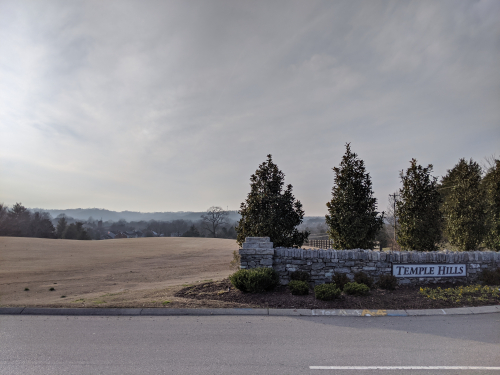
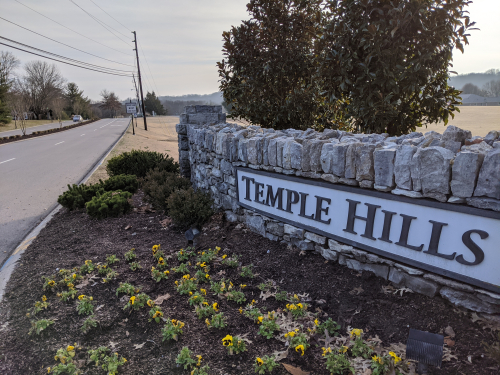
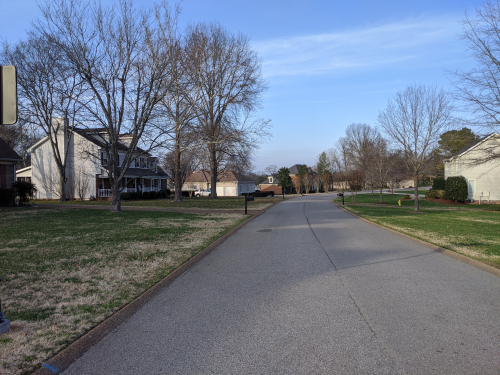
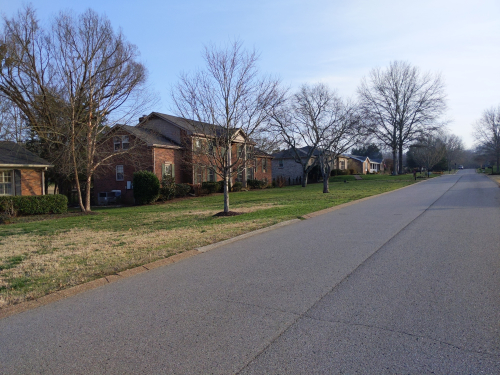
As we briefly noted in this post, before we departed the ALI-CLE Eminent Domain and Land Valuation Litigation Conference in Nashville, we just had to stop by the subdivision that was at issue in the Williamson County litigation. 

Frankly, there’s nothing especially special or noteworthy about this place, and only takings nerds will truly appreciate these pics. But given our propensity to make “takings pilgrimages” to the sites of famous property cases (see here (Claude Monet), here (Loretto), here (Chicago, B & Q RR), here (Dolan), here (Seneca Village), here (High Line), here (Hadacheck), and here (Nollan), for example), we just could not resist. 

So dig it, takings mavens. 

IMG_20200128_155300

There’s a golf course, of course. (There’s always a golf course.)

IMG_20200128_155147_1

“Temple Hills” beats “Glengarry Glen Ross”

PANO_20200128_154217.vr

A panorama of the main drag

IMG_20200128_154406

Up the street 

IMG_20200128_154302

Down the Continue Reading Williamson County, In Pictures

Profcorner.jpf

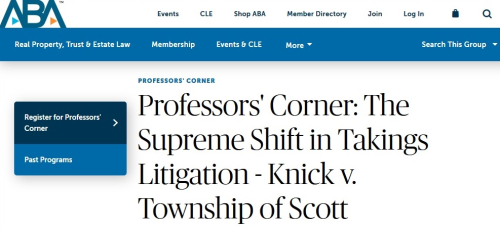
Please mark your calendars and join us next Tuesday, February 11, 2020 at 12:30pm ET for the free (for members of the ABA’s Real Property, Trust and Estate Section) webinar, the monthly “Professors’ Corner.”

This one will be on the aftermath of Knick v. Township of Scott, 139 S. Ct. 2162 (2019), in which the Supreme Court formally overruled the “state procedures” ripeness requirement in federal regulatory takings cases. 

We shall be speaking about the case and what’s next along with Professors Stewart Sterk and Michael Pollack (moderated by Professor Shelby D. Green). Here’s the summary of the webinar from the ABA website:

Last term, in Knick v. Township of Scott, the Supreme Court overruled the long-standing requirement that state takings claims first be litigated in state courts. The Court held that a property owner has an actionable takings claim when the government takes property without paying for

Continue Reading Tuesday Feb 11, 2020: Professors’ Corner – The Supreme Shift in Takings Litigation – Knick v. Township of Scott

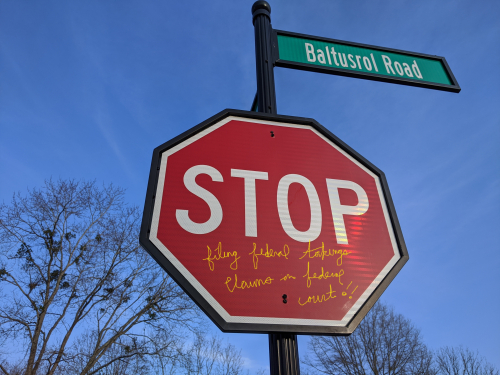
IMG_20200128_154634_1 STOP

Having just wrapped the 2020 ALI-CLE Eminent Domain and Land Valuation Litigation Conference in Nashville (very successfully, but more on that later), we could not depart the area without paying a visit to the site of the late-and-not-so-great Williamson County case, in a nearby suburb (we’ll also have more on that later, once we’re back in the office). 

Driving into the infamous — at least in takings circles — Temple Hills subdivision, we came across this STOP sign at a key intersection, with some curious graffiti. Continue Reading Saw This Sign In Williamson County, Tennessee

IMG_20200123_070935

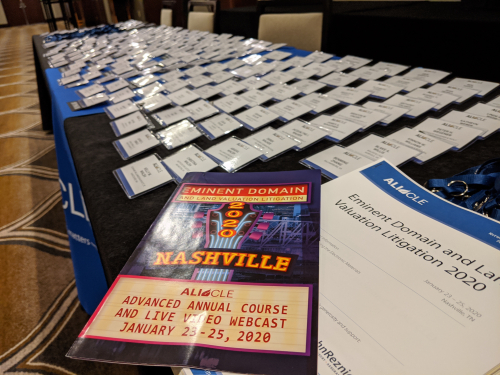
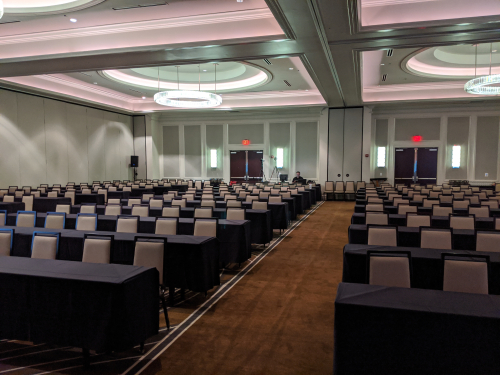
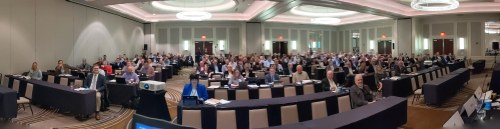
We’re in Nashville for the next three days, where we have record attendance (see above for the name-tag matrix), with nearly 300 attendees spread out over three rooms. 

IMG_20200123_070704

The Big Room, before. 

PANO_20200123_090701.vr

The Big Room, during. Like we said, record attendance. 

IMG_20200123_070830

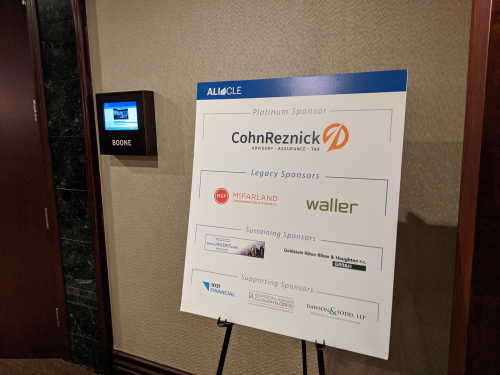
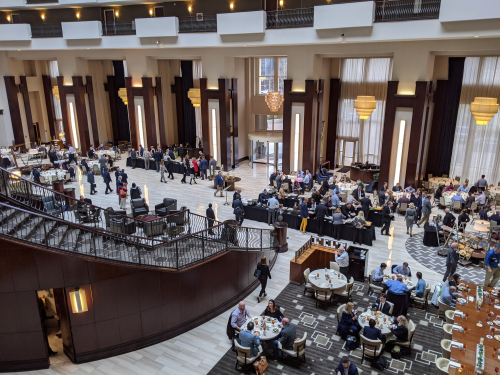
Thanks to the generosity of our sponsors, we have very good social events. Like the lunch, below.

IMG_20200123_122053

IMG_20200123_125822

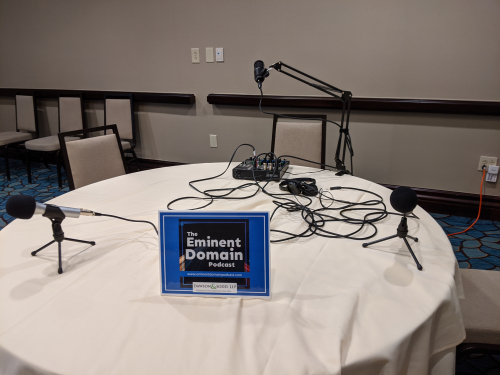
Clint Schumacher brought his Eminent Domain Podcast studio to Nashville to record future episodes.Continue Reading Greetings From The 37th Annual ALI-CLE Eminent Domain & Land Valuation Litigation Conference, Nashville