


Untitled Diagram-Page-1(1)

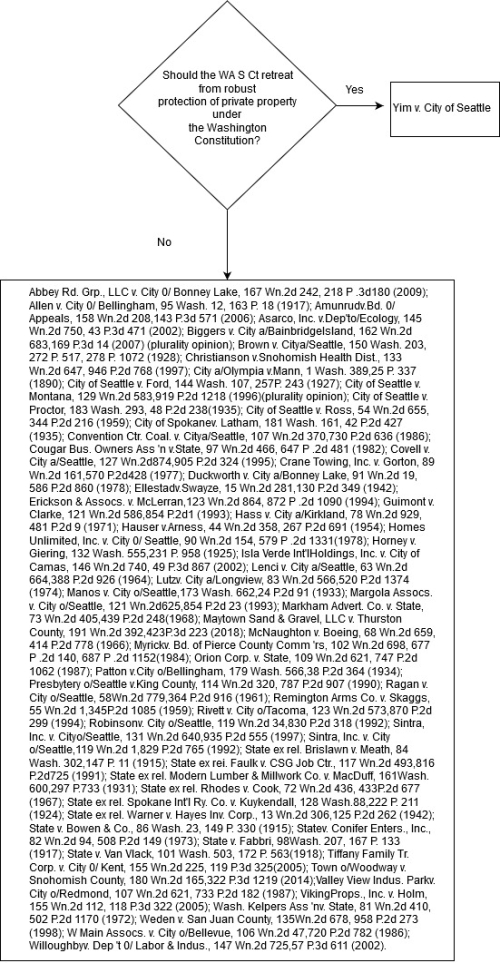
We add a flowchart to this post because the Washington Supreme Court on page 15 of its opinion in Yim v. City of Seattle, No. 95813 (Wash. Nov. 14, 2019) (em banc) (Yim I), includes a flowchart that purports to solve the regulatory takings puzzle once and for all.

Really.

You should check it out. We use “purports” because (surprise, surprise) the court gets it wrong. Flowcharts — also known as decision trees (if A, then B) — are supposed to help, not confuse. And this one doesn’t help if you are trying to figure out if a regulation effects a taking under the Fifth Amendment (and, as a result of the Yim I opinion, under the Washington Constitution). 

If that were not bad enough, in a companion opinion in the same matter (on certified questions from the federal court), Yim v. City of Seattle, No.
Continue Reading Washington (State) Supreme Court: All Those Opinions In Which We Held That Our Property Owners Have Greater Protections Under The State Constitution Were Just “Confused”

Check this out. The Complaint that we’ve been meaning to post for a while, filed last month in a Los Angeles U.S. District Court, alleging that California’s new rent control laws are a taking, among other things.

Are rent control laws takings? Yes, pretty sure about that. But will courts conclude that they are takings? If past experience is any guide, courts look for (and find) ways to conclude they are not takings, because, you know, this is one government regulatory scheme that people — here, tenants, can rely on (compared to others, where if you claim a property right in government regulation you are, in Chief Justice Roberts’ words, a “chump”).

Chump on, rent control challengers.

Complaint, Better Housing for Long Beach v. City of Long Beach, No. 2:19-CV-08861 (C.D. Cal. Oct. 15, 2019)… 

Continue Reading New Fed Ct Complaint: City’s And California’s New Rent Control Laws Are Takings

Here’s the OA video (courtesy of the Michigan Supreme Court) from last week’s arguments in what we’re calling the “keep the change” case. 

That’s the one where the government is arguing that after a property owner was late paying $8.00 in property taxes, the government is not only entitled to foreclose on the property, but to keep the difference between the sales price and the taxes and penalties owed. As our Louisiana friends might say, that’s a bit more than lagniappe

Eight bucks is more like a rounding error than a significant underpayment, but we get that you do owe every cent. And that when you don’t pay on time, they can hit you up for the taxes owed, the interest, and penalties. But as Gilbert & Sullivan wrote in their famous treatise on Remedies, “let the punishment fit the crime.” They can’t just pocket the difference

Continue Reading Oral Argument In Michigan “Keep The Change” Takings Case

Check out this story by JD Morris (“PG&E renews push to avoid strict liability for 2017, 2018 fires“) in the San Francisco Chronicle, about the recent (and ongoing) California wildfires, and the issue of what has been called the “unusual,” “unique,” and “so-called” doctrine of inverse condemnation in that state’s courts.

Recall that the theory is that when private property is damaged by a wildfire and a utility’s equipment is a substantial cause (or in the words of a recent California Supreme Court opinion, there’s a “robust nexus” between the damage and some public purpose improvement), that is a taking or damaging under the California Constitution. Like all takings and damagings resulting in the obligation to provide just compensation, traditional tort notions of fault and negligence don’t play a role. As the U.S. Supreme Court noted in Armstrong v. United States, 364 U.S. 40 (1960)

Continue Reading California Utility: To Hold Us Liable For A Taking Would Be A Taking

We think the Connecticut Supreme Court’s opinion in Mayer-Whitman v. Zoning Board of Appeals, No. SC 19972 (Nov. 5, 2019) is worth a read, even if it does not break new ground, because it does a good job of explaining some basic principles. 

Quick story: Breunich had a house. It didn’t conform to height, setback, and flood area requirements. That’s because it was build prior to the regulations were adopted. Dirt lawyers call this a “nonconforming use.” Civilians call it being “grandfathered.” Hurricane Sandy damaged the house, but the cost of repairs was more than 50% of the home’s value. And you know what that meant: Breunich could not rebuild without a variance.

He applied for a variance to rebuild the home in pretty much the same configuration it was before, asserting hardship because it would be impossible for the building to conform to both the height above-flood requirements

Continue Reading Connecticut: “Hardship” For Variances Means Inverse Condemnation

Registration underway, so come join us! Agenda full of hot topics in takings and appraisal law! The best national faculty! Renew friendships, and make new colleagues! And Nashville! 

Download the brochure and make your plans for January. (Don’t wait, we’ve sold out the past three years.)Continue Reading Register Now! ALI-CLE Eminent Domain And Land Valuation Litigation Conference (Nashville, Jan 23-25, 2020)

Here’s a two-fer that covers very difficult and unsettled subjects in takings law: judicial takings and rent control. 

In this cert petition, New York property owners assert that the New York Court of Appeals (the state’s highest court for those of you who do not watch Law & Order (dun-dun)), took private property when the court held that the petitioner’s apartments are governed by the Rent Stabilization Law.

That holding subjected luxury apartments that were never formerly governed by rent control to the tenant’s power to renew less-than-market rent in perpetuity. The petition asserts that before the Court of Appeals’ ruling, “It was settled as a matter of New York law and practice … that Section 421-g property was eligible for luxury decontrol[.]” Pet. at 35.

Here are the Questions Presented:

In Stop the Beach Renourishment, Inc. v. Florida Department of Environmental Protection, 560 U.S. 702

Continue Reading New (Judicial Takings!) Cert Petition: NY Court Took Property When It Disallowed Deregulation Of Luxury Rent Controlled Apartments

EXHIBIT A

We’re back again at that supposed distinction between the police power and the eminent domain power, which reminds us of that old tale about President Lyndon Johnson:

After reviewing a contingent of Viet Nam-bound Marines in California, Lyndon Johnson strode purposefully toward what he thought was his helicopter. “That’s your helicopter over there, sir,” said an officer, steering the President toward a different craft.

“Son,” replied Johnson evenly, “they are all my helicopters.”

Well, it’s all government power. 

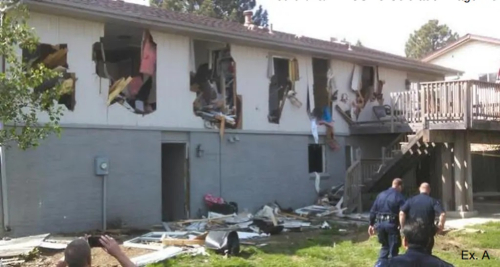
But not to the Tenth Circuit, which in this unpublished order concluded that when local SWAT teams destroyed an innocent family’s house to dislodge a fleeing suspect who had for hours holed up there and taken shots at the police, it wasn’t a taking because, guess what, the police were not exercising eminent domain power, it was the police doing what police do.

The Tenth Circuit relied on the fact that

Continue Reading CA10: SWAT Attack On Home Where Shoplifting Suspect Holed Up Isn’t A Taking

With the ongoing wildfire dramas ongoing across California, several of you have asked us to collect the posts we have done about inverse condemnation liability in one place. So here you go:

As you can see from the above video, this one isn’t over. Stay tuned.Continue Reading All Of Our Past California Wildfires And Inverse Condemnation Posts

Here’s the State of Hawaii’s response to an amicus brief we filed in a case that asks the Hawaii Supreme Court to resolve the question of what statute of limitations governs takings claims under the state constitution. We argued that constitutional claims such as these might not be subject to legislatively-imposed statutes of limitations, and that if they can then the majority rule in most state courts is that the adverse possession statute of limitations applies. 

The State argues that a takings claim is a breach of contract claim (as some states conclude), and thus a two-year statute of limitations applies. The property owner in this case argues that it is a six-year limitations period under Hawaii’s “catch-all” civil claims statute. 

So, how does your jurisdiction do it?

Defendants-Appellees’ [State of Hawaii] Response to Brief Amicus Curiae of Owners’ Counsel of America 

Continue Reading State’s Amicus Response: Two-Year Statute Of Limitations In State Law Takings Claims Because Inverse Condemnation Isn’t The Same As Eminent Domain