
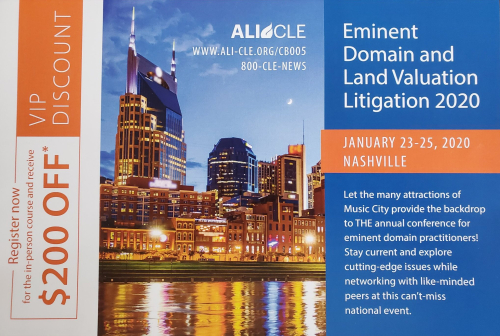
Details soon. In the meantime, get your earlier registration discount.Continue Reading Get Ready – ALI-CLE Eminent Domain And Land Valuation Litigation Conference, Nashville Jan. 23-25, 2020


Please read the Florida District Court of Appeal’s opinion in City of Fort Lauderdale v. Hinton, No. 4D18-2089 (July 24, 2019), especially the part starting on page 9 (the opinion is only 12 pages), where the court frames one of the arguments made by the appellant, Fort Lauderdale:
“The City contends that the Hintons cannot state a sufficient claim for inverse condemnation because they cannot prove a permanent physical occupation of their land that effectively deprives them of all reasonable and beneficial use and enjoyment of the property.” Slip op. at 9. Okay, we get that. The city didn’t like the trial judge’s ruling, and took an interlocutory appeal. No problem with that. Everyone is entitled to appeal.
But next, the city raised what we thought was an issue that really isn’t up for debate: “Citing Florida Fish & Wildlife Conservation Commission v. Daws, 256 So. 3d
The Land Use Committee of the ABA’s Section of State and Local Government Law is sponsoring a free (for Section members) informal webinar about the latest in takings law:
Knick Picking Regulatory Takings: Did the Court Right a Wrong, or Wrong a Right?
Friday, July 26 | 2 – 2:30pm ET
Here’s hoping you can join us for a half hour on the 5-4 SCOTUS decision in Knick v. Township of Scott (June 21, 2019). Knick overruled the 34-year-old precedent in Williamson County requiring that federal takings claimants seek compensation in state court before being allowed to proceed in federal court.
Presenters Dwight Merriam and Robert Thomas will discuss reaction to the decision — which has been as divided as the Court. Was this the conservative justices having their way? Is it a right versus left issue? Did that baby, stare decisis, get thrown out with the old ripeness bathwater?
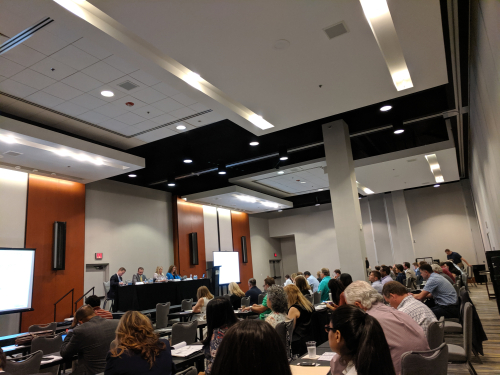
I am grateful that planning chairs Justin Hodge and Jeremy Baker invited me to their conference. A room full of experts. Here are the links to the cases and other items I spoke about:
Continue Reading Cases And Links From Today’s Eminent Domain And Pipelines Conference (Houston)
Posted without significant comment, the Court of Appeals of Washington’s recent unpublished opinion in Darland v. Snoqualmie Pass Utility District, No. 36002-4-III (July 16, 2019):
Snoqualmie Pass Utility District argues that the subsequent purchaser rule bars the Darlands’ inverse condemnation claim. We agree.
In Hoover v. Pierce County, 79 Wn. App. 427, 433, 903 P.2d 464 (1995), this court reinforced the general rule that a grantee or purchaser of land cannot sue for a taking or injury occurring prior to his acquisition of title, but rather, the subsequent purchaser may sue only for a new injury or taking. A prior owner’s right to damages for injury to property does not pass to a subsequent purchaser unless expressly conveyed. Crystal Lotus Enterprises Ltd. v. City of Shoreline, 167 Wn. App. 501, 505 n.8, 274 P.3d 1054 (2012). An exception to the doctrine exists when additional governmental action causes
Here’s what we’re reading this Friday:
No sooner was the ink dry on the Supreme Court’s opinion in Knick v. Township of Scott, than the Court’s decision started to have some effect.
First, the Court granted another pending cert case on takings ripeness and sent back down to the Ninth Circuit for more in light of Knick.
And now this order from the Seventh Circuit in a case that had been argued (listen above, or download here), but held pending Knick. Jensen v. Village of Mount Pleasant, No. 18-2187 (7th Cir. July 3, 2019).
This was a case where the federal district court had dismissed the owners’ Fifth Amendment claims as unripe under Williamson County. After argument in the Seventh Circuit, the Supreme Court granted cert in Knick, and the Seventh Circuit delayed deciding the case until the Supreme Court decided Knick.
Shortly after the Supreme Court opinion, the Seventh Circuit
Continue Reading Knick Already Taking Effect, Even Where It Isn’t Necessary
Yes, we did memes in our Knick brief, and in a follow-up blog post.
But colleague Benjamin Tozer has taken it to the next level.
We’re not worthy! Continue Reading Video: What Federal Takings are like post-Knick
If you are going to be attending the ABA Annual Meeting in San Francisco next month, here are some of the CLE and other programs of interest to property, land use, and eminent domain types, sponsored by our Section, the State and Local Govt Law Section:
Thursday, Aug. 8
In June 2019, the Supreme Court overruled its Williamson County precedent, which required that property owners, as a practical matter, must bring their Fifth Amendment takings claims against state or local governments in state courts. The Court’s new decision, in Knick v. Township of Scott, allows them to bring their inverse condemnation claims directly in federal court. Their insights into this important decision and its ramifications will be discussed by panelists who pled both sides of this case. Moderator: Steven J. Eagle, Professor Emeritus,
Continue Reading Dirt Lawyer CLE At ABA Annual Meeting (San Francisco)
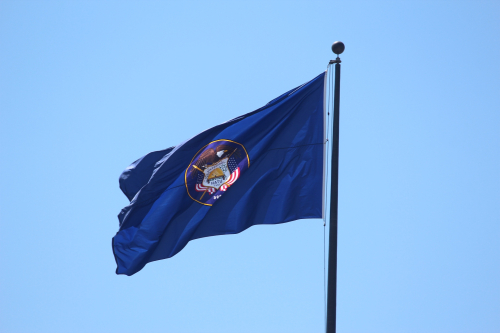
The flag of the State of Hatu
Williams, a prisoner, thought that Utah prison officials should have paid him interest on his prison account. Acting as his own attorney, he sued under § 1983 for a taking and for a deprivation of due process in federal court, raising claims against the Utah Department of Corrections, several state prison officials in their official capacities, and the bank in which his prison account was housed (and several bank employees). The federal district court dismissed, but not on the Eleventh Amendment grounds you might think.
Williams appealed to the Tenth Circuit, which, in Williams v. Utah Dep’t of Corrections, No. 18-4058 (July 8, 2019), affirmed the dismissal, expressly analyzing the claims under the Eleventh Amendment.
That provision, as you are aware, establishes a state’s immunity from lawsuits in federal court. Over the years, courts have created exceptions to the general rule that