


Here’s what we are reading this Tuesday:


Continue Reading Tuesday Takings Round-Up: Alien Takings; Zombies; Kelo, Philippines-Style; Kafka
The California Supreme Court’s relatively short unanimous opinion yesterday in City of Oroville v. Superior Court, No. S243247 (Aug. 15, 2019) may have a bigger impact outside of that case than within in.

While that is undoubtedly true in many decisions by a precedential court of last resort, we highlight that here because inverse condemnation is a trending topic in California right now due to the multiple litigations spawned by a series of wildfires, and the City of Oroville case is all about the details of California’s somewhat unique inverse condemnation doctrine.  

Short story is that a dentist’s office flooded with you-know-what when the municipal sewer backed up. Dentists said the City didn’t maintain the sewer (sewer systems are supposed to take crap away in a one-way direction, not return it into habitable spaces). The City for its part argued that if the dentists had only installed the

Continue Reading Cal Supreme Court: Stop Saying Inverse Condemnation Is “Strict Liability”

20180823_102346_HDR

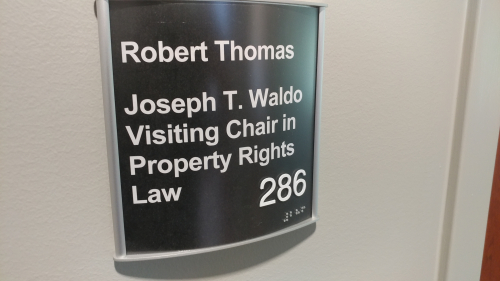
We’re about to get underway with the fall semester at William and Mary Law School, where we’re again teaching an upper-division course, Eminent Domain and Property Rights

We’ve more than doubled the size of last year’s enrollment, so it looks like the word is getting out. We cover not only eminent domain and just compensation, but takings (yes, we have a lot of new materials to cover there), civil forfeiture, a small bit of crossover with land use, local government, and related, property rights as civil rights, how property law is discussed in the public sphere, due process, and how to lawyer up these cases. And in early October, the opportunity to have some of the nation’s best property law scholars “guest lecture” during the Brigham-Kanner Property Rights Conference. Here’s the official description:

Property rights and the sovereign’s power of eminent domain have been essential components of

Continue Reading Law 608: Eminent Domain And Property Rights – Season 2

Mark your calendars for Thursday, August 22, 2019, 2 – 3pm ET, for a free ABA program, “When the Floods and Fires Come: Landowner’s Property Damage Claims.” This session, produced by the Section of Litigation and organized by our Damon Key colleague Mark Murakami. Featured speakers are our colleagues Anthony Della Pelle (NJ), Kristen Renfro (CA), and Pepperdine lawprof Shelley Saxer (CA).

Here’s the description:

In the wake of the Superstorm Sandy, the 2017 hurricanes, and the California wildfires, landowners damaged by the disasters are faced with a confusing array of potential recovery options. This program is designed to assist small and general practice attorneys whose clients are harmed by these disasters. Anthony Della Pelle, Esq. of New Jersey and Kristen Renfro, Esq. of California will discuss the practitioner’s views and Professor Shelley Saxer of Pepperdine Law School will discuss the legal theories relating to governmental

Continue Reading Upcoming Free Program: “When the Floods and Fires Come: Landowner’s Property Damage Claims”

Here is the motion asking the Hawaii Supreme Court for leave to file an amicus curiae brief (and the proposed brief) we filed earlier today in a case we’ve been following

The question is the applicable statute of limitations for regulatory takings claims under the Hawaii Constitution’s “takings or damagings” clause. The case started out in a Hawaii state court, was removed to the U.S. District Court by the State Land Use Commission. The district court dismissed the state takings claim under the statute of limitations. 

Hawaii has not adopted a statute of limitations expressly for takings or inverse condemnation claims. Thus, the question is what is the closest analogue claim. If there isn’t one, Hawaii has a “catch all” statute (six years) for civil claims. When the case reached the Ninth Circuit, that court certified the state law question limitations to the Hawaii Supreme Court. 

Our brief argues the

Continue Reading Amicus Brief: State Takings Claims Are Constitutional (Not Torts); Adverse Possession Statute Of Limitations Is Nearest Analogue

Synchronicity (Jung, not The Police). Serendipity. Lattice of coincidence. Whatever you call it, sometimes things seem to come in waves. 

So it seems with the statue of limitations for inverse and regulatory takings claims this week. We had not dealt with the issue for a while. Radio silence. Then boom! The issue crops up repeatedly and we can’t seem to avoid it. First, in a brief we’re drafting in a pending case in the Hawaii Supreme Court. Then in a Federal Circuit opinion yesterday. And also yesterday in an opinion from the Maryland Court of Special Appeals, Harford County v. Maryland Reclamation Associates, Inc., No. 12-C-13-000509 (Aug. 1, 2019). 

MRA bought land way back in 1990 (statute of limitations cases often have a long history, no?) to operate a rubble landfill. But after the purchase, the County changed its regs to prohibit

Continue Reading Lattice Of Coincidence: Regulatory Takings Claim Accrues When Regulator Makes Final Decision (Williamson County Lives!), Not When Appeals Are Exhausted

Recently, we requested crowdsourcing of this year’s “come to the ALI-CLE Eminent Domain Conference video.” Instead of doing the video ourselves, we asked folks to “please send a short clip of you and/or your colleagues telling us why you think the Eminent Domain and Land Valuation Litigation Conference is the place to be in January. Humor welcome, but not required.”

Our friend and colleague, St. Louis’ Paul Henry, has answered the call, admirably. Paul, as you may remember, is famous for his presentation a couple of years ago at the Conference about “Everything About Eminent Domain I Need To Know I Learned From Star Trek.” Which he gave in a Starfleet captain’s uniform. Brave man. Readers know that we dig Star Trek. But we are not that brave, so bravo, Paul.  

See if you don’t agree that Paul has now raised the video bar. 

Continue Reading Capt Henry Orders You To Boldly Go To The 2020 ALI-CLE Eminent Domain And Land Valuation Litigation Conference, Nashville, Jan. 23-25, 2020

Leave it to Federal Circuit Judge Timothy Dyk — who, as far as we can tell, has never once ruled against the government in a takings case — to conclude that the U.S. Supreme Court’s recent opinion in Knick v. Township of Scott, 139 S. Ct. 2162 (2019) actually works to the detriment of property owners when it comes to the statute of limitations applicable to regulatory takings claims. 

In Campbell v. United States, No. 18-2014 (Aug. 1, 2019), the plaintiffs alleged that it was a taking when their product liability tort claims against General Motors were extinguished by GM’s bankruptcy. The CFC held that the claims were barred by the six-year statute of limitations, and the Federal Circuit agreed. 

Here’s the specifics of the plaintiffs’ claim:

Relying on A & D [Auto Sales, Inc. v. United States, 748 F.3d 1142 (Fed. Cir. 2014)], on July

Continue Reading Fed Cir: File Your Regulatory Takings Claims Early (And Often?). The Statute Of Limitations Starts Running Before The Impacts Of The Regulation Are Felt

Usually, when we’re scanning the daily email from the Federal Circuit for takings decisions of interest, we look for “United States” as the defendant, and our eyes glaze over the other cases on the court’s docket such as patent matters. But today, we were rewarded: a takings issue in a patent matter.

In Celgene Corp. v. Peter, No. 18-1167 (July 30, 2019), the court concluded that the invalidation of an issued patent via inter partes review was not a taking. This issue was ripened by the U.S. Supreme Court’s recent decision in Oil States, which noted that patents may be “property for purposes of the Due Process Clause or the Takings Clause.” 

Celgene obtained patents for “a system to safely distribute thalidomide to patients.” Slip op. at 4. The Coalition for Affordable Drugs objected, and sought inter partes review, which according to the USPTO is, “a trial proceeding

Continue Reading Fed Cir: Inter Partes Reexamination Of Patents Isn’t A Taking