A lot is being written about Friday’s Supreme Court opinions in Knick v. Township of Scott, No. 17-647 (U.S. June 21, 2019) (including us). Here’s a sampling. 


Continue Reading Knick Round-Up

Kungfu

We’ll be doing a longer post with our thoughts on the U.S. Supreme Court’s landmark ruling in Knick v. Township of Scott, No. 17-647 (June 21, 2019). But here’s the big picture.

It appears that at least five Justices finally seem to understand what we in the property bar have been saying for decades – that the essence of a federal “takings” claim against a local or municipal government is that “by regulation, you have deprived my property of ‘productive use’ [as Chief Justice Roberts noted on page 14 of the slip opinion], and you have not compensated me.” So it is enough that the government hasn’t paid me, and I have no obligation to “ripen” my federal claim by chasing down the local government for compensation in state court.

So nearly 100 years after Justice Holmes famously opined for the Court in Pennsylvania Coal Co. v. Mahon,

Continue Reading Williamson County Overruled: After Nearly A Century, Supreme Court Finally Has Figured Out What A Regulatory Takings Claim Looks Like

One does knick meme

Property lawyers, dust off your Federal Rules of Civil Procedure, and federal judges your long vacay from dealing with regulatory takings and inverse condemnation cases is over, because this just in: by a 5-4 margin (Chief Justice Roberts authored the majority opinion, with Justice Kagan writing the dissent), the U.S. Supreme Court today finally (finally!) overruled the state-litigation prong of the Williamson County ripeness doctrine. Knick v. Township of Scott, No. 17-647 (June 21, 2019).

Yes, overruled. Not trimmed around the edges. Overruled. 

Here’s what our quick skim turns up as a critical passage:

The Court in Williamson County relied on statements in our prior opinions that the Clause “does not provide or require that compensation shall be actually paid in advance of the occupancy of the land to be taken. But the owner is entitled to reasonable, certain and adequate provision for obtaining compensation” after a taking.

Continue Reading “The state-litigation requirement of Williamson County is overruled.”

The recent opinion of the Texas Court of Appeals (First District) in University of Houston v. Jim Olive Photography, No. 01-18-00534 (June 11, 2019) addressed a fascinating (and still unsolved) question: does intellectual property qualify as “property” for purposes of the takings clause? 

The court held “no,” but that answer isn’t definitive.  

The facts of the case are pretty simple: Jim Olive took a photograph which — shame on them — the University used on its website without compensating Mr. Olive. He sued the University in a Texas state court for taking his intellectual property, seeking compensation. 

If your first instinct was to say this looks like copyright infringement, you’d be right. Problem is, copyright claims are brought in federal court. But state cannot be sued for damages there. And copyright claims are “tort-y” which means that if a copyright holder sues the state government for damages in state

Continue Reading Public University’s Rip-Off Of Photograph Is Copyright Infringement, Not A Taking

A must-read for takings mavens. Property rights gurus Professor Gideon Kanner and Michael Berger have published a new article, The Nasty, Brutish, and Short Life of Agins v. Tiburon, 50 Urb. Lawyer 1 (2019). It’s the lead article in the latest volume of The Urban Lawyer, the law journal of our Section of the ABA, the Section of State and Local Government Law.

Barista’s note: since TUL ended its long-time editorial relationship with UMKC Law School last year, the journal has been published in-house, and we’ve taken on the role of Editor-in-Chief, in-between our lawyering and teaching day jobs. We recognize the efforts of our ABA editor, as well as our team of volunteer Associate Editors (our fellow lawyers who took on the responsibility of tech editing the pieces) in producing the journal. 

Kanner and Berger have written an informative (and entertaining) tour-de-force of modern regulatory takings law.

Continue Reading New Must-Read Article: Kanner & Berger, “The Nasty, Brutish, and Short Life of Agins v. City of Tiburon”

Our friend and colleague Dwight Merriam recently published this piece about the looming Knick v. Township of Scott decision. Yes, ripeness, and how SCOTUS will treat regulatory takings. We posted our own prognostications here (“Shaka, When The Walls Fell: Yes, Knick Will Be About Takings, But It Will Be More About Federalism“).

Awaiting ‘Knick” … Will SCOTUS Fix the Ripeness Mess?

by Dwight Merraim

The decision in an important takings case, Knick v. Township of Scott, Pennsylvania, reargued Jan. 16, is soon to be released. Be watching for it, because it could have a major impact on how governments regulate land use, and on the willingness of private property owners to challenge government regulation that overreaches. As an added bonus, we will get to see where Justice Brett Kavanaugh may position himself on property rights issues.

The issue is one of “ripeness;” specifically, whether the court should

Continue Reading Merriam: “Awaiting ‘Knick’…Will SCOTUS Fix the Ripeness Mess?”

0606191053_HDR

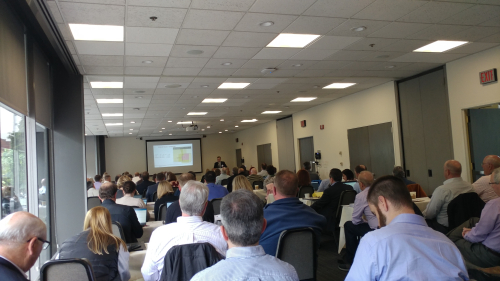
Here are the links to the cases which were not in your materials. Theme of the day: amateurs! 

Our thanks to colleagues Jill Gelineau and Paul Sundermier for asking us to present. It was good to see our Oregon friends again. 


Continue Reading Links From Today’s Portland Eminent Domain Conference

In Berry v. City of Chicago, No. 1-18-0871 (May 22, 2019), a divided Illinois court of appeals reversed the dismissal of an inverse condemnation claim, holding that even though the potential damage was widespread, the plaintiffs might be able to show that they incurred damage beyond those incurred by the general public.

The case should be interesting to both inverse and straight takings mavens because the court split on how the “public in general” is defined: does it mean, as the majority essentially concluded, everyone served by the alleged condemnor, or (as the dissenting justice concluded) just those who were subject to the action which is claimed to be a taking (or, in eminent domain terms, the project)?

The complaint alleged: 

[T]he City embarked on a project to replace water mains and water meters throughout Chicago. In replacing the water mains and meters, however, plaintiffs allege that the City

Continue Reading How Is “The Public” Defined When It Comes To Special Damages?

Inverse_excerpt

There’s a lot to digest in the draft workgroup reports of the California Commission on Catastrophic Wildfire Cost and Recovery, which were released yesterday.

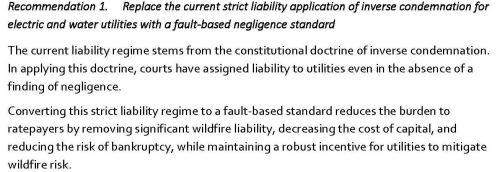
But the bottom line stands out: California’s version of inverse condemnation liability — which holds a private utility liable for just compensation and damages if its activity was a cause of the damage or loss caused by a wildfire — has got to go. Or at least be so substantially modified as to lose its salient feature, liability even in the absence of the utility’s negligence, as the excerpt of the draft executive summary above details.

The draft Utility Liability Workgroup Report goes into it a bit more: 

Finding 3. The current application of inverse condemnation imperils the viability of the state’s utilities, customers’ access to affordable energy and clean water, and the state’s climate and clean energy goals and does not equitably socialize the

Continue Reading (Draft) California Wildfire Commission Report: Inverse Condemnation Has Got To Go

With the opinion in the Knick v. Township of Scott case to drop as soon as Tuesday (we’re guessing the opinion will be by Chief Justice Roberts, by the way), hold on: we’re about to get super nerdy here. Impossibly nerdy. Yes, we’re revisiting the Star Trek analogies. We’ve been down this road before, even going so far as to have a colleague (who is perhaps even further down the rabbit hole than we are) present a takings CLE in his Starfleet uniform

The bottom line is this (and if you are not into Trek, you can stop right here): to us the key question which the Court is grappling with is whether a state’s judiciary is part of the state’s compensation system. If the majority of the justices conclude that it is, then don’t expect an out-and-out overruling of Williamson County, only a modest trim

Continue Reading Shaka, When The Walls Fell: Yes, Knick Will Be About Takings, But It Will Be More About Federalism