


The Arizona Court of Appeals’ opinion in Arizona Electrical Power Cooperative v. DJL 2007 LLC, No. 1 CA-CV 16-0097 (May 9, 2019), is about the date of valuation in eminent domain, but beyond that is interesting to us because it sheds light on a case we’ve been following about natural gas pipelines and the use of the federal courts’ injunction power to effect immediate possession

In the Arizona case, the owner purchased land from the BLM subject to the private electric company’s 30-year easement on which it had installed high-voltage transmission lines. The grant of easement expired in 2011, but the electric company did not remove the lines. In 2014, it instituted an eminent domain action to condemn the easement. 

The trial court rejected the utility’s request for immediate possession. Instead, it granted a preliminary injunction allowing the utility to continue to operate and maintain the transmission lines.

Continue Reading AZ App: Private Utility Does Not Effect A Taking “until after trial and payment”
Remember that Christopher Nolan movie from a few years ago, “Inception,” with its dream-within-a-dream storyline?

Well, that’s what a recently-filed cert petition which asks the U.S. Supreme Court to jump into California’s inverse-condemnation-liability-for-wildfires issue reminds us of with its taking-within-a-taking argument, as detailed in the Question Presented:

Whether it is an uncompensated taking for public use in violation of the Fifth and Fourteenth Amendments for a State to impose strict liability for inverse condemnation on a privately owned utility without ensuring that the cost of that liability is spread to the benefitted ratepayers.

Let’s see if we are keeping the argument straight: it’s a taking to hold a private entity which possesses the delegated power of eminent domain liable for a taking for burning down private property unless the utility is also entitled to pass the cost of any taking judgment on to those who benefit from

Continue Reading New Cert Petition: Fifth Amendment Requires California To Spread The Cost Of Wildfire Inverse Condemnations To Ratepayers

The title of this post may have you wondering, especially the part about how a regulation that invites others to physically enter private property, is determined by a court to not be a physical taking. (The court also hints at looking at a physical taking under Penn Central, and not by applying per se rules.) 

At issue in the Ninth Circuit’s 2-1 opinion in Cedar Point Nursery v. Shiroma, No. 16-16321 (May 8, 2019) was a regulation adopted by California’s Agricultural Labor Relations Board which requires agricultural employees to open their land to labor union organizers. The regulation is framed as protecting the rights of ag employees to “access by union organizers to the premises of an agricultural employer for the purpose of meeting and talking with employees and soliciting their support.”

The regulation, as the Ninth Circuit majority pointed out, “is not unlimited,” and regulates the “time

Continue Reading PruneYard Undone: California’s Union Easement – Which Invites Labor Organizers To Enter Private Property – Isn’t A Physical Taking

Here’s what’s on the reading list for today:


Continue Reading Tuesday Takings And Property Round-Up

The city conceded that its street and storm water project resulted in a neighboring commercial property flooding three times, and that “the evidence supported a prima facie case of a ‘partial taking’ of Lenertz’s property.” So far, so good. 

But Lenertz had alleged the city’s project caused past and future flooding, and resulted in a total take. “Near the conclusion of Lenertz’s case in chief, but before receiving testimony from appraiser Daniel Boris, his expert on damages, the court found the evidence established only a partial taking of Lenertz’s property.” Because the appraiser was going to testify about the “full measure of damages to the property,” and not the before-and-after value, the court concluded that the jury could not consider the appraiser’s testimony, and entered judgment in favor of the city.  

In Lenertz v. City of Minot, No. 20180153 (Apr. 3, 2019), the North Dakota Supreme Court agreed. It

Continue Reading Flooding Was A Taking. But What Kind Of Taking?

Thanks to Professor Michael Wara’s Twitter feed, here is what might possibly be the first and only example of a comic strip devoted to inverse condemnation.

Yes, it is on an advocacy site (the International Brotherhood of Electrical Workers Local 1245), and it doesn’t really go into the details of the doctrine, but come on, what did you expect? Just sit back and enjoy.

Continue Reading California Inverse Condemnation And Wildfires: The Comic

0412191003c_HDR

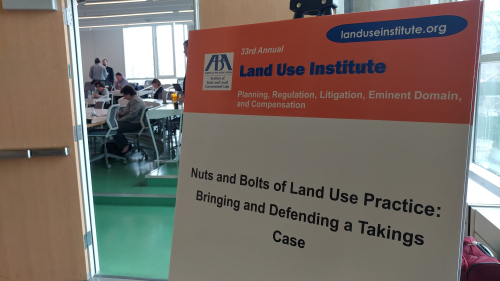
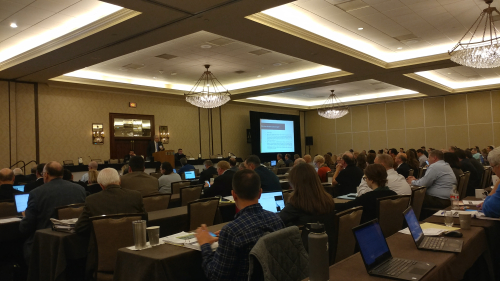
Here are the links from today’s two sessions (the first, federal water issues impacting local land use; the second, Bringing and Defending a Takings Case):

The morning started off with a talk by former Detroit Mayor (and Michigan Supreme Court justice) Dennis Archer, about Poletown, eminent domain, and economic

Continue Reading Links And Materials From Today’s Land Use Institute Sessions, Baltimore

Pretty simple facts in the North Dakota Supreme Court’s opinion in Lincoln Land Development, LLC v. City of Lincoln, No. 20180117 (Mar. 15, 2019): back in the day (the 1980’s) the City had a dirt road over private property, used to access its sewage treatment plant. Lincoln Land Development bought the property in 2005. Recently, the City graded and paved the road, raised the road bed, and added things like culverts.  

Inverse condemnation? 

The City denied liability, arguing that Lincoln Development didn’t have the right to exclude the City because the City owned an easement — either by express grant, or by implication or estoppel — and thus Lincoln Development didn’t possess property that the City had taken. 

The most interesting part of the North Dakota Supreme Court’s opinion, in our opinion, starts on page 5, where the court discusses the easement by prescription claim (after having agreed with

Continue Reading ND Supreme Court Rejects City’s Claim That “We Already Own The Property By Prescriptive Easement So Are Not Liable For A Taking”

0401191044b_HDR

Great crowd today in Austin for CLE International’s Eminent Domain seminar, co-chaired by our colleagues Chris Clough, Sejin Brooks, and Christopher Oddo. We spoke about “National Trends and Developing Issues in Eminent Domain.” 

Here are the cases I referred to which are not included in your written materials:


Continue Reading Materials And Links From Today’s Austin Eminent Domain CLE

Here’s the amici brief we signed onto for Owners’ Counsel of America, filed last week in a regulatory takings case we’ve been following.

This brief, one of several filed which urge the Court to review the Federal Circuit’s conclusion there was no taking (despite a Court of Federal Claims verdict that there was), argues that categorical rules are not useful in regulatory takings cases for the most part, and economic realities often mean that a property owner can suffer a taking even if it has not yet realized a positive cash flow from its investment in the property:

But the Federal Circuit has now pronounced a categorical rule—one that arbitrarily insulates government from takings liability no matter how strongly the Penn Central factors might otherwise militate in favor of a takings claimant. Love Terminal Partners, L.P. v. United States, 889 F.3d 1331, 1344 (Fed. Cir. 2018). What

Continue Reading New Amici Brief: Investment, Not Profit, Is What The Takings Clause Recognizes