We’re posting this Complaint, not because it raises any new or novel issue, but because one of the plaintiff/property owners is San Francisco 49ers legend Joe Montana, who is suing San Francisco, alleging that the city’s maintenance of its stormwater/wastewater system (yes, the systems are one and the same) caused sewage to flood their Marina district homes.

Read the story here from SF Gate (“49ers legend Joe Montana sues San Francisco alleging ‘toxic fecal’ matter in home“).

We’re going to dust off the California Supreme Court’s latest ruling on inverse condemnation liability for flooding, since we haven’t looked at the doctrine in-depth in a while.

Complaint for Damages, Declaratory and Injunctive Relief, Armstrong v. City and County of San Francisco, No…

Continue Reading Asserting His Property Right To Exclude “toxic fecal matter,” Joe Montana Sues San Francisco For Inverse Condemnation

Screenshot 2023-08-26 at 10-33-05 Brigham-Kanner Property Rights Conference

Heads-up: the registration page for the 20th Brigham-Kanner Property Rights Conference, October 26-27, 2023, at the William and Mary Law School in Williamsburg, Virginia, is now up.

Early registration is a good thing because space is limited, especially at the Wren Building banquet on the 26th, at which the 2023 B-K Property Rights Prize will be presented to Prof. Gregory Alexander.

So please don’t miss out.

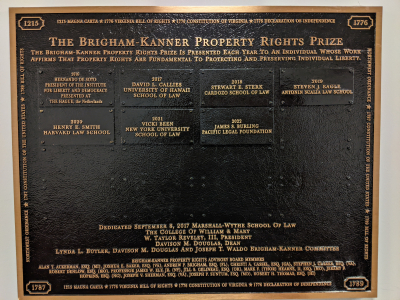
2022 BK plaque
The Property Rights Hall of Fame (second plaque)

If you are not already familiar with the Conference, it is (in our opinion) the best one-day event on property and property rights theory and practice. Expressly designed to bring together the legal academy and the practicing dirt law bar, the conference is where we discuss the burning property and property rights issues of the day. Here’s the 2023 Program:

  • Property and Propriety (or a Well-Ordered Society): A Tribute to Gregory S.


Continue Reading Register Now For The 20th Brigham-Kanner Property Rights Conference, Oct. 26-27, 2023

Here’s our colleague and friend, Pepperdine lawprof Shelley Saxer, an expert on inverse condemnation and its use in mass disaster cases, on the use of inverse condemnation as a theory of recovery for the Maui disaster. Here’s the description from Bloomberg Law Podcast:

“Shelley Ross Saxer, a law professor at Pepperdine University, discusses the Lahaina fire victims using a legal shortcut to secure compensation from Hawaiian Electric. June Grasso hosts.”

Worth a listen.Continue Reading Lawprof Shelley Ross Saxer Joins Bloomberg Law Podcast On Maui Wildfires And Inverse Condemnation

On this morning’s drive-time program, we joined KHVH’s Rick Hamada about whether Hawaii might adopt California’s version of inverse condemnation liability in wildfire cases. We also tried to clear up a few misconceptions (gad, I used “disinformation,” a term I try to eschew).

Here’s the program description:

Inverse Condemnation and Maui Wildfires: A Conversation with Robert Thomas

Tune in to a thought-provoking episode where we engage in a conversation with legal expert Robert Thomas on the topic of inverse condemnation in relation to the recent Maui wildfires. As the community grapples with the aftermath of the devastating fires, we delve into the legal aspects of property rights, government accountability, and compensation for affected individuals. Join us as we explore the implications of inverse condemnation, a legal doctrine that holds governments accountable for taking private property without just compensation. Gain insights into the challenges faced by property owners in the wake

Continue Reading Our Drive-Time Conversation About Hawaii Inverse Condemnation And Wildfires

Untitled Extract Pages

Two years ago, Owners’ Counsel of America endowed a scholarship in the name of its founder, property rights advocate and trial lawyer Toby Prince Brigham (1934-2021). The scholarship is for a second- or third- year law student to attend the annual three-day ALI-CLE Eminent Domain and Land Valuation Litigation Conference (the upcoming Conference will be in New Orleans, Louisiana, February 1-3, 2024).

The Conference affords the Scholar an all-expenses-covered opportunity to meet and network with leading property rights and eminent domain lawyers from across the country, while also learning about property law and practice. 

Here’s the official description from OCA:  

In honor of Toby’s legacy of professionalism and achievement, in 2021 OCA established the Toby Prince Brigham OCA Scholarship to pay for all expenses of a second or third year law student to attend the ALI-CLE Eminent Domain conference and associated OCA events held annually in January. This unique

Continue Reading Owners’ Counsel Toby Prince Brigham Scholarship – Applications Being Accepted

Well, that was quick. As reported here (“HECO Kept The Power Flowing In Lahaina Even As Poles Toppled“), we’ve already seen the first lawsuit filed seeking recovery for the Maui wildfire that destroyed Lahaina town — a class action even before there’s been any official word about what caused or contributed to the conflagration:

Meanwhile, a group of Honolulu- and California-based law firms filed a class action suit Saturday against HECO on behalf of victims and survivors of the Lahaina fire.

The suit alleges that HECO’s downed power lines caused the fire. Graham Lippsmith of the firm Lippsmith LLP said Saturday that the suit was also largely based on HECO’s decision not to de-energize the power Tuesday in West Maui.

A separate Honolulu attorney also said Saturday that his firm is weighing whether sue HECO on behalf of its clients, also largely based on the downed poles.

They

Continue Reading First Lawsuit Filed (Incl. Inverse Condemnation) For Maui Wildfire: Is California-Style Inverse Condemnation Coming?

Here’s the latest in a case we’ve been following.

In Ideker Farms, Inc. v. United States, No. 21-1949 (June 16, 2023), the U.S. Court of Appeals for the Federal Circuit held that temporary, but recurring government-caused flooding was correctly treated by the Court of Federal Claims as a categorical per se taking, and not under Arkansas Game & Fish‘s Penn-Central-plus multifactor test. The court also held that the property owners are entitled to just compensation for their lost crops.

The opinion is pretty dense (39 single-spaced pages) so we’re not going to provide a blow-by-blow account of the arguments and the court’s reasoning. But we will hit some of the highlights:

  • The Missouri River floods annually. In the 1990s, the Corps of Engineer and Fish and Wildlife Service “began discussions concerning proposed changes to the River designed to mitigate the environmental impact” of the federal flood


Continue Reading CAFED: Temporary But Recurring Flooding Is A Categorical Taking, Not Penn-Central-Plus

Screenshot 2023-06-16 at 07-52-47 How Did Property Rights Fare at the Supreme Court What Happened in the 2022 Term and What's Next ALI CLE

On Wednesday, August 9, 2023 at 1:00 – 2:00 p.m. (Eastern Time), please join us for ALI-CLE’s web program, “How Did Property Rights Fare at the Supreme Court? What Happened in the 2022 Term and What’s Next.”

Here’s the course description:

This has been a blockbuster U.S. Supreme Court term for property law, with the Court deciding three major property cases: Tyler v. Hennepin County (government’s keeping the excess value when seizing and selling a home to satisfy a property tax debt is a taking), Wilkins v. United States (is the federal Quiet Title Act’s statute of limitations a jurisdictional bar?), and Sackett v. EPA (the scope of Clean Water Act wetlands jurisdiction). To gain a better understanding these opinions, the current state of takings and property law, and what these cases mean for your practice, join a distinguished panel of experts for this one-hour webcast. The faculty will

Continue Reading Join Us August 9, 2023: ALI-CLE’s “How Did Property Rights Fare at the Supreme Court? What Happened in the 2022 Term and What’s Next”

Check out this now-under-consideration Petition for Review, which asks the California Supreme Court to take up a case involving Murderers Creek, in Pleasant Hill, California. (Now there’s a jarring juxtaposition for you.)

The case started off as a “routine inverse condemnation case.” Pet. at 2. When Murderers Creek flooded, it damaged the plaintiffs’ land. The County, the plaintiffs allege, didn’t maintain a 40-year old concrete spillway which is part of a drainage system the County required a private developer to install in the 1970s as a condition of subdivision. The County never actually took over the drainage system, but it did accept the dedication “for recording only.”

The plaintiffs said this should have been enough to establish a claim for inverse against the County: it has been a longstanding rule in California that drainage infrastructure that diverts surface waters onto private property triggers inverse liability even if privately

Continue Reading California Supreme Court Reviewing The Murderer’s Creek Inverse Case

Here are what others are saying about Supreme Court’s recent ruling in Tyler v. Hennepin County, No. 22-166 (U.S. May 25, 2023), the case in which the Court unanimously held that the county’s keeping the excess equity in Ms. Tyler’s home over what she owed in property taxes and fees is an uncompensated taking of private property.

  • As usual, lawprof Ilya Somin was first out of the gate with “Major Unanimous Supreme Court Victory for Property Rights in Tyler v. Hennepin County” (“While the Supreme Court decision left some notable issues unresolved, it nonetheless sets a significant precedent. Most obviously, the jurisdictions that currently authorize home equity theft—some twelve states and the District of Columbia—will no longer be allowed to do so. In addition, the holding that states cannot just redefine property rights at will has important implications for other property rights issues. It makes it harder


Continue Reading Tyler Takings Round-Up