We’ve been eagerly waiting for the new season of the Institute for Justice’s podcast series, “Bound by Oath” to drop. Not only because it’s a great series – produced by John Ross, it is more like an audio documentary than a typical podcast – but also because John was kind enough to ask us to participate again (our last appearance was in Season 1, where we guested on the episode about the origins of the “incorporation” doctrine).

This season is all about property rights, and episode 2 is all about regulatory takings. Pennsylvania Coal Co. v. Mahon, and Penn Central Transp. Co. v. New York City, to be exact.

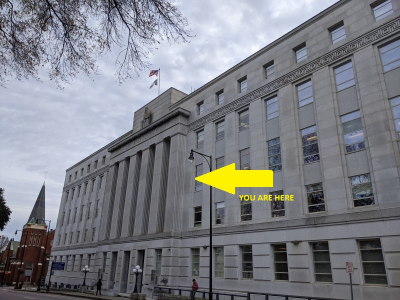
So just over a year ago, John and I headed up to anthracite coal country in Pennsylvania. We wanted to be on site on the exact 100th anniversary of the Supreme Court issuing the Mahon
Continue Reading “Groping in a Fog” – Bound by Oath Podcast, S3 E2: Regulatory Takings – Penn Coal And Penn Central … Unplugged!
You might not think that the principle of law the Louisiana Court of Appeal (Fourth Circuit) enunciated in Watson Memorial Spiritual Temple of Christ v. Korban, No. 2023-CA-0293 (Dec. 13, 2023) is really in need of enunciating: if the government takes property, the property owner is entitled to just compensation. Entitled, as in the condemnor must pay.

But apparently, that principle isn’t all that obvious. At least in Louisiana. As readers of this blog understand, you can get a final judgment for inverse condemnation from a Louisiana court, but the defendant/taker retains the discretion whether to actually pay it, and the usual judgment-enforcement procedures are not available. In short, the “requirement” to pay just compensation is more of a suggestion than an actual requirement.

That’s what happened here. Property owners obtained just compensation judgments against the Sewerage and Water Board of New Orleans. The judgment withstood the SWB’s

Continue Reading Fieri Facias: You Take, You Pay – Providing Just Compensation After A Taking Is A Ministerial Duty

Pace
22nd annual Alfred B. DelBello Land Use
and Sustainable Development Conference

Come, join us (and others) on Thursday-Friday, December 7-8, 2023, at Pace Law School in White Plains, New York for the Land Use and Sustainable Development Conference (this year’s conference theme is “Balancing Economic Realities with Environmental and Social Concerns”).

We’re speaking about the 100th anniversary of the modern regulatory takings doctrine, which got its start nearly 101 years ago with the Supreme Court’s opinion in Pennsylvania Coal Co. v. Mahon, where the Court held that property may be regulated, but if the regulation “goes too far,” it will be deemed a taking.

Here’s a description of the program:

The 100th Anniversary of Pennsylvania Coal vs. Mahon: How the Takings Clause Became the Primary Check on Government Power When SCOTUS Abandoned Review Under the Due Process and Contracts Clauses During the New Deal

The Takings Clause and 100

Continue Reading Join Us For 100 Years Of Pennsylvania Coal (Pace Land Use Conference, Dec. 8, 2023)

Check this out, our law firm colleague Joshua Thompson talks about regulatory takings, and his big Supreme Court victory in Cedar Point Nursery.

If you are reading this blog, you already know what that means. Regulatory takings. Bundle of sticks. Penn Central (bleh), and right to exclude. Here’s the description of the program:

In this thought-provoking episode, Bob Stetson and Joshua Thompson, Director of Equality and Opportunity Litigation at the Pacific Legal Foundation, discuss the landmark case of Cedar Point Nursery vs. Hassid and explore the intricate balance between private property rights and public interests. What constitutes a ‘taking’ and how far government regulations can go in the name of the public good?

Stream it above, or listen on Spotify here.

(Our own thoughts on the Cedar Point case here.)Continue Reading New Podcast: The Cedar Point Takings Case (From The Guy Who Argued Cedar Point)

Another must-listen episode of Clint’s Eminent Domain Podcast. He’s joined by Pepperdine Law School Professor Shelley Ross Saxer:

Professor Shelley Ross Saxer joins the show to discuss the role that the damaging clauses found in more than half of state constitutions across the United States play in inverse condemnation claims related to natural disasters such as the recent Hawaii wildfires.

Definitely worth a listen (as always with EDP). Stream above, or download here. Continue Reading Inverse Condemnation And Hawaii’s Wildfires: Lawprof Shelley Saxer Joins Clint Schumacher’s Eminent Domain Podcast

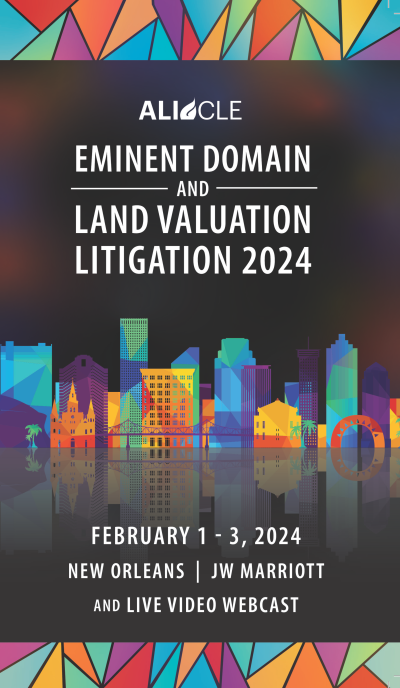
ALI-CLE brochure cover page

Here’s the brochure and the full agenda and registration information for the upcoming ALI-CLE Eminent Domain and Land Valuation Litigation Conference at the JW Marriott in New Orleans, February 1-3, 2024.

This is the long-running nationally-focused conference on all things eminent domain, takings, valuation, and related. We have three tracks, from which you can choose a la carte – Practice, Substantive, and Condemnation 101:

For over 40 years, we’ve been bringing eminent domain practitioners together to examine the latest issues, engage in healthy debate, and get the information they need to stay current in their practice. This year – our 41st – is THE perfect time to reunite with your eminent domain colleagues. There will be plentiful opportunities to meet and mingle with the faculty and other registrants – throughout the conference and at evening social events. Attendees come back year after year to make new friendships and renew

Continue Reading Here’s The Program For The 41st ALI-CLE Eminent Domain And Land Valuation Litigation Conference, Feb 1-3, 2024, New Orleans

NCSCT

Here’s the latest on a kind of strange case we’ve been following.

Our case starts off as a somewhat typical public use challenge. After a developer failed to negotiate purchase from Rubin an easement for a sewer line to serve a nearby housing project, the developer enlisted the Town of Apex to lend a hand.

Next, whaddaya know, the Town is taking the easement for the developer’s sewer line from Rubin by eminent domain, with the developer paying the compensation and the costs of the lawsuit. If this sets off your private benefit radar, you’d be right. The North Carolina courts sure thought so. No public use. 

You might think that this would signal the end of the matter. We know what would happen if the Town had affirmatively abandoned the taking. In that case, it wouldn’t be off the hook if it walked away, and although it would

Continue Reading Midnight Quick Take: NC Supreme Court To Consider Remedies For Failed Takings – What Happens When A Taking Lacks A Public Use, But They’ve Already Seized The Property?

HSBA 10-2023

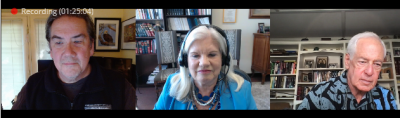
Yesterday, during the Annual Meeting of the Hawaii State Bar Association, we participated in a program sponsored by the Real Property and Financial Services Section, “Inverse Condemnation & Paying for Disasters.”

As you can see above, we joined lawprofs Shelley Saxer and David Callies to share thoughts about inverse claims, and the difference between these property arguments and tort negligence claims.

Here are some of the key cases and materials which we mentioned (or should have):


Continue Reading Links And Materials From “Inverse Condemnation & Paying for Disasters”

Here’s what we’re reading about the Supreme Court’s property rights docket — some good, some disappointing — this day.

  • Niina Farah, “Supreme Court flooding case could ripple across the energy sector (E & E News / Energywire) – About the Devillier case (which we summarized here), in which we were quoted: “The Supreme Court decision to hear the Devillier case comes after a concerted effort in recent years to convince the court to address procedural maneuvers that have made it challenging for property owners to bring their claims to court, said Robert Thomas, director of property rights litigation at the Pacific Legal Foundation. The nonprofit is among the groups that has asked the court to address takings cases and has lent its support for the property owners in Devillier in a ‘friend of the court‘ brief. ‘There’s a lot of gamesmanship going on


Continue Reading Supreme Court Property Rights Round-Up

Why is it, you ask, that the ALI-CLE Eminent Domain & Land Valuation Litigation Conference (scheduled next February 1-3, 2024, in New Orleans) is an event that seems to be growing in popularity and attendance. In recent years, we have standing room only in the Conference halls, and have sold out the hotel block. After all, this is a pretty niche area of law. So what gives?

When we were in Austin earlier this year, we thought it might be nice to try and answer that question. We asked Conference participants why they come, year-after-year (and in Austin, despite massive travel disruptions). Yes, it is the various venues (Nashville, Austin, Scottsdale, Palm Springs, to name a few recent locations), and yes, it is the excellent and useful programming.

But as we suspected it is more than that. As the above video notes

Continue Reading ALI-CLE’s Eminent Domain & Land Valuation Litigation Conference (Feb 1-3, 2024, New Orleans): Why Attend? Here’s Why.