We’ve been receiving a lot of visits lately from folks looking for information on inverse condemnation liability after the recent Northern California wildfires, and the flooding in Houston. In addition to the news stories (see SF Chronicle wildfire story here, and the Texas Tribune flood story here) which we’ve already posted, here are other links which may be useful:


Continue Reading More On Inverse Condemnation Liability For Fires And Floods
Update: 10/28/2019: Lights Out in the Land of No: The Practical Effects of California’s Wildfire Inverse Condemnation Doctrine,” a post about the (ongoing) wildfires and latest developments in inverse condemnation doctrine.

Update 3/12/2018:California Wildfires, Inverse Condemnation, and Climate Change,” a post about the various responses to the wildfire inverse condemnation lawsuits.

——————————————–

Here’s a story from the San Francisco Chronicle about the legal angles in the recent northern California wildfires, “PG&E could pay dearly for North Bay fires, even if it followed rules. (“The lethal wildfires in the North Bay could exact a heavy cost on Pacific Gas and Electric Co., even if the utility did nothing wrong.”).

The focus of the piece is on inverse condemnation and the potential liability of the power company (PG&E):

If investigators do find that PG&E’s electrical lines started the fires, the company will probably be liable

Continue Reading California Fires And Inverse Condemnation: The “You Broke It, You Bought It” Theory

We were all set to dive into the California Court of Appeal’s opinion (rendered in September, but only published yesterday) in Dryden Oaks, LLC v. San Diego County Regional Airport Authority, No. D069161 (Oct. 19, 2017), when our colleague Bryan Wenter beat us to the punch. 

So we won’t go into detail, and recommend instead you read his post at the Miller Starr Regalia Land Use Developments blog, “Court Rejects Regulatory Takings and Pre-Condemnation Misconduct Claims Based on Airport Land Use Commission’s Reclassification of Property Within Different Safety Zone.”

As Bryan writes:

In short, in 2002 the City approved permits for both lots despite determinations the San Diego County Regional Airport Authority’s determination the projects were incompatible with the airport. The developer completed construction of a commercial building on one of the lots in 2005, but the second permit expired in 2012 without commencement of any

Continue Reading Cal App: Airport Didn’t Take Property By Adopting A Safety Plan That Prohibited Nearby Building (But Maybe The City Did)

The complete agenda and faculty list has now been posted on the ALI-CLE website, and early registration is open! Go now and reserve your spot. 

We paid a visit to Charleston recently, the venue for our January 2018 conference, to scout it out. We can report that we’re going to have a great time, for sure. When we polled you last year, you selected Charleston as your first choice (a new city for the Conference), and it is shaping up to be a very good selection. In addition to the usual lineup of CLE programming, there are a ton of things to see and do in the area. We recorded a short video down at the “four corners of law” (the intersection of Meeting Street and Broad Street), to give you a preview (the weather was much better than in our 2016 preview video, too).

As an added

Continue Reading 2018 ALI-CLE Eminent Domain Conference – Agenda And Faculty Now Posted

This just in: the Hawaii Supreme Court has rendered a unanimous opinion in Leone v. County of Maui, No. SCAP-15-599 (Oct. 16, 2017), a case we’ve naturally been following because it involves regulatory takings (and we were involved in a similar case on a neighboring property). 

We haven’t had a chance to review the 48-page opinion in detail (once we do so, we will post a more detailed review), but the issue the court was presented with was, as we noted here, whether leaving land in its vacant state court be considered an economically beneficial use. Short story is that the court held yes, it could, thus seeming to create a lower court split (hello, cert petition) with at least one other court, the Federal Circuit in Lost Tree, concluding that economically beneficial use means more than someone might buy it down the road. 

There’s

Continue Reading Conflict Check: Hawaii Adds To Lower Court Regulatory Takings Split: Is Leaving Land Vacant On The Hope It Is Worth More In The Future “Economically Beneficial Use”?

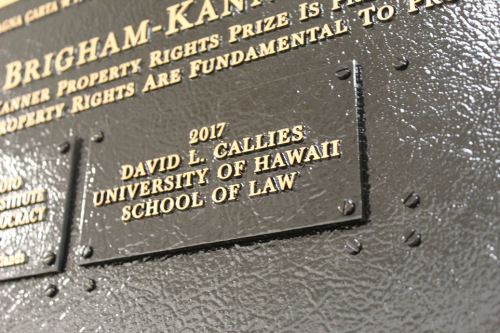
IMG_2931

University of Hawaii Law School Professor David Callies last night was presented with William and Mary Law School’s Brigham-Kanner Property Rights Prize which is “presented annually to a scholar, practitioner or jurist whose work affirms the fundamental importance of property rights.” 

As W&M notes about Professor Callies, a “prolific scholar whose work explores land use, property, and state and local government law, Callies has lectured around the world and authored or collaborated on about 90 articles and 20 books. He has been a member of the prestigious American Law Institute since 1990 and is the Benjamin A. Kudo Professor of Law at the University of Hawaiʻi at Mānoa. Prior to entering academia, he was an attorney in private practice and an assistant state’s attorney.”

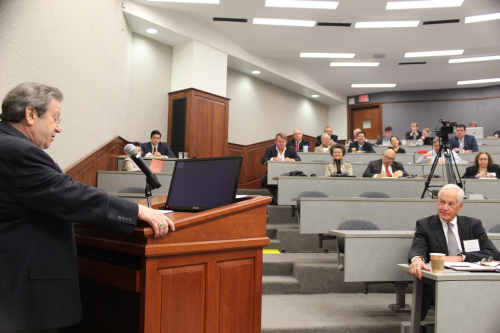
IMG_3028

We’re spending today in a series of panels which explore and build upon Professor Callies’ lifetime of work. Michael Berger, a past Prize winner, kicked off

Continue Reading Professor David Callies Awarded William & Mary Law’s Brigham-Kanner Property Rights Prize

ALI-CLE2018

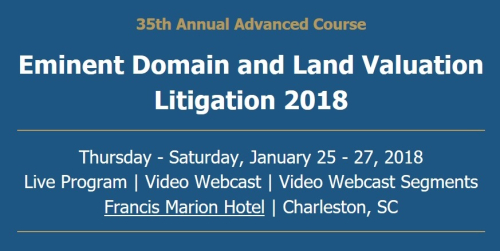
It’s not too early to reserve your spot at the 35th Annual ALI-CLE Eminent Domain and Land Valuation Litigation Conference, to be held at the Francis Marion Hotel in historic downtown Charleston, South Carolina, January 25-27, 2018. 

We’re finalizing the Conference details, but can report that the program will, as usual, feature expert presenters from across the nation, and both an in-depth update on the subjects we love, and a “101” track for those new to the field or who would appreciate a refresher. Check out some of the topics:

  • Takings and Damaging by Flood: Case Selection Advice For Savvy Practitioners
  • Quarterbacking the Case: Blocking Defenses, Controlling the Witnesses, and Converting for Verdicts
  • We’ve Been Working on the Railroad: Utility Crossing Disputes
  • Protecting Your Record,and Anticipating Appeals
  • Lucas 25 Years Later: Property Rights in the Age of Global Warming
  • Building and Growing Your Eminent Domain Practice With


Continue Reading 2018 ALI-CLE Eminent Domain Conference: Early-Bird Registration Discount Now Posted

It’s no secret: along with a lot of our colleagues, we have thought for a long time that the Supreme Court needs to address the “final decision” prong of the Williamson County ripeness test. Ever since four Justices in 2005 concurred in San Remo Hotel to say so, we’ve been anticipating the case which presents the Court with the vehicle to finally present that issue. There have been a lot of attempts in the interim, but none so far successful (here’s the latest, a case asking the Court to overrule Williamson).

Meanwhile, the lower courts have been steadily chipping away (see this decision, for example) at Williamson County, concluding it is a prudential doctrine, that further applications would be futile, that it doesn’t apply to facial claims, and similar. 

Here’s another cert petition, recently filed, that doesn’t call for overruling Williamson County outright

Continue Reading New Williamson County Cert Petition: How Far Down The Rabbit Hole Does The “Final Decision” Requirement Take Us?

DSCF3369

Back when the opinion was first released, we posted a list of Murr v. Wisconsin links. Now that Court is nearly back from its summer vacation, here’s an updated list:

Will there be more? No doubt. Murr is the takings case that keeps on giving. Continue Reading The Takings Case That Keeps On Giving: Murr Round-Up, Continued