A quick one from the Virginia Supreme Court, on pleading inverse condemnation in flooding cases. Or in any inverse case, actually.

In AGCS Marine Insurance Co. v. Arlington County, No. 1160221 (June 15, 2017), the court held that the insurance company (which paid off the property owner after a county sewer line flooded its store, and exercised its subrogation rights by bringing an inverse claim against the county) initially didn’t plead the claim adequately. But its proposed amended complaint fixed the pleading defects and made out a valid claim.

The case started when a county sewer line backed up, which caused raw sewage to flow into a neighboring grocery store. The insurance company paid the policy limits, and brought suit against the county. Here’s how the plaintiff initially pleaded the inverse claim:

The original complaint stated that the sewer line and the sewage treatment plant for the sewer line “were

Continue Reading Virginia SCT Clarifies How To Plead A Flooding Inverse Condemnation Claim
Under Missouri law, the owner of land must have owned it at the time of the taking in order to have standing to bring an inverse condemnation claim. In Hull v. Pleasant Valley School District, No. WD79302 (June 6, 2017), the Missouri Court of Appeals (Western District), a case involving inverse condemnation liability for flooding, concluded that the owners of a golf course who recorded title to the land after the first instance of flooding had standing to bring a total taking claims.  

The Hulls purchased the golf course from Mr. Hull’s parents in 2005 but didn’t record the deed until 2009. The first flood occurred in 2007. After the jury awarded the Hulls $3 million for the total taking (after which the court ordered the Hulls to sign over the deed to the district), the district asserted the Hulls lacked standing because the deed wasn’t recorded until

Continue Reading Golf Course Owners Who Recorded Title After The First Flood Had Inverse Condemnation Standing

A quick one from the Oregon Court of Appeals. In Courter v. City of Portland, No. A158840 (June 7, 2017), the court concluded that the property owners’ inverse condemnation claim — which alleged that the City had not buried its pipes deep enough — was ripe for judicial review.

The case started after the City condemned a utility easement on the property and then didn’t bury the pipes deep enough. Doing so exceeded the scope of the condemned easement and interfered with the owners’ right to develop their property in the future because they’d have to either rezone the property or have the pipes buried deeper in order to develop. The City argued that the case wasn’t ripe because the damages which the owners complained of had not yet occurred. “[B]ecause a court could not adjudicate whether they were harmed by the placement of the pipes until plaintiffs successfully

Continue Reading Oregon App: Physical Inverse Condemnation Claim Is Ripe From The Moment Of Occupation

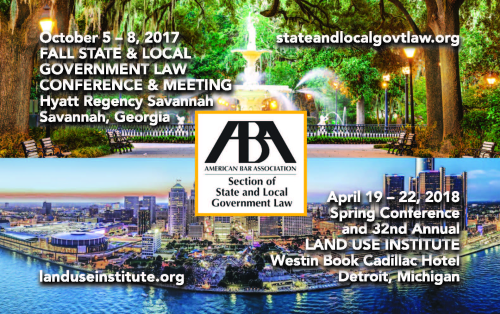
ABA State and Local 2017-2017 conferences image

Mark your calendars for this Friday, June 16, 2017, at 2:00 p.m. Eastern Time for a free talk we’ll be giving, “Regulatory Takings: Emerging Issues.” 

Yes, it’s free, but there’s a catch: this talk is sponsored by the ABA Section of State and Local Government Law’s Land Use Committee, and you have to be a Section member (or be willing to join us). One of the benefits of being a member is that you can sign on to these bi-monthly calls and learn about the latest developments in the broad range of topics the Committee covers. Ping me if you want to sign up.  

And what’s the deal with the graphic above? Well, starting in August 2017, I’ll be taking over as Chair of the Section (assuming my ABA colleagues do not come to their senses before then), and the big focus of the Chair is to

Continue Reading Upcoming Free Takings Talk (Friday, June 16, 2017). But There’s A Catch…

You heard that right. After the Michigan Court of Appeals’ recent ruling in Lanzi v. Township of St. Clair, No. 329795 (May 23, 2017), you should consider skipping the usual Williamson County step of filing your federal takings claims in state court.

In that case, property owners sued the township after the township’s sewage system broke down and backed up grey water into the plaintiffs’ basement. They brought a complaint in Michigan state court alleging both negligence and a physical invasion taking. The township alleged it was immune by statute from such suits. The trial court rejected the argument and the township appealed. 

The court of appeals reversed on the negligence claim, agreeing with the township that it was immune because it had taken reasonable steps to repair any defects in the sewer system. We’ll let you read that part of the opinion if you’re interested.

What got us

Continue Reading Michiganders: Go Ahead, File Your Federal Regulatory Taking And Inverse Condemnation Claims In Federal Court

Here’s one we’ve been waiting for (we filed a brief in support of the property owner), one in which we were hoping (although not expecting) a more favorable result.

In Brott v. United States, No. 16-1466 (May 31, 2017), the Sixth Circuit held that federal inverse condemnation plaintiffs who sue for more than $10k are not entitled to bring their claims before an Article III tribunal in the first instance, and can be forced by Congress to pursue claims in the Court of Federal Claims. The court also concluded that it wasn’t a problem constitutionally for the property owners to not be able to have their claims determined by a jury. 

The opinion noted the oft-quoted Supreme Court cases which concluded that the Just Compensation requirement in the Fifth Amendment is “self-executing,” that this means that a waiver of sovereign immunity isn’t necessary, that once a taking occurs

Continue Reading 6th Cir: Takings Clause Isn’t Really Self-Executing, So Federal Takings Plaintiffs Must Go To The CFC; And No, They Don’t Get A Jury Either

Here’s the unanimous Supreme Court opinion, issued this morning in a case we’ve been following, Town of Chester v. Laroe Estates, No. 16-605 (June 5, 2017), a takings case, although the issue resolved by the Court is one of civil procedure. 

The Court’s holding is remarkably unremarkable: a plaintiff — including a plaintiff who intervenes in a lawsuit as of right under Fed. R. Civ. P. 24(a)(2) — must have Article III standing. We say “unremarkable” because we never could quite figure out why that proposition was apparently so controversial that it ended up with a lower court split: doesn’t every federal court plaintiff need to show that there’s a live case and controversy on every claim and form of relief that is alleged? Yes, the parties didn’t dispute it, and the Court, in the opinion authored by Justice Alito, reached that conclusion in the second sentence:

Continue Reading SCOTUS: To Intervene As A Plaintiff (In A Takings Case), You Need Article III Standing (Duh)

Here’s the amici curiae brief we filed today on behalf of Owners’ Counsel of America, NFIB Small Business Legal Center, Cato Institute, and Professor David Callies in support of a cert petition which we detailed here.

The case is a regulatory takings claim, and involves wet and dry sand beaches, public trust, and other favorite topics. The case arose because the N.C. Legislature by statute moved the “public trust” shoreline landward, and allowed the public to use what had formerly been private beach.  

Here’s the Summary of Argument from our brief:

The North Carolina Court of Appeals permitted the Town of Emerald Isle (Town) to impress into public service the portion of the Nies family’s property above the mean high water mark as a road and park. North Carolina law has never subjected this dry sand to public ownership, through the public trust doctrine or otherwise.

Continue Reading SCOTUS Amicus Brief: States May Be Able To Rewrite Property Law, But They Can’t Avoid Paying For The Change

IMG_20170526_144554

Welcome to a new entry in the eminent domain and takings blogosphere, Texas colleague Clint Schumacher‘s Eminent Domain Podcast. Yes, you don’t have to read to get your takings updates, you can listen while you work, while you work out, or while you drive or fly. Go here to subscribe or download episodes via his website, or here for iTunes.

Clint has formatted his program very cleverly, with an Opening Statement, Direct Examination (in-depth discussion of the topics), Cross-Examination (a “lightning round” quick-question-and-answwers), and Closing Arguments.

He was kind enough to ask me to be his inaugural guest, and we spent some quality time discussing the Honolulu rail project, recent interesting cases, the “three unities” test, the annual ALI-CLE Eminent Domain Conference, and … Kevin Bacon. Don’t miss that.

Click here to open this first episode in a new window

Clint and his firm also produce

Continue Reading Clint Schumacher’s New Eminent Domain Podcast

We don’t normally post trial court decisions, particularly ones which simply dismiss a case. But the U.S. District Court for the Eastern District of Pennsylvania’s recent memorandum order in The Property Management Group, Ltd. v. City of Philadelphia, No. 17-1260 (May 23, 2017), which deals in part with a somewhat unusual takings claim, is posted here for two reasons. First, Williamson County. Second, the opening paragraph.  

The case involves Philadelphia’s notorious parking situation, something that — if you have ever parked a car on the street in that city — can be a real exercise in frustration and even fear. Predatory towing, ransoming cars, private spaces, and the like. The city council, apparently responding to towing abuses (see page 2 of the slip opinion, for example), adopted an ordinance which added a “ticket-to-tow requirement” which required that a law enforcement officer first certify that a vehicle

Continue Reading Federal Court Dismisses Removed Takings Claim Under Williamson County … And That’s OK