


Seattle

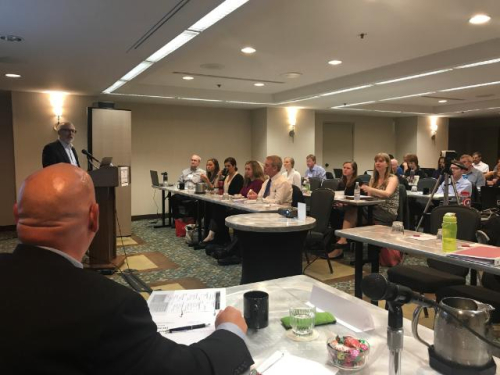
My thanks to Bart Freedman (K&L Gates) and Kinnon Williams (Inslee Best Doezie & Ryder) for asking me to speak on national takings and inverse condemnation issues at yesterday’s Eminent Domain conference in Seattle.

As you can see, the room was packed and standing room only. Here are the cases and issues I mentioned during my talk, “National Takings Trends, Hot Practice Areas, and Property Rights in the Age of Trump:”


Continue Reading Cases And Links From Washington Eminent Domain Conference

Here’s the Reply Brief we’re filing today in Bay Point Properties, Inc. v. Mississippi Transportation Commission, No. 16-1077 (cert. petition filed Mar. 3, 2017), a case which seeks review of a decision by the Mississippi Supreme Court. We represent the petitioner.

The brief responds to the MTC’s Brief in Opposition, and rather than paraphrase our arguments, we’re just going to copy-and-paste them below, after we link to the other briefs in the case:


Continue Reading SCOTUS Cert Reply Brief: Mississippi Can Rewrite Its Easement Laws, But It Can’t Avoid Compensation When It Takes Property

No, it’s not for that job position, recently vacated.

This is an opening at a slightly lower level, but perhaps of more interest to our readers. The U.S. Department of Justice is seeking a “Trial Attorney (Inverse Condemnation) GS-14/15.” Here’s the job description:

The attorney selected will be expected to represent the United States in Fifth Amendment takings litigation before the Court of Federal Claims and federal district courts throughout the nation. Cases will involve border security, military readiness, transportation infrastructure, and flood control. The attorney must be comfortable in a “first-chair” role in multiple complex cases, and have demonstrated and substantial experience in all aspects of civil litigation, including pre-trial discovery, presentation of oral argument, and examination of fact and expert witnesses.

The cases handled by the Section require attorneys to achieve intellectual command of complicated facts, scientific principles, and legal issues, often rapidly. Successful candidates

Continue Reading Job Opening At The DOJ (No, Not That One)

Apparently, property owners setting their buildings on fire to collect the insurance is a thing in Pennsylvania, the location of our story. We say this because the Pennsylvania legislature adopted a statute which requires that before an insurance company pays out proceeds from a fire policy to a “named insured,” it check with the local municipality to see if any property taxes are owed on the property. If so, the municipality grabs the payout to satisfy the delinquent taxes.  

You can kind of see where this is going, can’t you? Yes, one entity owned the burned building, while another entity was the named insured.

We usually leave insurance matters to our law partner Tred Eyerly, who blogs about insurance coverage and related matters. Stuff like that is above our pay grade, and we defer to professionals.

But the U.S. Court of Appeals’ opinion in Trustees of Conneaut

Continue Reading 3d Cir: PA Statute Requiring You To Pay Someone Else’s Property Taxes Isn’t A Taking

Do you really need an excuse to visit Seattle? If you do, and want to earn some CLE credit while you’re at it, check it out the brochure for the upcoming Eminent Domain seminar on May 18, 2017. This is a one-day program that focuses on the hot topics in our area of law. We’ll be speaking about “Changes in National Public Policy” and the latest developments in eminent domain and takings law. 

Agenda and full registration information here

Come, join us. 

7th Annual Eminent Domain Seminar, Seattle, Washington, May 18, 2017 

Continue Reading Seattle Eminent Domain Conference, May 18, 2017

We don’t usually post trial court decisions. They are, obviously, subject to change by an appellate court, and because many are interlocutory, alteration by the rendering court iself.

But for this order from the U.S. District Court for the Northern District of Florida, we’ll make an exception. It’s a land use case (it’s right there in the first sentence, “This is a land use case.”), in which the plaintiffs are challenging two ordinances adopted by the County. The first prohibited obstruction of the beach with ropes, chains, signs, or fences. The second prohibited anyone from interfering with public use of dry sand beach areas. Under Florida law, the dry sand portion of the beach is privately owned. 

As you might expect, because the effect of the ordinance was to invite the public to use private property (as Laurence Tribe wrote in his treatise on Constitutional Law when discussing Kaiser Aetna

Continue Reading Federal Court: Williamson County Ripeness Not Required In Facial Takings Claims

Remember back from Admin Law the notion of a “quasi-judicial” proceeding? That term always has bugged us, because, you know, it was used when an agency was sorta acting like a court (but also was sorta acting like a legislative body). Half full, half empty, take your pick. 

The fact pattern presented in the Florida District Court of Appeals’ opinion in Highland-in-the-Woods, LLC v. Polk County, No. 2D15-2801 (Apr. 28, 2017), involved the other side of that coin, an exaction the County argued was legislative even though imposed by an agency, and therefore off-limits to the exactions test of Nollan-Dolan-Koontz. (We think distinctions like this don’t matter — that whether or not its a legislature or an agency that is making a demand that in order to make use of your property, that you have to give up a constitutional right — but we recognize that the

Continue Reading Fla App: A Sorta-Legislative Exaction Is Subject To Nollan-Dolan, But This One Passed The Test

Here’s the cert petition, recently filed, which asks the U.S. Supreme Court to review a decision of the North Carolina appellate courts. We say “appellate courts,” because the decision being reviewed is one from the N.C. Court of Appeals, because the N.C. Supreme Court, after granting discretionary review, punted and dismissed the appeal after it was fully briefed and teed up for oral arguments.

What happened that cause the court to dismiss? Who really knows the internals, but the one thing we do know is that some members of the court changed due to a judicial election. We know the above because we were watching the case closely; we filed an amicus brief in support of the property owner in the N.C. Supreme Court, a brief that apparently didn’t get read (not that amicus briefs get read all that frequently anyway, but you get our drift).

The case is

Continue Reading New Regulatory Takings Cert Petition: Legislature Can’t Simply Declare Private Property To Be Public

Here are the full set of petitioner-side amici briefs in 616 Croft Ave., LLC v. City of West Hollywood, No. 16-1137, the case which asks the Supreme Court to determine whether the Nollan-Dolan-Koontz exactions standards apply to conditions on development imposed by a legislature. 

The City waived response, but the Court asked for one. This could get interesting, so stay tuned. 

Continue Reading SCOTUS Amici Briefs In Legislative Exactions Case

Not a lot in Jabary v. McCollough, No. 15-40009 (Apr. 19, 2017) to grab onto, so we’re not really surprised that the Fifth Circuit didn’t publish. But because the case involves Williamson County takings ripeness and is in our wheelhouse, we’re posting it nonetheless.

The first two sentences, “City building inspector Bret McCullough shut down Mike Jabary’s hookah lounge. He did so by leaving a notice on the door of the establishment that summarily revoked Jabary’s certificate of occupancy and informed him that he was violating the city code by doing business without the certificate” give you a clue that this is a procedural due process case as well as a takings case. Jabary met with success with his due process challenge (the district court denied the building inspector’s motion for summary judgment on immunity grounds, after which the inspector appealed), and, predictably, the district court held that Jabary’s

Continue Reading 5th Cir (Unpub) – Takings Claim Not Ripe