


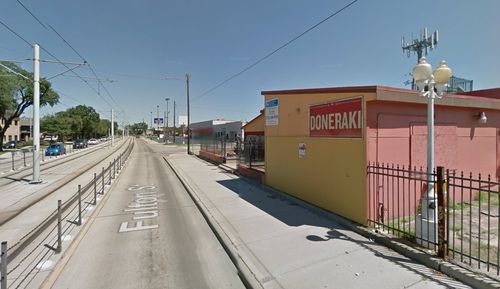
Doneraki

We did a post a while back about a Houston barbecue restaurant which had some troubles with the Harris County, Texas, Metropolitan Transit Authority. The court of appeals held that the restaurant’s lost profits could not be recovered in an inverse condemnation action.

Well, that same court has rendered an opinion in a case involving a different restaurant impacted by the same transit authority. Doneraki serves Mexican fare (although our first impression was that a restaurant with “doner” in the name was probably a Turkish joint; we stand corrected). Or should we say “served Mexican fare,” because alas, the place — as the photo above shows — is now boarded up and out of business.

The owners alleged it was the Transit Authority’s construction of the rail, and the resulting rail line (also shown) that caused it to fail. The rail did not condemn any of Doneraki’s property. The
Continue Reading Tex App: Rail Construction Cutting Off Access Can Be Inverse Condemnation – Even When There’s Been No Taking

Programming note: On the day we remember our nation’s war dead, we thought we’d repost this one, about how Arlington National Cemetery came to be, and how yes, there’s a takings story there.

———————————————————

LastbattlebookYou know how we’re always saying that the provisions in the Takings Clause are “self-executing,” that even in the absence of a waiver of sovereign immunity, the Tucker Act, and section 1983, property owners would still be able to maintain a claim for compensation? Well here’s an article that explains that how that rule was first articulated, and not in a dry academic way, but with a fascinating historical story.

It’s the tale of United States v. Lee, 106 U.S. 196 (1882). We knew the land that is now Arlington National Cemetery was once owned by Robert E. Lee, but we can’t say that we gave much thought to how it became public property. We

Continue Reading Memorial Day, Arlington National Cemetery, And Takings

Here’s the amicus brief we filed yesterday on behalf of lawprof David Callies and our colleagues at Owners’ Counsel of America in an important case involving ownership and use of the “dry sand” beach, now pending in the North Carolina Supreme Court.  

In Nies v. Town of Emerald Isle, No. COA15-169 (N.C. App. Nov. 17, 2015), the court of appeals held that the dry sand portion of the beach — the part between the mean high water mark and the dune or vegetation line — is subject to the public trust. Consequently, the Town was not liable for a regulatory taking when it allowed the public, for a fee, to drive on the beach. The Nies family, which thought it owned the property inland of the MHWM under long-standing North Carolina law, and that the public trust only applied to property seaward of the MHWM, sought compensation.  The North Carolina

Continue Reading Amici Brief: If A Legislature Or Court Moves The Public Trust Shoreline Inland, It’s A Taking

Someone up in Asheville must’ve really ticked off someone else down at the North Carolina legislature. Because for some reason, the state adopted a statute which, just like that, transferred the city-owned water system to a newly-created county sewer and water district. The statute didn’t change the water system’s operation — and this was key in the resultant lawsuit in which the city sued the state — only the ownership.

The law on its face is one of general application, and doesn’t name Asheville’s system specifically. But the statute covered only systems that met certain standards (population, for example), and which were located in a county that already has a public sewer system. And guess which was the only city in all of North Carolina which qualified? You guessed it, Asheville.  

The city wasn’t too happy about that and called bunk (perhaps appropriate, given that the new entity to which

Continue Reading NC Supreme Court Arguments: Can A State Take A City’s Water System?

We thought there was a chance in a case out of San Jose, California, that the U.S. Supreme Court might take up the long-standing issue of whether legislatively-imposed exactions meet the nexus and proportionality unconstitutional conditions tests from Nollan, Dolan, and Koontz. Do those tests require an individualized determination, or is it enough that the conditions are imposed on everyone? 

But the Court declined to review that case. There was a question in whether San Jose’s affordable housing requirements were “exactions,” because the California Supreme Court disposed of the case by concluding that the regulations were mere run-of-the-mill zoning ordinances, and thus not subject at all to N-D-K. Thus, the heightened scrutiny required by N-D-K didn’t apply.  

This cert petition, recently filed, however, presents the legislatively-imposed question very clearly. In Common Sense Alliance v. Growth Management Hearings Bd., No. 72235-2-1 (Wash.

Continue Reading New Cert Petition: Are Legislative Exactions Immune From Nexus And Proportionality Requirements?

Untitled Extract Pages

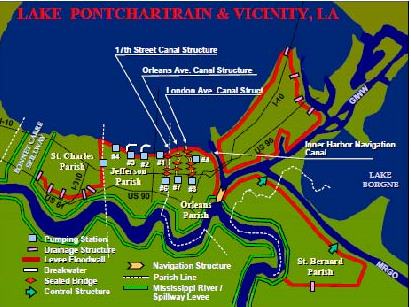
About this time last year, the Court of Federal Claims held that the federal government was liable for a temporary taking to certain property owners for the flooding caused by Hurricane Katrina and the Corps of Engineers’ failure to maintain the “MR-GO” (Mississippi River-Gulf Outlet) canal system. See also a guest post by our colleague Ed Thomas, “Katrina Flood Decision Emphasizes Science.” 

The CFC has now followed up on that ruling with an order (St. Bernard Parish Gov’t v. United States, No. 05-1119L (May 4, 2016)) determining just compensation, thus teeing the case up for the federal government’s appeal to the Federal Circuit.

The opinion is a long one (44 single-spaced pages, including footnotes) and has a lot of detail and technical stuff for you smart readers, but it also has pictures and charts for the rest of us.  

The opinion also contains

Continue Reading CFC Awards Just Comp In Katrina Flooding Case And Tees Up The Appeal

20151205_145903

Earlier today, we asked the Federal Circuit for its permission to file this amici brief urging the court to rehear its recent panel decision in Romanoff Equities, Inc. v. United States, No. 15-5034 (Fed. Cir. Mar. 10, 2016).

This is a rails-to-trails takings case in which the panel concluded that the words in the original easement grant “for railroad purposes and for such other purposes as the Railroad Company … may … desire to make” mean that the easement was a “general” easement which allowed the grantee to not only make railroad use of the easement, but literally any use it desired. Thus, when the railroad abandoned the line and the City of New York turned it into the Highline public park, the reversionary property owners were not entitled to compensation.    

Our brief argues that there’s no such animal as a “general” easement that allows the

Continue Reading Amicus Brief: NYC’s Highline Park Is A Taking: A “General” Easement Allowing All Uses Isn’t Really An Easement At All

The New Hampshire Supreme Court, in our view, got it wrong in Ashton v. City of Concord, No. 2015-0400 (Apr. 29, 2016). Really, really wrong.

Indeed, the New Hampshire court seems to have resurrected the California Supreme Court’s now-defunct rule from Agins v. City of Tiburon, 598 P.2d 25 (Cal. 1979), which held that there is no compensation remedy when the application of an ordinance denies an owner all beneficial use of property, only declaratory and equitable relief. See id. at 26 (“the need for preserving a degree of freedom in the land-use planning function, and the inhibiting financial force which inheres in the inverse condemnation remedy, persuade us that on balance mandamus or declaratory relief rather than inverse condemnation is the appropriate relief under the circumstances”). The Agins rule was held unconstitutional in First English Lutheran Church of Glendale v. County of Los Angeles, 482

Continue Reading Does New Hampshire Think It’s California? Wrongful Denial Of Demolition Permit Cannot Be A Taking Because City Was Merely Applying The Statute

Another day that we’re tied up, so there won’t be too much analysis. But we wanted to post this fascinating case out of the California Court of Appeal, Friends of Martin Beach v. Martin Beach 1 LLC, No. A142035 (Apr. 27, 2016).

As the caption of the case indicates, it involves beach access. Specifically, access to a Northern California beach that, despite some junky Yelp reviews, is apparently popular enough to spawn a “friends of” activist defense group. The Friends want access across private property owned by a really rich Silicon Valley guy. Before he owned it, they alleged, the owners let the public cross to get to the beach. The Silicon Valley guy, however, didn’t continue that practice, and the lawsuit followed.

The owner claimed he had exceptionally good title, because the land, like much land in California, could trace title back to a Spanish or Mexican

Continue Reading Cal App On Tidelands And Mexican Title: Owner Has Title In Land Used For Beach Access, But May Have Lost It By Dedication

We’re tied up today, so can’t write much, but wanted to post this recent decision from the Court of Federal Claims. Here’s the court’s own summary:

Plaintiffs Love Terminal Partners, L.P. (“Love Terminal Partners”) and Virginia Aerospace, LLC (“Virginia Aerospace”) are leaseholders of property at Dallas Love Field Airport (“Love Field”), located in Dallas, Texas. In their complaint, filed in the United States Court of Federal Claims (“Court of Federal Claims”) on July 23, 2008, plaintiffs allege that the federal government, through the enactment of the Wright Amendment Reform Act of 2006 (“WARA”), prohibited the use of their property, thereby destroying all economic value or benefit of their leasehold and effecting a taking without just compensation, in contravention of the Fifth Amendment to the United States Constitution. Plaintiffs seek compensation for the taking as well as interest from the date of the taking, attorneys’ fees, appraiser and expert witness fees

Continue Reading $133,500,000 CFC Verdict For A Categorical Lucas Taking