BK-plaque-2015

As we’ve done every year lately, we’re soon headed to the Brigham-Kanner Property Rights Conference at the William and Mary Law School in Williamsburg, Virginia.

This year, the B-K Property Rights Prize will be awarded to Harvard lawprof Joseph Singer, who is, shall we say, an interesting choice, given his theory that a “robust regulatory structure” goes hand-in-hand with property rights, liberty, and the free market. Robust regulation isn’t exactly what you might think of when you think “property rights,” is it? So it should make for an interesting conference.

Professor Singer publishes a blog that is worth following, “Property Law Developments.” It is not one of those blogs that are heavy on the analysis, but its a good place to keep up on recent developments in all things property law. 

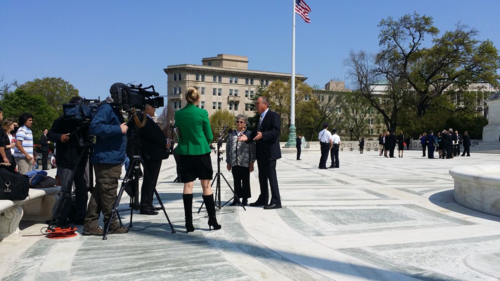
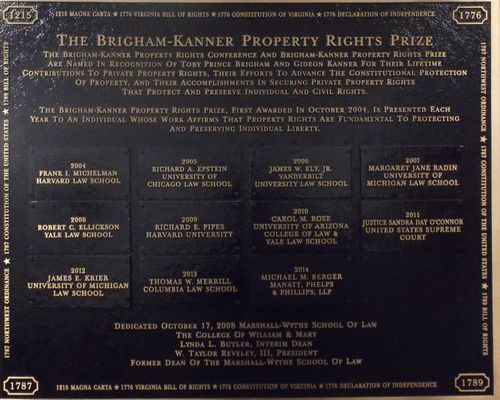
The plaque pictured above is a list of prior prize winners.

Here are the conference details:

Continue Reading Join Us: 2015 Brigham-Kanner Conference At William And Mary Law School
We have learned that the North Carolina Supreme Court has granted the State’s request to review Kirby v. North Carolina Dep’t of Transportation, No. COA14-184 (Feb. 17, 2015).

That’s the case in which the Court of Appeals not only held that the property owners’ claims were ripe, but that the Map Act — which gives the DOT the ability to designate property for future highway use and prevent its development in the meantime — effected a taking. The appeals court reversed the trial court’s dismissal and sent the case back down for a calculation of the compensation owed to each property owner.

This is one to watch, for sure. We’ll keep on doing so and let you know as things develop. 

Continue Reading NC Supreme Court To Review “Map Act” Takings Case

After the Supreme Court’s decision in Horne v. Dep’t of Agriculture, 14-275 (U.S. June 22, 2015), we were waiting for this shoe to drop. And now it has.

In “Raisin ruling seen as a lifeline for endangered species,Environment & Energy writes, “[a] Supreme Court ruling that struck down an odd Depression-era raisin program may have revived a critical government defense for endangered species and other wildlife protections, legal experts say.” 

The theory is based on the Horne majority’s rejection of Leonard & Leonard v. Earle, 279 U.S. 392 (1929), the case in which the Court upheld a Maryland state tax which required oyster farmers turn over to the state 10% of the empty oyster shells which they harvested, or pay a monetary equivalent. The Horne majority concluded that Leonard was not applicable because the oysters in Leonard were government property, in contrast to raisins, which —


Continue Reading Nice Try: No, The Supreme Court Didn’t Make Wildlife Public Property In The Raisin Case

There are many ways to keep nuisance birds off of your building or away from your crops.

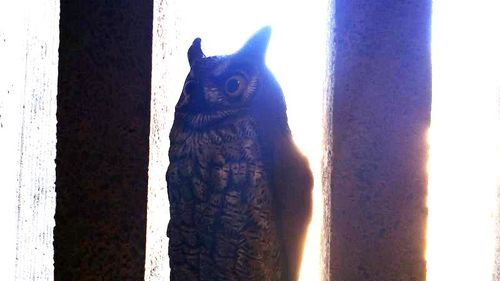
There’s this one, a plastic owl perched on the 4th floor of the Maui courthouse.

6a00d83451707369e201bb08668850970d-800wi

There are other devices: scarecrows, balloons, and even dead birds. But our favorite is the scare gun, a “propane powered gas gun which produces a periodic loud explosion.” Sounds like fun.

But not to the powers-that-be in the Town of Trempealeau, Wisconsin. In 2013, the Town adopted an ordinance, amended the following year, which requires anyone who wants to use a scare gun to get a permit. These permits restrict the time, place, and manner in which the owner can employ said gun. 

Farmer Klein had used a scare gun on his property since 1962 to keep blackbirds from devouring his crops. He obtained a permit, but apparently didn’t follow the ordinance closely enough because he

Continue Reading Wisconsin App: Town’s “Scare Gun” Permit Requirement Not A Taking

Takings nerd alert: we posted about this case late last year, when the Wisconsin Court of Appeals held that two separate parcels owned by the same family must be treated as a single unit for purposes of determining whether there’s been a taking. Eventually, the Wisconsin Supreme Court denied review.

So here’s the next step, the cert petititon in Murr v. Wisconsin, No. ___ (filed Aug. 14, 2015), which asks the U.S. Supreme Court to review a single Question Presented:

In a regulatory taking case, does the “parcel as a whole” concept as described in Penn Central Transportation Company v. City of New York, 438 U.S. 104, 130-31 (1978), establish a rule that two legally distinct, but commonly owned contiguous parcels, must be combined for takings analysis purposes?

Read this post for more background. Disclosure: the petitioners are represented by Pacific Legal Foundation, and we manage PLF’s Hawaii

Continue Reading New Cert Petition: Does The Takings “Denominator” Rule Require Two Parcels To Be Treated As One?

The headline of this post shouldn’t be that surprising, especially when the the property owner purchased the land already subject to a floodplain designation, and those regulations effectively prohibited development.

But the two twists in the South Carolina Supreme Court’s opinion in Columbia Venture, LLC v. Richland County, No. 27563 (Aug. 12, 2015), were (1) when Columbia Venture purchased the land, the floodplain designation didn’t encompass as much of the land as it eventually did, and the larger area was only preliminarily designated, and (2) various county agencies had informed Columbia that there was a chance it might get permission to build even if the regulations were eventually adopted.   

Those twists, however, were not enough to save Columbia’s takings claim, and the court rejected both its categorical and Penn Central arguments.  

The facts of the case are somewhat dense, but here’s what you need to know. Columbia

Continue Reading No Taking When Owner Prohibited From Developing In Floodplain

Here’s a short one from the Court of Appeals of Texas, Eighth District, involving how well a regulatory takings claim needs to be pleaded in a complaint. 

In County of El Paso v. Navar, No 08-14-00250-CV (Aug. 7, 2015), the court held that a pro se plaintiff who alleged, among other things, that the County refused “

to issue certificates of 

compliance to him without a legitimate basis unreasonably interfered with his right to use and 

enjoy his property as a mobile home park” 

was specific enough to give the County notice of the allegation, and should not be dismissed.

Read the opinion for the details of the claim, but here’s the critical allegation in the complaint:

The [County]’s conduct, as alleged, was intentional and constituted an unreasonably interfered [sic] with [his] right to use and enjoy his property. The economic impact and the extent to which the regulation

Continue Reading Tex App: Penn Central Claim Was Poorly Drafted, But It’s Good Enough

To those able to join us today for IMLA’s “The Takings Issue” webinar, thank you. Here are the links to the items which I discussed:

On Koontz:

On California Building Industry Ass’n v. City of San Jose:


Continue Reading Links From Today’s “The Takings Issue” Webinar

If you need CLE credits, you are in luck. There’s a plethora of upcoming programs that may be of interest to readers. 

First, the ones we’re involved with:

  • The Takings Issue – August 10, 2015, 1 – 2pm ET (webinar) – from the International Municipal Lawyers Association. We’re joining Professors Dan Mandelker and John Echeverria, and land use lawyer Michael Giairno, to talk takings. “Two titans of takings, who just happen to have profoundly opposing views of the world, have graciously agreed to discuss the latest developments and spar. This will be the Great Debate of 2015.” Sounds like fun, no? Registration free for IMLA members, $99 for everyone else. More information, including registration, here
  • Is Sharing Really Caring? The Law of Transportation Sharing: Uber, Lyft, and the Sharing Economy – July 30, 2015, 2:15-3:45pm CT (in-person) –  at the ABA Annual Meeting in Chicago. We’re moderating a session


Continue Reading Mark Your Calendars For Upcoming Events: Takings, Sharing Economy, Fair Housing, etc.

20150422_112618
The Hornes outside the Supreme Court

“Separate educational facilities are inherently unequal.”
Chief Justice Earl Warren,
Brown v. Board of Education

“The Fourteenth Amendment does not enact
Mr. Herbert Spencer’s Social Statics.”
Justice Oliver Wendell Holmes,
dissenting in Lochner v. New York

“…prejudice against discrete and insular minorities…”
Justice Harlan Fiske Stone, in footnote 4,
United States v. Carolene Products Co.

“Raisins … are a healthy snack.”
Chief Justice John G. Roberts,
Horne v. Dep’t of Agriculture

A Supreme Court win is a win, particularly by a margin of 8-1, so we’re not going to complain too much about the Court’s opinion in Horne v. Department of Agriculture, No. 14-275 (U.S. June 22, 2015), holding that the USDA’s requirement that raisin producers physically turn over a percentage of their yearly crops to the government without being provided compensation is a taking in violation of the Fifth Amendment.

I

Continue Reading Horne v. USDA: Way More Than Silly Raisin Jokes