


In 1989, agents of the Libyan government blew up a plane of civilians, killing 170 passengers and crew. Victims’ families brought suit against the Socialist People’s Libyan Arab Jamahiriya in U.S. District Court in D.C. for damages, and after winning summary judgment, the court entered judgments totaling approximately $1.3 billion. Libya appealed to the D.C. Circuit.

The very day the appeal was filed, the U.S. government and Libya entered into a settlement agreement which established a $1.5 billion settlement fund to compensate U.S. victims, and a $300 million fund to compensate “Libyan victims of U.S. airstrikes.” The two governments agreed that the funds were in full settlement of all claims for its respective nationals. As a consequence of this agreement, all pending lawsuits in the courts were “terminated.” The U.S. intervened in the D.C. Circuit appeal, and asked the court to dismiss. The court agreed, and terminated the appeal
Continue Reading CFC: Terrorism Victims Properly Alleged Their Judgments Against Libya Were Taken By Govt Settling Claims By Agreement

Here’s the recently-published brochure with more details about the ALI-CLE Eminent Domain and Land Valuation LItigation conference, set for Austin in January 2016. 

In the coming days and weeks, we’ll be posting more details about the conference. Our co-planning chairs Joe Waldo, Jack Sperber, and Andrew Brigham have assembled a great agenda, taught by the usual stellar faculty. If eminent domain, appraisal, or land use is your thing, you really should attend. 

33d Annual ALI-CLE Eminent Domain and Land Valuation Litigation Conference, Jan. 28-30, 2016, Austin, TX

Continue Reading ALI-CLE Eminent Domain And Land Valuation Conference: Full Brochure

Here are some upcoming events in which you may be interested, in chronological order:


Continue Reading Upcoming Events And CLE’s – Appellate, RLUIPA, Sharing Economy, And More

ALI-CLE-2016-masthead

Here’s the full agenda for the 2016 Eminent Domain and Land Valuation Litigation / Condemnation 101 Conference, January 28-30, 2016, in Austin, Texas. 

Together with our friend and colleague Joe Waldo, we think we’re put together a pretty good program that covers a lot of ground. This is the first time the conference has been to Austin, and we’re starting off with a talk by Austin Mayor Steve Adler, who in his former life was an eminent domain lawyer. Other highlights:

  • Professor Ilya Somin will speak about his recently-published book in a segment entitled “The Impact of Kelo and the Limits of Eminent Domain.”
  • Pipelines and Energy Corridors: Valuation Perspectives of Condemnors and Condemnees” with the lawyers on the front lines of one of the hottest topics in eminent domain law nationwide.
  • Retired Minnesota Supreme Court Justice Paul H. Anderson will give us his tips


Continue Reading It’s Here – 2016 ALI-CLE Eminent Domain Conference: Complete Agenda, Faculty, Registration Information

Our friend and colleague Alan Ackerman posted a note on his blog about a recent District Court ruling from the Western District of Virginia which upheld the power of a potential condemnor to enter property for the purposes of survey, without formally taking the property. See “Virginia Federal Judge Follows What May Be the Majority Rule for Surveys.” But Alan didn’t post the court’s written ruling. So here you go, all 35 pages of it.

The issue was whether a Virginia statute, which “authorizes a natural gas company to enter private property without the landowner’s written permission and perform a survey for a proposed natural gas pipeline,” is a facial violation of the U.S. and Virginia Constitutions, and “is thus void and unenforceable.” Slip op. at 1. The court granted the gas company’s motion to dismiss. It concluded that the facial challenge failed because the property

Continue Reading Federal Court: Virginia’s Entry Statute Not Facially Unconstitutional

Check this out, a story in the September 28, 2015 edition of the New York Times, “Owner of Grand Central Sues Developer and City for $1.1 Billion Over Air Rights.”

Reminds us of this obscure Supreme Court case we heard about…

The Times reports that the current owner of Grand Central Terminal is, with the counsel of uberlawyers, suing New York City in federal court, alleging a taking and related. So what’s this all about (we thought this was “old, unhappy, far-off things, And battles long ago”)?

Apparently, the city granted a Grand Central neighbor permission to build a massive 1500 feet high office tower, and in doing so, took Grand Central’s property (its air rights) without compensation:

On Monday, Mr. Penson filed a $1.1 billion lawsuit in United States District Court in Manhattan that argued that the administration of Mayor Bill de Blasio, a Democrat

Continue Reading Penn Central, Part Deux? A New Complaint Alleges A Taking Of Grand Central Air Rights

20150910_144339

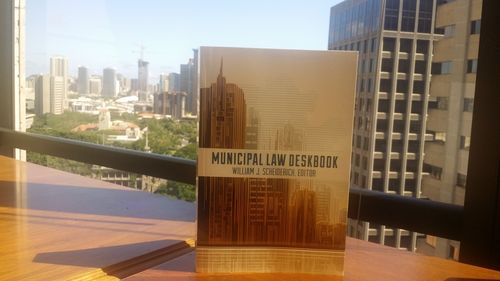
Look what arrived in the mail, a copy of the ABA Section of State and Local Government Law’s recently-published Municipal Law Deskbook, edited by our friend and colleague, Oregon’s Bill Scheiderich

We received a gratis copy because we authored the chapter on Regulatory Takings. The book is designed as a quick reference guide for you muni law types who don’t keep the entire set of McQuillin Municipal Corporations in your library, or for you non-muni law lawyers who want a handy reference guide when these issues come your way:

[The] Municipal Law Deskbook offer[s] legal guidance to municipal attorneys, private practitioners, city administrators, and educators. The book covers a full range of those issues that commonly arise in day-to-day local government administration and the content is intended for attorneys and nonlawyers alike. The chapters cover such topics as when and how federal laws and regulations preempt local legislation

Continue Reading New Book: Municipal Law Deskbook

Here’s the cert petition you knew was coming, which asks the U.S. Supreme Court to review the California Supreme Court’s decision upholding the City of San Jose’s “inclusionary housing” requirement by applying rational basis review. The California court held the requirement was not an “exaction,” and was no more than a mere zoning regulation or price control. 

Here’s the Question Presented:

A San Jose, California, ordinance conditions housing development permits upon a requirement that developers sell 15% of their newly-built homes for less than market value to city-designated buyers. Alternatively, developers may pay the city a fee in lieu. The California Supreme Court held that, even where such legislatively-mandated conditions are unrelated to the developments on which they are imposed, they are subject only to rational basis review.

This raises an issue on which the state courts of last resort and federal circuit courts of appeal are split nationwide. The

Continue Reading Cert Petition: Requirement That Developers Set Aside “Affordable” Units Is Subject To More Than Rational Basis Review

From the Texas Court of Appeals in Sloan Creek II, LLC v. North Texas Tollway Authority, No. 0-5-14-1456-01456 (Aug. 28, 2015):

This is an interlocutory appeal of the trial court’s orders granting two pleas to the jurisdiction challenging an inverse condemnation counterclaim under article I, section 17 of the Texas Constitution. In its counterclaim, Sloan Creek II, L.L.C. alleged the increased amount and rate of erosion of creek banks on its property due to increased rainwater runoff from highway improvements was an inverse condemnation in violation of the Texas Constitution. Because we conclude Sloan Creek II failed to create a fact issue on whether the governmental entities involved knew the highway improvements were substantially certain to increase the amount and rate of erosion, we affirm the trial court’s orders dismissing the article I, section 17 counterclaim.

Slip op. at 1. 

We don’t have much more to add, except to

Continue Reading “Should Have Known” Isn’t Enough To Show Intent In Inverse Condemnation

Here’s the latest in a case that we’ve been following, which was in both state and federal court, Bridge Aina Lea v. Land Use Comm’n

The litigation is a series of two lawsuits that originated in state court in the Third Circuit (Big Island), one an original jurisdiction civil rights lawsuit, the other an administrative appeal (that’s a writ of administrative mandate for you Californians). The State removed the civil rights lawsuit to U.S. District Court in Honolulu and promptly moved to dismiss, and this portion of the case nearly caused us to flash back to our Federal Courts class in law school, since it raised a host of procedural questions such as the effect of removal, whether certain defendants are “persons” under 42 U.S.C. § 1983, whether the federal court must abstain from addressing the federal takings claim, whether there is a state damage remedy for

Continue Reading Hawaii Federal Court Gets Rid Of Most Claims Against Land Use Commission, But Allows Takings And Vested Rights Claims To Go Forward