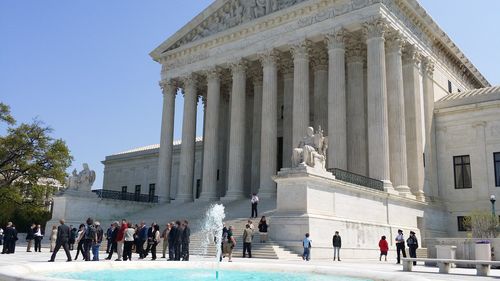
Update: here’s more Horne talk, in addition to our own initial thoughts in the above video and this post (“Magna Raisins: 8-1 SCOTUS Says There’s A Taking, But Not All Agree On Remedy“):


Continue Reading Raisin Round-Up

Here’s the podcast of our recent talk to the American Bar Association’s Section of State and Local Government Law about the (then) upcoming decision in Horne v. Dep’t of Agriculture, No. 14-275. Transcript here, if you’d prefer to read it.

This is a preview of the decision. But since we made some predictions — several of which bore fruit in today’s opinions — we thought we’d post it while we digest the Court’s opinions. 

As you may know, the Court today issued its opinions, with eight justices concluding that the raisin marketing order is a physical taking of property, rejecting the Ninth Circuit’s holding that the physical takings rules do not apply when personal property is involved.

We’ll have more analysis shortly, including a round-up of how other commentators view the case. Stay tuned. 


Continue Reading Podcast: Leviathan Shrugged? The Supreme Court’s Raisin Takings Case

As we predicted, the Supreme Court today held that personal property — here, raisins — is property protected from uncompensated acquisition, and that the USDA’s New Deal regulations pursuant to which the Department fined the Hornes for not turning over to the government a massive percentage of their yearly crop without compensation, is a physical taking under LorettoHorne v. Dep’t of Agriculture, No. 14-275 (June 22, 2015). 

Eight justices rejected the Ninth Circuit’s weird ruling that the regulations did not work a taking because raisins are personal property and not land, holding that “[t]he reserve requirement is a clear physical taking. Actual raisins are transferred from the growers to the Government.” Slip op. at 8. The Court cited [the] Magna Carta, noting it protected certain crops from appropriation:

The Takings Clause provides: “[N]or shall private property be taken for public use, without just compensation.” U. S.

Continue Reading Magna Raisins: 8-1 SCOTUS Says There’s A Taking, But Not All Agree On Remedy

We’ve already weighed in on how the Court of Federal Claims’ decision holding that the government’s takeover of AIG was an illegal exaction, but that it wasn’t a taking. But here are the thoughts of others:

  • Lawprof Ilya Somin: “Court rules that federal takeover of AIG was an “illegal exaction,” but not a taking” (“As Judge Wheeler notes, the rule that illegal exactions cannot qualify as takings is based on longstanding precedent. But I am nonetheless skeptical of its validity. It seems to me that a taking occurs any time the government seizes private property, regardless of whether the government’s action was otherwise properly authorized or not. just as unauthorized government action can violate other constitutional rights, such as those protected by the First Amendment or the Fourth Amendment, so too it can violate the Takings Clause of the Fifth Amendment. Nothing inherent in the logic of either


Continue Reading AIG/Starr Round-Up

Opinions reversing grants of summary judgment tend to be unexciting by nature because they are all about whether one side or the other submitted enough evidence to create a factual dispute that a jury must resolve. Civil procedure mavens rejoice, but the substantive law in the opinion can be dry. The latest inverse condemnation case from the Texas Supreme Court, Harris Cnty Flood Control Dist. v. Kerr, No. 13-0303 (June 12, 2015) is no exception, even though it is about (sorry, pun intended) flooding. 

The property owners brought an inverse case after their land and homes were repeatedly flooded, blaming the flood control district for approving the development of the land in the first place, even though the district spent a lot of money on flood control. The property is in a flood zone, and the district didn’t require the appropriate mitigation measures when it approved development.

Under Texas

Continue Reading Texas: Property Owners Entitled To Trial On What Govt Knew About Flooding And When It Knew It

You remember that Ingrid Bergman and Charles Boyer classic “Gaslight,’ in which Bergman’s character is driven by her manipulative husband to doubt her own grip on reality? It gave rise to the term “gaslighting,” which, according to Wikipedia, is “a form of mental abuse in which information is twisted or spun, selectively omitted to favor the abuser, or false information is presented with the intent of making victims doubt their own memory, perception, and sanity.”

Well, yesterday’s New York Times report about the verdict in the AIG bailout takings case, “In A.I.G. Case, Surprise Ruling That Could End All Bailouts,” for a moment had us believing we were being gaslighted, because the Court of Federal Claims had issued a zero verdict for the plaintiffs in their takings case against the federal government, even though the court ruled the government wrongly conditioned

Continue Reading Is The NYT Gaslighting Us? In What Alternate Reality Is The CFC’s Zero Just Comp Award A Victory?

The Court of Federal Claims has issued its Opinion and Order in the AIG takings case, which we have been following. This is the case brought by “uberlawyer” David Boies. Background on the case, here, including pleadings, and audio of a talk we gave about the case to the ABA. At the early stages of this case, we characterized any claim for $25 billion, even when the plaintiff is represented by a top-shelf guy, as “audacious.”  

Bottom line: the feds treated AIG badly, very badly. But the measure of liability in a takings case isn’t based on bad treatment generally, but on bad treatment economically. And in that arena, “twenty percent of something [is] better than 100 percent of nothing.” 

We’ll have more after we’ve had a chance to review the 75-page single-spaced opinion, so complex it needed to have a dramatis personae appended (pages

Continue Reading Audacity Ain’t Enough For The CFC: Gov’t Behaved Badly, But AIG Bailout No Taking Because No Damage

Pic_shot_1429716535697

            “It’s Frank’s world, we just live in it.”

                      – attributed to Dean Martin, about Frank Sinatra

A narrowly drawn opinion from the Supreme Court in Horne v. Dep’t of Agriculture, No. 14-275, argued in April and to be decided by the Court sometime before the Term ends this month, could attract more than the needed five Justices to form a bare majority, and the initial reports from the arguments agree that the Hornes’ takings argument appeared to gain traction with at least a couple of Justices from the Court’s left bloc. Combined with the property-friendly Justices and Justice Kennedy (who appeared to view the government’s arguments with great skepticism), they could put the Hornes well over the top. 

There may be much more at stake, however, if any part of the government’s

Continue Reading Leviathan Shrugged: Oral Arguments In Horne Reveals The Taking, But Remedy Still Open

A new article worthy of your time from The Urban Lawyer, the law review published by the ABA Section of State and Local Government Law: “The Power of Eminent Domain in the Aftermath of Hurricane Katrina: Should Common Interest Communities Be Compensated for the Loss of Asssments,” by James R. Conde.

The article (rightly, we think) criticizes the Fifth Circuit’s decision in United States v. 0.073 Acres of Land, 705 F.3d 540 (5th Cir. 2013), a case we wrote up here. The Supreme Court denied review

Here’s the abstract of the article:

In 2005, Hurricane Katrina flooded New Orleans and destroyed approximately 80% of the city’s housing stock. The New Orleans flood generated a corresponding flood of litigation against the Army Corps of Engineers (the “Corps”). After the storm, Congress took steps to repair the Corps’ impaired reputation and to provide disaster relief to

Continue Reading New Article: “Eminent Domain in The Aftermath of Hurricane Katrina”

Honchariw v. County of Stanislaus, No. F069145 (June 3, 2015), is one especially for you Californians, addressing the somewhat unusual process under state law for challenging a land use action by local government which is claimed to take property.

Under the California Supreme Court’s decision in Hensler v. City of Glendale, 876 P.2d 1043 (Cal. 1994), before a landowner can seek just compensation for a regulatory taking, it must first challenge the validity of the action using the writ of mandate procedure (administrative appeal to all you non-Californians), to allow the agency the chance to rescind the act. The property owner may — but need not — join to the writ of mandate a claim for damages (just compensation), and raise the claims concurrently.

Sometimes plaintiffs do join both claims in a single complaint, sometimes they don’t. Hensler is considered an exception to the usual rule prohibiting

Continue Reading Cal App: Mandamus Challenge To Validity Of Govt Action Must Include Takings Claim