


Third time around for Lost Tree’s takings case against the federal government on this blog.

The first was the Federal Circuit’s decision concluding that a single Florida parcel owned by the plaintiff was the relevant parcel against which the impact of the Corps of Engineers’ denial of a § 404 wetlands dredge and fill permit is to be measured. The court overturned a Court of Federal Claims decision which concluded the relevant parcel was that single plot plus an additional nearby lot, plus “scattered wetlands in the vicinity” also owned by the same owner. 

Second was the Court of Federal Claims, which on remand held that there was a taking, and that, after applying either the Lucas total wipeout or the Penn Central ad hoc test (the diminution in value caused by the denial of the permit was 99.4%), the just compensation owed to Lost Tree was in the neighborhood
Continue Reading Fed Cir: “Economically Beneficial Use” Means More Than Someone Might Buy The Property

Here’s the latest in a case we’ve been following, a takings claim against the federal government which was dismissed by the Federal Circuit under 28 U.S.C. § 1500, the statute which deprives the Court of Federal Claims of jurisdiction over a case if a related case is pending in another court at the time the CFC complaint is filed.

The core issue is one we’ve dealt with extensively before, and which the Supreme Court dodged in in United States v. Tohono O’odham Nation, 131 S. Ct. 1723 (2011), namely, whether § 1500’s jurisdictional bar operates in takings claims, which are required to be split between the CFC and the district courts (aka the “Tucker Act Shuffle”). We filed an amicus brief in that case, arguing that the statute cannot be read to deprive takings plaintiffs of their right to secure just compensation, when they may be required

Continue Reading New Cert Petition: Revisiting Tohono And § 1500 In Federal Takings Claims

An interesting decision with an international flavor from the Court of Appeals for the D.C. Circuit, Helmerich & Payne Int. Drilling Co. v. Bolivarian Republic of Venezuela, No. 13-7169 (May 1, 2015).

We suppose that if you are a U.S. oil exploration company operating in Hugo Chavez’ Venezuela, you get used to entertaining a certain amount of risk. But for more than 50 years prior, Helmerich “successfully operated an oil-drilling business in Venezuela through a series of subsidiaries.” Slip op. at 3. But in 2008, after PDVSA, the state-owned oil corporation fell behind in its rig lease payments to Helmerich’s subsidiary and the subsidiary “disassembled its drilling rigs and stacked the equipment in its yards,” the Venezuelan government decided to do something about it:

[O]n June 12, 2010, PDVSA employees, assisted by armed soldiers of the Venezuelan National Guard, blockaded H&P-V’s premises in western Venezuela, and then did the

Continue Reading Public Use, Venezuelan Style: Nationalization Of Oil Rigs Could Be A “Discriminatory Taking”

The powers-that-be planned on building a major freeway interchange, part of which was going to be on the property owned by Jefferson Street Ventures. Problem was, Jefferson Street also had plans for its property — a shopping center — and when it came time for it to apply to the City of Indio for permits to build, the city said yes, but only if Jefferson Street left open and didn’t build on the 11 acres on which the interchange was envisioned.

We’re going to buy it eventually said the city, but the complex federal and state process for studying, evaluating, and funding the project takes a long time, and if you build on it now, it’s going to cost us more in the future to take the developed property and relocate all of the tenants.

In Jefferson Street Ventures, LLC v. City of Indio, No. G049899 (filed Apr. 21

Continue Reading Cal App: “Temporary No-Build Area” While City (Maybe) Gets Around To Condemnation Is A Taking

Our American Bar Association colleague Ed Thomas (no relation, although we often joke that we’re probably cousins), the President of the Natural Hazard Mitigation Association and a guy who acknowledges that the need to protect against natural disasters must take property rights into account, has compiled some thoughts about the Court of Federal Claims’ recent opinion in a case holding the federal government liable for the taking of property during Hurricane Katrina.

++++++++++++++++++++++++++++++++++++

Major Court Decision with implications for Climate Adaptation, Hazard Mitigation and a Safer and More Just Future.

by Edward A. Thomas Esq., 
President, Natural Hazard Mitigation Association

May 7, 2015

On May 1, 2015, the U.S. Court of Federal Claims issued an enormously important decision concerning flood damage caused by Hurricane Katrina and subsequent hurricanes. That case, Saint Bernard Parish Government v. United States, No. 05-1119L (May 1. 2015), found the United States government liable for

Continue Reading Guest Post: Katrina Flood Takings Decision Emphasizes Science

A long opinion (73 pages) from the U.S. Court of Federal Claims in St. Bernard Parish Gov’t v. United States, No. 05-1119L (May 1. 2015), and it is worth reading in its entirety (there are even photos and maps embedded). But here’s the short version:

In Arkansas Game & Fish, the United States Supreme Court held that “[f]looding cases, like other takings cases, should be assessed with reference to the ‘particular circumstances of each case,’ and not by resorting to blanket exclusionary rules.” 133 S. Ct. at 521; see also Loretto v. Teleprompter Manhattan CATV Corp., 458 U.S. 427 (1982) (“[N]o ‘set formula’ exists to determine, in all cases, whether compensation is constitutionally due for a [G]overnment restriction on property. Ordinarily, the Court must engage in ‘essentially ad hoc, factual inquiries.’” (quoting Penn Central, 438 U.S. at 124); Ridge Line, 346 F.3d at 1352 (“A

Continue Reading CFC: Katrina Flooding Is A Taking

Remember Dunn v. City of Milwaukie? That’s the case in which the Oregon Supreme Court reversed an inverse condemnation judgment in favor of a homeowner who had sewage back up into her house after the city “hydrocleaned” the sewer system, because she had not shown that the government had “acquisitory intent.”

The court, however, felt okay about depriving Ms. Dunn of an inverse condemnation remedy for her house being tainted with municipal crap, because sovereign immunity had been waived, and she could still sue the city in tort.

Turns out, she was s**t out of luck there, also. In Dunn v. City of Milwaukie, No. A139386A (Apr. 22, 2015), the Oregon Court of Appeals concluded that she missed Oregon’s 180-day statute of limitations/repose to bring these type of  claims. She knew, they held, but she waited too long. As we wrote in our report on the earlier decision

Continue Reading Sue Early, Sue Often If Your Home Flooded With Municipal Waste In Oregon

While we put the finishing touches on our full write-up of last week’s oral arguments in Horne v. U.S.D.A., No. 14-275 (we posted our initial thoughts after attending the Court’s session here), here are other summaries of the arguments:

  • Supreme Court justices appear ready to rule against California raisin board” from the Los Angeles Times, isn’t a purely objective view of the case, and the “meta-message” (the Hornes are ingrates for challenging a program that benefits them) comes through loud and clear. The report also misunderstands the relief which the Hornes seek: “While it appeared clear a majority will side with Horne, it is not clear what this means for other farm products, or even what compensation he is due.” We hope this misconception doesn’t carry over to the Justices, since the Hornes are not seeking just compensation in this action, and only argue that


Continue Reading Horne Oral Argument Round-Up

Pic_shot_1429716535697

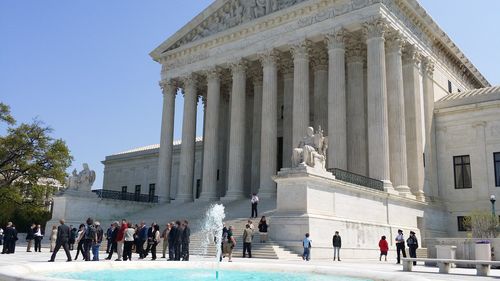
We were in the neighborhood, so decided to drop in on today’s Supreme Court oral arguments in Horne v. U.S.D.A., No. 14-275, the case about the taking of California raisins. 

The arguments ended a few minutes ago, and here’s our initial thoughts:

  • The Leviathan of the regulatory state was on full display today, with the government arguing that the seizure of the raisins wasn’t a taking, it was an “in-kind tax” and “just a standard regulation.”
  • The government actually argued that these regulations benefitted the Hornes, and that they were free to do other things with their grapes if they didn’t like the raisin regulations and government seizure.
  • The Monsanto and Leonard cases will figure prominently in the opinions. Read them again. 
  • Our initial tally: there’s enough votes to find that the USDA cannot fine the Hornes for violating the regulations because to do so would be a taking.


Continue Reading SCOTUS Oral Arguments In Horne (Taking California Raisins) – First Report

On Wednesday, April 22, 2015, the Supreme Court will hear oral arguments in Horne v. U.S.D.A., No. 14-275, the second time this case has been to the Court. 

The first time around, the unanimous Court held that the Hornes could raise the Takings clause as a defense to the USDA’s action to enforce a regulatory scheme that Justice Kagan characterized as perhaps “the world’s most outdated law,” and which was derided by Justice Scalia as “a crazy statute.”

The Court remanded the case to the Ninth Circuit, which, to no one’s real surprise, held that the scheme was not a taking. The Court again granted cert to consider these Questions Presented:

  1. Does the government’s “categorical duty” under the Fifth Amendment to pay just compensation when it “physically takes possession of an interest in property,” Arkansas Game & Fish Comm’n v. United States, 133 S. Ct. 511, 518 (2012),


Continue Reading Raisin Takings Case Round II: Oral Argument Preview