


The Texas Supreme Court is generally pretty good about property rights. See this opinionthis one, and this one, for examples.

So when the legal analysis in one of its regulatory takings/inverse condemnation opinions has the following language — especially in a case where a municipal government has treated the plaintiffs/property owners very badly — it would be understandable if you predicted the court was coming down on the side of the property owners:

The right to acquire and maintain private property is among our most cherished liberties. As Locke explained, the value of private property lies not only in its objective utility, but also in any personal investment therein. See John Locke, Two Treatises of Government 134 (Thomas I. Cook ed., Hafner Press 1947) (1689). Accordingly, the right to undisturbed enjoyment of residential property is all the more sacred. The unique importance of the home is reflected in our Bill of

Continue Reading Texas (Reluctantly) Finds No Regulatory Takings Claim
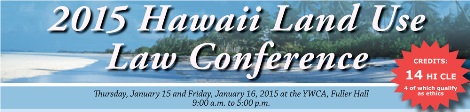
2015 Hawaii Land Use Law Conference Banner - Credits

Registration is now open for the 2015 Hawaii Land Use Law Conference, to be held in downtown Honolulu on Thursday-Friday, January 15-16, 2015.

This is the bi-annual conference, co-chaired by U. Hawaii lawprof David Callies and land use lawyer Ben Kudo, that brings together the big names in our area of law. In other words, the one conference you don’t want to miss if you are a Hawaii land use or property lawyer, in-house counsel, a planner, an appraiser, a property owner or manager, or a law student interested in these topics. 

Download the full brochure here, or view it below. 

The keynote speaker this year is lawprof Richard Epstein, addressing “Stealth Takings: Exactions, Impact Fees and More.” Immediately following his talk, I will be moderating a panel on “Impact Fees and Exactions After Koontz,” with colleagues Bruce Voss and David Brittin. The rest

Continue Reading Registration Open: 2015 Hawaii Land Use Law Conference, Jan. 15-16, 2015

Here are all of the amici briefs in support of the property owners/petitioners in Kurtz v. Verizon New York, Inc., No. 14-439 (cert. petition filed Oct. 14, 2014).

That’s the case in which the Second Circuit threw out a complaint on Williamson County ripeness grounds. Odd thing was that the court held that a procedural due process claim was not ripe under Williamson County‘s exhaustion of state remedies prong. But as we wrote here (and in our amicus brief for NFIB Small Business Legal Center), Williamson County is built on a takings-specific rationale: a federal takings claim is not ripe for federal court review until just compensation has been denied by the state (including a state court).


Continue Reading Amici Briefs In SCOTUS Due Process Ripeness Case – The End For Williamson County?

Here’s another one of those police power vs. takings cases, again involving governmental liability for destroying property supposedly in order to save it. We think the Alaska Supreme Court’s decision in Brewer v. Alaska, No. 14-916 (Nov. 28, 2014) got the analysis right, and properly shifted the focus in these cases from the government’s police power reasons for taking the actions which it did, to whether those actions were within the scope of the necessity doctrine.

Like others, Brewer involved landowners suing the government for setting fires on their land to stop or prevent wildfires (such as this case from the Federal Circuit). In Brewer, the land was designated for “aggressive initial attack” in the event of a fire. In 2009, the “Railbelt Complex” wildfire approached the properties, at which point, the state set fire to vegetation around the owners’ homes to deprive the fire of fuel. When the

Continue Reading Alaska: Police Power Not A Blanket Exception To Takings Liability – State May Be Liable For Backfires

Check out this story from today’s Greensboro/Winston-Salem (NC) News-Record, “DOT’s long road to nowhere angers property ownersabout the practice in North Carolina of using “protected corridors” to designate property under the state’s Transportation Corridor Official Map Act for future highway use, but then not condemning and paying for the land (while preventing the owners from making any use of it). 

We posted about the NC Supreme Court’s decision in one of those cases, where the court concluded that the property owners could not litigate it as a class action, but must do so in individual cases (800 of them!). Another post on the Map Act cases here (“Lines On A Map” Or Inverse Condemnation: How Long Can A Taking Be Only ‘Planned’ But Not Executed?“). 

The News-Record story is a good read, and a quick summary; recommended reading. It doesn’t hurt that the

Continue Reading N.C.’s Map Act: Clouding Use By Condemnation On The “Long Road to Nowhere”

Here’s the audio of the recording of the ABA talk we did last week on the Starr International v. USA takings case, “Taking AIG Without Compensation: The $40 Billion Question,” now ongoing in the Court of Federal Claims. The materials and links referred to in the talk are available here. If streaming doesn’t work for you, download the mp3 here.

Continue Reading Audio Of ABA Talk On Starr International v. United States Trial: Taking AIG Without Compensation – The $40 Billion Question

For those of you who couldn’t join us at the William & Mary Law School last month for the Brigham-Kanner Property Rights Conference (see our report here), the law school has made videos of the four panel presentations available here

They’re high quality videos, so be prepared for big downloads, but the presentations are worth it. While they are all good, our favorite was the impromptu discussion/debate during the third panel, “Balancing Private Property and Community Rights,” featuring panelists Kames Burling (Pacific Legal Foundation), Professors Richard Epstein (NYU), Steven Eagle (Geo. Mason), Mark Poirer (Seton Hall), and James Stern (William & Mary). 

Continue Reading Brigham-Kanner Property Rights Conference – Panel Videos Now Available

To all who were able to join today’s ABA Section of Real Property, Trust and Estate’s Condemnation, Zoning and Land Use Committee’s call on the AIG takings trial, currently pending in the U.S. Court of Federal Claims, thank you for participating. I’ve posted the entire talk (minus questions) above.

Here are the links to the stories, analysis, and materials I mentioned: 

  • The original complaint, first filed in the CFC in November 2011. 
  • Second Amended Complaint in the CFC case, along with Mr. Boies’ quote that this will be “an easy case to litigate.” We described the case as “audacious,” if only because it seeks $25 billion in just compensation. 
  • Professor Gideon Kanner’s (who has been following this case more closely than we have) first thoughts on the complaint. 
  • The CFC’s Opinion and Order granting in part and denying in part the United States’ motion to dismiss.  


Continue Reading Links From Today’s ABA Talk On The AIG Bailout Takings Case

Today, on behalf of the National Federation of Independent Business Small Business Legal Center, we filed this amicus brief in Kurtz v. Verizon New York, Inc., No. 14-439 (cert. petition filed Oct. 14, 2014). The cert petition, filed on Kurtz’s behalf by the Institute for Justice, is posted here

That’s the case in which the Second Circuit threw out a complaint on Williamson County ripeness grounds. Odd thing was that the court held that a procedural due process claim was not ripe under Williamson County‘s exhaustion of state remedies prong. But wait, you say, Williamson County is based on a takings-specific rationale: a federal takings claim is not ripe for federal court review until just compensation has been denied by the state (inclulding a state court). That’s what our brief says, too: 

For nearly 30 years, Williamson County’s state remedies requirement has required federal courts to

Continue Reading New Amicus Brief: Overrule Williamson County! (At Least The State Exhaustion Requirement)

So, the President today announced support of “net neutrality,” which Wikipedia describes as “the principle that Internet service providers and governments should treat all data on the Internet equally, not discriminating or charging differentially by user, content, site, platform, application, type of attached equipment, or mode of communication.”

President Obama has come out in support of reclassifying internet service as a utility, a move that would allow the Federal Communications Commission to enforce more robust regulations and protect net neutrality. “To put these protections in place, I’m asking the FCC to reclassifying internet service under Title II of a law known as the Telecommunications Act,” Obama says in a statement this morning. “In plain English, I’m asking [the FCC] to recognize that for most Americans, the internet has become an essential part of everyday communication and everyday life.”

Full story here. Sounds pretty good, right?

Maybe not

Continue Reading The Eminent Domain Angle In “Net Neutrality”