DSCF2208

You can’t have rights without advocates.”

                              – Michael Berger

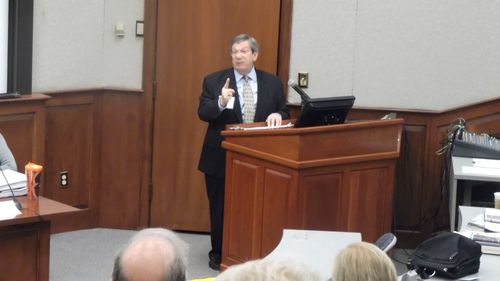
We’re at the William and Mary Law School in Williamsburg, Virginia today for the 11th Brigham-Kanner Property Rights Conference. As we’ve noted earlier, Michael Berger is this year’s B-K Prize honoree, for his career contributions to property law and his “scholarly work and accomplishments [which] affirm that property rights are fundamental to protecting individual and civil rights.”

The list of past recipients is an All-Star roster of property scholars and jurists, including lawprofs Frank Michelman, Richard Epstein, James Ely, Carol Rose, Thomas Merrill, and Supreme Court Justice Sandra Day O’Connor (the latter perhaps more for where she ended up in her Supreme Court career than where she started). See the plaque on the Law School’s wall for the complete list of

Continue Reading 2014 Brigham-Kanner Property Rights Conference Report: Honoring Michael Berger

Banner

If you haven’t already, please mark you calendars: the agendas and faculty lists for the February 5-7, 2015 ALI-CLE eminent domain programs in San Francisco have been finalized. Registration is ongoing, and there’s even a few more days left for the early registration discount. Substantial group discounts are also available. 

We’re talking, of course, about Eminent Domain and Land Valuation Litigation (the “masters” program, now in its 32nd year), and Condemnation 101: How to Prepare and Present an Eminent Domain Case (the boot camp or refesher course on eminent domain fundamentals).  We’re the co-Planning Chair of the Eminent Domain and Land Valuation Litigation program along with Joe Waldo, and we think we’ve assembled an exciting agenda, presented by a faculty comprised of the nation’s best-of-the-best in our field of law.

Some highlights:

  • Eminent Domain National Law Update – Amy Brigham Boulris, Gunster, Yoakley & Stewart, P.A.,


Continue Reading ALI-CLE 2015 Eminent Domain and Land Valuation Litigation & Condemnation 101 Agendas And Faculty Announced

We didn’t think the issue of whether a property owner is competent to testify about the value of his or her own property was unsettled, but apparently an Alaska trial court did. In an inverse condemnation action which claimed that the operation of a nearby airport diminished Mr. Briggs’ property value, the court granted the City summary judgment “because the property owner failed to submit any expert testimony regarding damages.” 

The Alaska Supreme Court reversed. In Briggs v. City of Palmer, No. S-14969 (Sep. 12, 2014), the court concluded that an inverse condemnation plaintiff does not need expert testimony to prove the value of damages, relying on established Alaska law. The court cited several of its own earlier decision which hold that property owners are competent to testify about the value of their own property. 

Given that precedent, what gives? What would make the trial court conclude otherwise? Maybe

Continue Reading Alaska: Owner Can Testify About Value Of Their Own Property

Here’s one for the regulatory takings mavens, because it has just about every conceivable issue: ripeness, res judicata (yes, arugment was that the complaint was filed both too early and too late), RookerFeldman, the Tax Injunction Act, and an analysis of whether the property owner’s complaint stated a claim for relief under the Takings Clause. 

At issue in Coleman v, District of Columbia, No. 13-1456 (D. D.C. Sep. 30, 2014) was the District’s statutory provision which allowed it to place a lien on properties whose owners do not pay their full property tax bill, and then sell the property at auction if the lien is not satisfied. So far so good – this scheme isn’t that much different from similar provisions in virtually every state. The problem with DC’s system is that “the law permits the taking of not only the amount of delinquent taxes, plus any

Continue Reading Federal Court: DC’s Tax Sale Statute May Be A Taking

We like the Texas Supreme Court, because (among other things) it livestreams oral arguments, and once completed, archives them for those who can’t be there in person, or watch live. So even though we couldn’t make it to Austin for the arguments earlier this month in Texas v. Clear Channel Outdoor, Inc. (a case which we posted about here), we were able to follow along with the archived video

The case presents two questions: first, whether a billboard owner is entitled to just compensation when the land on which it sits is taken by eminent domain because it may be possible to relocate the billboard, and second, what method of valuation can be used to measure compensation, if so. We filed an amicus brief in the case arguing that “[b]illboards are not designed to be moved. And the most valuable part of a billboard is not steel

Continue Reading Oral Argument Video In Texas Supreme Court Condemnation Case: Is A Billboard Moveable Property?

Here’s one to definitely add to your blogroll: Federal Takings, by the rails-to-trails litigation practice at Arent Fox, including our frequent guest blogger, Thor Hearne. 

The focus is on rails-to-trails cases, but also by necessity covers takings cases in the Court of Federal Claims and the Federal Circuit. Recent posts include, “Arent Fox Files ‘Rails to Trails’ Cert Petition with US Supreme Court for High Line Park Landowners,” and  a summary of an ongoing R-T-T case from Michigan. 

Highly recommended. 

Continue Reading New Blog Worth Following: Federal Takings

Here’s one to add to the “unusual takings cases” category, at which we looked at last week

In  Young v. Larimer County Sheriff’s Office, No. 13CA1338 (Sep. 11, 2014), the sheriff raided Mr. Young’s (medical) marijuana grow and seized as evidence “forty-two mariijuana plants by cutting them off just above the roots.”

Now, we don’t know much of anything about the botany of the cannabis plant, medical or otherwise. And the court might not have any specialized knowledge either. But it doesn’t take Cheech and Chong to know that “[t]his action killed the plants.” Slip op. at 2. Bummer, man. 

The jury was more kind to Mr. Young than was the sheriff. It bought Young’s claim that his weed was not evidence, but medicine under the Colorado medical marijuana statute. The “jury acquitted him of all charges based on the affirmative defense of medical use of marijuana by

Continue Reading No Taking When Sheriff Took His (Medical) Weed

Like love, takings claims can often be found in some very unusual places. And (like love) unfortunately, those claims are not always successful.

When we think of “takings,” things like eminent domain condemning land, inverse condemnation (of land) by flood waters, and cases like that spring to mind first. Even when regulatory takings are involved, the conventional view at least starts with claims about land, and although the Supreme Court hasn’t come out and said it, the argument has been made that the takings and exaction/unconstitutional conditions doctrines are reserved for claims involving land. 

But not always so. 

Here are three recent decisions where property rights and takings came up in situations you might not have expected.

Takings and Labor Law

The first is from the U.S. Court of Appeals for the Seventh Circuit. In Sweeney v. Pence, No. 13-1264 (7th Cir. Sep. 2, 2014), the court held that

Continue Reading Lookin For Takings In All The Wrong(?) Places

A reminder: the 11th annual Brigham-Kanner Property Rights Conference is coming up on October 30-31, 2014, at the William and Mary Law School in Williamsburg, Virginia. As we noted earlier, Michael Berger will receive the Brigham-Kanner Prize, so this one is special – he’s the first practitioner to receive the Prize.

More here, from W&M, including agenda and registration information. Here’s the flyer.

We’re going – hope to see you there. 

11th Annual Brigham-Kanner Property Rights Conference – Oct 30-31, 2014 – Michael Berger

Continue Reading October 30-31, 2014: Brigham-Kanner Property Rights Conference @ William & Mary Law

2010-03-24 15.24.40
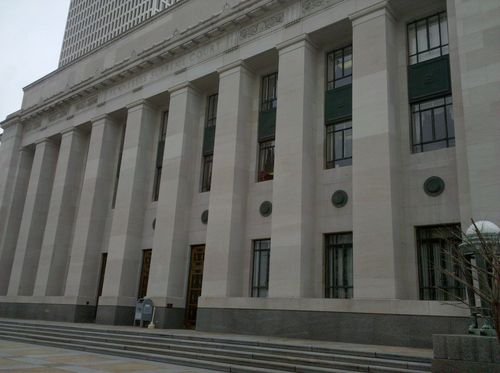
Tennessee Supreme Court, Nashville

In Phillips v. Montgomery County, No. M2012-00737-SC-R11-CV (Aug. 18, 2014), the Tennessee Supreme Court held that a property owner could recover under the state’s inverse condemnation statute, Tenn. Code Ann. § 29-16-123, for a regulatory taking:

We hold that, like the Takings Clause of the United States Constitution, article I, section 21 of the Tennessee Constitution encompasses regulatory takings and that the Property Owners’ complaint is sufficient to allege a state constitutional regulatory taking claim, for which they may seek compensation under Tennessee’s inverse condemnation statute, Tennessee Code Annotated section 29-16-123.

Slip op. at 12.

That’s all well and good, and we applaud the court for doing so. But wait a minute, you say, that statute and this issue sure sound familiar.

Indeed they do. This is the same statute which the U.S. Supreme Court, in Williamson County Regional Planning Comm’n v. Hamilton Bank

Continue Reading Tennessee Finally Recognizes Regulatory Takings Cause Of Action – A Quarter Century After The US Supreme Court Wrongly Assumed It Did