Is there a more appropriate place at which to study property rights and dirt law than William and Mary Law School? After all, it is a stone’s throw from Jamestown, the place where there’s a good argument the concept of property law and property rights first took hold in the New World. As noted by author David Price in “Love and Hate in Jamestown – John Smith, Pocahontas, and the Start of a New Nation” –

The introduction of private property for the common citizen had a salubrious effect on the owners’ sense of initiative, as John Rolfe would observe. By the end of 1619, he reported, the “ancient” (or longtime) colonists had chosen their allotments, “which giveth all great content, for now knowing their owne lande, they strive and are prepared to build houses and to cleare their grounds ready to plant, which giveth …

Continue Reading Ye Olde Law 608: Eminent Domain & Property Rights, S5E1 @ William & Mary Law
IRWA

The International Right of Way Association‘s Real Estate Law Committee produces twice-a-year reports “which contain summaries of eminent domain decisions and legislation within the United States.”

And what is really nice is that they make the report available

We’re posting it here because we’re one of the co-authors. Hat tip to our co-authors Brad Kuhn, Jillian Friess Leivas, and Ajay Gajaria.

The report is short, and doesn’t contain a lot of fluff. Just what you wanted.Continue Reading IRWA’s Summary Of Major Eminent Domain Cases & Legislation (Jan-May 2022)

Last week, along with my colleagues Deborah La Fetra and Kady Valois, we filed this cert petition in a case we’ve been following (even before we joined as counsel).

The petition seeks review of the Fifth Circuit’s opinion holding that there’s nothing a federal court can do if a local government does not pay a state-court just compensation judgment for an unreasonably long time. Because we are counsel in the case we won’t go into further detail, but will leave it to you.

Here’s the Question Presented:

A fundamental element of just compensation is “certain payment of the compensation without unreasonable delay.” Bragg v. Weaver, 251 U.S. 57, 62 (1919). In 2013, the Sewerage & Water Board of New Orleans inversely condemned the properties of 70 home and business owners for a flood control project. The property owners obtained state court judgments starting in 2018. Louisiana law

Continue Reading New Cert Petition (Ours): Can Condemnor Delay Actually Paying Compensation Indefinitely?

Here’s the latest in an issue we’ve been following for a while. You recall that several years ago, a divided panel of the Ninth Circuit held there’s nothing particularly special about an unresolved takings claim for just compensation that sets it apart from other creditor claims in a government bankruptcy.

The Ninth Circuit majority held that owners who assert their property was taken by the debtor-government before the bankruptcy — but who have not been compensated — are just unsecured creditors who must “share[] the pain” of the government going broke and sloughing off debt, even if it means that as a result the owner has had its property taken without just compensation. SeeNinth Circuit: Inverse Condemnation Plaintiff Must “Share The Pain” – City Can Shed Obligation To Pay Just Compensation In Bankruptcy, Which Is ‘Purely A Monetary Claim’.”

Next up, Round 2: In In re Financial

Continue Reading CA1 Splits With CA9: “[T]he Fifth Amendment precludes the impairment or discharge of prepetition claims for just compensation in Title III bankruptcy.”

Screenshot 2022-07-07 at 13-44-38 The Brigham-Kanner Property Rights Conference

By now, you know that the 19th Brigham-Kanner Property Rights Conference is set for September 29-30, 2022, at the William and Mary Law School in Williamsburg, Virginia (register here – space is limited – fee ranges from free to $195 – a bargain!). And you know that our colleague Jim Burling is this year’s B-K Prize winner.

But now you know who is speaking at the Conference, and the topics: here’s the full agenda. The list of speakers is too long to list here but check out these topics:

  • Panel 1: The Importance of Property Rights: A Tribute to James S. Burling
  • Panel 2: Reshaping the Framework Protecting Property Under the Roberts Court (that’s the panel we’re speaking on)
  • Roundtable: Emerging Issues in Takings and Property Rights Litigation
  • Panel 3: Choosing A Property Regime
  • Panel 4: Property Rights in Times of Scarcity and Crisis

Who can

Continue Reading Here’s The Full Speaker And Topic List For The Brigham-Kanner Property Rights Conference (Sep 29-30, 2022)

Untitled Extract Pages

In honor of property rights advocate and trial lawyer Toby Prince Brigham (1934-2021), Owners’ Counsel of America has endowed a scholarship for a second- or third- year law student to attend the annual three-day ALI-CLE Eminent Domain and Land Valuation Litigation Conference (the upcoming Conference will be in Austin, Texas, February 2-4, 2023.

In honor of Toby’s legacy of professionalism and achievement, in 2021 OCA established the Toby Prince Brigham OCA Scholarship to pay for all expenses of a second or third year law student to attend the ALI-CLE Eminent Domain conference and associated OCA events held annually in January. This unique scholarship affords the student the opportunity to learn about the substantive law of eminent domain and property rights, while also meeting and networking with the leading lawyers in these practice areas from across the country. This is what the very first Toby Prince Brigham OCA scholar, Nina Sawaya

Continue Reading Owners’ Counsel Toby Prince Brigham Scholarship – Applications Being Accepted!

Book_475

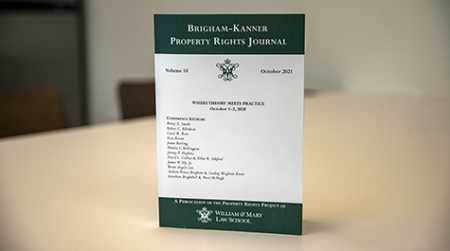
In case you have not already obtained your printed copy (you really should subscribe), it is now available in pdf format.

The theme for the issue is “Where Theory Meets Practice,” and with articles on “Property Beyond Flatland,” “Property Rights and the Modern Resurgence of Rent Control,” “Hurdles to Just Compensation,” “Implied Preemption in the Regulation of Land,” and “‘Equitable Compensation’ as ‘Just Compensation’ for Takings.” And more.

Check out the complete article list here, or below.

And don’t forget to mark your calendars for the 2022 Brigham-Kanner Property Rights Conference, in Williamsburg and the William and Mary Law School, September 29-30, 2022. Plan on joining us in the fall for what is, in our opinion, the best single-day conference on property rights.

Table of Contents, Brigham-Kanner Prop. Rts. J. vol. 10 (2021) Continue Reading Brigham-Kanner Property Rights Journal Vol. 10 Now Available

On one hand, there’s nothing terribly surprising about the Texas Supreme Court’s opinion in Hlavinka v. HSC Pipeline Partnership, LLC, No. 20-0567 (May 27, 2022) holding that yes, “polymer-grade propylene” qualifies as an “oil product” under Texas statutes that allow a private pipeline company to take property to transport oil products, and that yes, a private pipeline counts as a public use. After all, the first sentence of the opinion sets the context for those of you who may not realize how important the energy industry is to that state:

Recognizing the important role that pipeline development plays in meeting our state’s manufacturing and energy needs, the Legislature grants common carriers the right to condemn private property for the construction of pipelines that transport certain products.

Slip op. at 1.

But on the other hand, the very last portion of the opinion gives a hint that maybe the court

Continue Reading Texas: At Least One Customer Is Served So Pipeline Is A Public Purpose, But Let’s Loosen Valuation Rules For Energy Corridors

Not too long ago, we posted the Fifth Circuit’s panel opinion in a case where the court held that there’s nothing a federal court can do if a local government does not pay a state-court just compensation judgment. We filed an amicus brief in that case arguing “[t]he Takings Clause does not permit the Sewerage Board to take property and hand the owner an IOU the Board might pay sometime in the future if and when it feels like it. Instead, it requires the Sewerage Board to pay the court ordered just compensation without ‘unreasonable delay.'”

Well, in the interim we’ve traded in our amicus hat for a co-counsel hat, and last week asked the Fifth Circuit to rehear the case en banc, via this en banc petition.

Since we’re now co-counsel in the case, we won’t go into further detail, but will leave it there for you to

Continue Reading Are The Federal Courts Powerless When A Condemnor Doesn’t Pay Just Compensation?

Here’s an issue that we’ve been following for a while. What will a court do when a condemnor is ordered to pay (the property owner has a judgment in hand), but the condemnor says “no thanks”?

The latest incarnation is the U.S. Court of Appeals’ opinion in Ariyan, Inc. v. Sewerage & Water Board of New Orleans, No. 21-30335 (Mar. 21, 2022). There, a group of property owners successfully brought Louisiana law takings claims against the Board after its flood control project caused “property damage and economic loss.” In the various cases, verdicts were rendered, and judgments were issued from 2018 through 2020.

Well, you know what is supposed to happen next. Judgment debtors are supposed to pay up, or else the judgment creditor may satisfy the judgment by other means.

But when the government is the judgment debtor, the creditor can’t just put a lien on City

Continue Reading What Can A Property Owner Do When A Condemnor Doesn’t Pay? (Fifth Circuit: Nothing)