Screenshot 2022-02-15 at 07-42-11 Eminent Domain Reports - Publications IRWA

Check this out: the International Right of Way Association’s Real Estate Law Committee produces twice-a-year reports “which contain summaries of eminent domain decisions and legislation within the United States.” (This is the “international” right of way association, so that last qualifier is important.)

And what is really nice is that they make the report available

We’re posting it here because we’re one of the co-authors. The laboring oars on this are really Brad Kuhn and Jullian Friess Leivas (both from the Nossaman firm), but they were kind enough to ask me for some input.

Brad and Jillian wrote up more at the California Eminent Domain Report.

The report is short, and doesn’t have a lot of fluff. Just what you wanted.Continue Reading IRWA’s Summary Of Major Eminent Domain Cases & Legislation (June-Dec 2021)
PXL_20220127_144224442

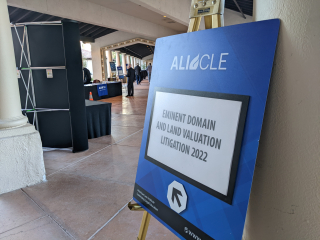
After a two-year absence in which we went remote, in the last week of last month (our usual spot on the calendar, between the playoffs and Super Bowl), we once again met in-person for the American Law Institute-CLE Eminent Domain and Land Valuation Litigation Conference.

Approximately 200 lawyers, judges, legal scholars, appraisers, law students, right-of-way agents, relocation experts, property owners, and other related professionals gathered in-person–yes, in-person–at the Scottsdale (Arizona) Resort at McCormick Ranch, to get reacquainted, learn stuff, and renew ties last made in-person in Nashville in 2020. In addition to the live attendance, we also welcomed about 50 remote colleagues, who joined the live webstream.

This was the 39th edition of the Conference, one of the most-established and successful conferences in the ALI-CLE stable of programs.

To those who joined us – thank you. This conference reminded us of why this program is so

Continue Reading 2022 ALI-CLE Eminent Domain And Land Valuation Litigation Conference, Scottsdale: You Should Have Been There!

Screenshot 2022-01-24 at 11-03-28 “Equitable Compensation” as “Just Compensation” for Takings

An article, from the just-published issue of the Brigham-Kanner Property Rights Journal, about a rarely-covered academic topic, just compensation.

Brian A. Lee (Brooklyn), “Equitable Compensation” as “Just Compensation” for Takings, 10 Brigham-Kanner Prop. Rts. J. 315 (2021).

Here’s the Abstract:

The Fifth Amendment’s requirement that the government pay “just compensation” to owners of taken property is typically assumed to mean “full” compensation, equivalent to the taken property’s fair market value. In this symposium contribution to the Brigham-Kanner Property Rights Journal, I explore an often overlooked alternative understanding of “just compensation” for takings, one freed from automatic equation with full, fair-market-value compensation. Rooted in traditional equity, this “equitable compensation” alternative has significant historical roots, starting with the Fifth Amendment’s drafters’ striking choice not to follow the Northwest Ordinance of 1787’s requirement of “full” compensation, and running through a line of cases and commentary that has emphasized takings compensation’s equitable

Continue Reading New Article: “‘Equitable Compensation’ as ‘Just Compensation’ for Takings” (Brigham-Kanner Property Rights Journal)

If you ever get the opportunity to teach in a law school — either as a full-time legal scholar, or part-time as an expert adjunct practitioner — take it if you can. You might think you know a lot about a particular subject, but there’s nothing like spending time at the lectern in a law classroom in front of sharp and eager lawyers-in-training to sharpen your thoughts, and get you to truly understand a subject.

And folks calling you “professor” can evoke a smile.

Sensei

But if there’s one downside to the law school experience from the teacher’s side of the lectern, it’s grading. Especially at a law school like William and Mary that has a pretty strict mandatory curve. In upper-division courses that we handle like Eminent Domain and Property Rights Law and Land Use — where we’re dealing with some very high-level stuff and the quality of the

Continue Reading The Circle Is Now Complete: A Sampling Of Final Paper Topics From William and Mary Law’s Eminent Domain & Property Rights, And Land Use Courses

There’s not a lot of direct takings love in the U.S. Court of Appeals for the Second Circuit’s opinion in Melendez v. City of New York, No. 20-4238 (Oct. 28, 2021), but there’s enough there that you might want to read it anyway.

Because the opinion resurrected the plaintiffs’ Contracts Clause claim. You heard that right, their Contracts Clause claim. The plaintiffs asserted that New York City’s ordinance that prohibiting “threatening” a tenant due to their Co-19 status violated free speech and due process rights, and the city’s ordinance voiding personal guarantees for commercial leases impaired their lease contracts. The district court dismissed the case for failure to state a claim, concluding that the guaranty ordinance served a legitimate public purpose and did not favor any class.

The Second Circuit affirmed dismissal of the free speech and due process claims, but also concluded that the complaint alleged a plausible

Continue Reading CA2: NYC’s Eviction Moratorium May Have A Contracts Clause Problem

PXL_20211001_131054682Joe Waldo leading off the Conference with a remembrance of
Toby Prince Brigham, for the eminent property rights practitioner
for whom the Conference is named.

I was honored to speak today at the 2021 Brigham-Kanner Property Rights Conference, and here’s a rough transcript of my remarks.

Seeking Justice Through Just Compensation

Dean Spencer, Professor Been, Professor Butler, and colleagues.

The title of our session is “The Relationship between Eminent Domain and Social and Racial Injustice,” and my colleagues have ably covered the ways in which limitations on the power to take can move us towards justice. And there is little I might add to their contributions, except to note this, a quote from a commentator in a recent story about historical “slum clearance” in the Tampa, Florida, area:

“If you want to know where historic Black neighborhoods were once located, look for a sports arena or

Continue Reading Seeking Justice Through Just Compensation: 2021 Brigham-Kanner Property Rights Conference

PXL_20210920_195630876

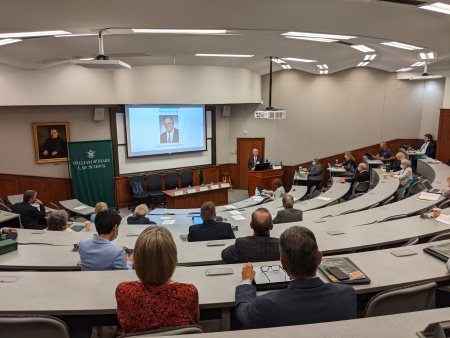
There’s still plenty of time to register and join us for the 18th Annual Brigham-Kanner Property Rights Conference at the William and Mary Law School, Thursday and Friday, September 30 and October 1, 2021.

Yes, you may attend in-person, or remotely. The registration fees are very reasonable, ranging from $0 (yes, free!) to $200 (go here, and click “Tickets” for the details).

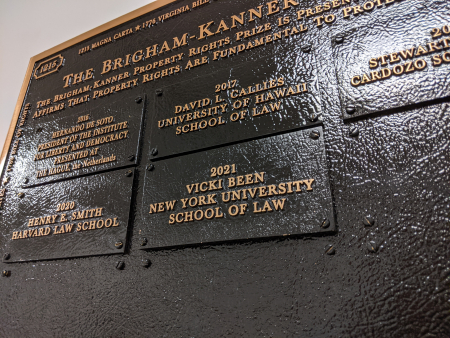
This year’s Brigham-Kanner Property Rights Prize winner is Professor Vicki Been (NYU Law). The Conference includes presentations on:

  • Remembering Toby Brigham
  • The Role of Empirical Research in Defining the Scope of Constitutionally Protected Property Rights: A Tribute to Been
  • The Relationship between Eminent Domain and Social and Racial Injustice (this is the panel on which we’ll be presenting)
  • Just Compensation Issues, Changing Public Uses, and Other Recent Developments
  • The Interdependence of Property and First Amendment Rights
  • The Distributional Implications of Land Use Regulation

Details on

Continue Reading 2021 Brigham-Kanner Property Rights Conference (Sep. 30 – Oct. 1, 2021) – Still Time To Join Us

All the topics you want to know about, presented by top-notch faculty from across the nation. Sessions include:

  • Keynote: Do Animals Have Property Rights?
  • Did the Supreme Court Signal a New Direction in Property Rights in Cedar Point Nursery?
  • Maximizing Relocation Benefits: Understanding the Law and Regulations to Ensure Fairness
  • Challenging Public Use: Lessons From a 67-Day Trial
  • COVID Takings
  • Property Rights as Civil Rights
  • Eminent Domain National Update
  • Federal Court and the Daubert Challenge: How to Prepare
  • How to Position Your Client for the Fallout When Projects Don’t Get Built
  • Rural Broadband and the Emerging Constitutional Challenges
  • Are Precondemnation Entry Statutes Still Valid After Cedar Point Nursery?
  • How Condemnor and Property Owners’ Counsel Prepare the Battlefield
  • How Will the Trillion Dollar Infrastructure Bill Impact Your Practice?
  • Ethics
  • …and more, including a full slate of networking and social events!

We’ve sold out the last few years, so don’t Continue Reading Registration Open Now: ALI-CLE Eminent Domain & Land Valuation Litigation Conference, Jan 26-29, 2022, Scottsdale

IMG_20200914_132901

Yes, it’s that time of the year again. Fall’s-a-coming, and that means that soon, we’ll be back at the William and Mary Law School in Williamsburg, Virginia to lead two courses:

  • Eminent Domain and Property Rights
  • Land Use Controls

Unlike last year, we’re not going to be on Zoom, or in the Tennis Center, or even spread out in a distanced classroom. Back in-person with some precautions taken.

The registration numbers are good (really good), and two full classrooms will be a nice sight after what seems like a very long time.

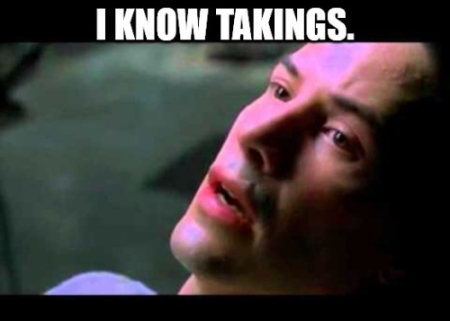
Time to jack back into the (takings and land use) Matrix.

6a00d83451707369e20240a476d216200c-800wiContinue Reading Back To School: Season Four

You just have to love any case that starts with the sentence, “Dried mangoes form the core of this commercial dispute, which involves a Fifth Amendment challenge…” Shades of Horne!

Well, you can add mangoes to your “healthy snack” list (hat tip CJ Roberts) and include the Supreme Court of Guam’s opinion in Western Sales Trading Co. v. Genpro Int’l, Inc. (Guam), No. CVA19-023 (July 28, 2021), in your oeuvre of fruit/takings cases, because the court held that a territorial statute permitting a judgment creditor to take property from a third party (who obtained it from the judgment debtor) violates the Takings Clause. The court concluded that Guam Code Ann. §§ 23401-23406 (the “turnover statute”) works an unconstitutional taking in violation of the Fifth Amendment and the Guam Organic Act. Follow along.

The statute allows a judgment creditor to apply to the Guam courts for an

Continue Reading Inorganic Fruit: Statute That Allows Creditor To Seize Property From Third Party Rec’d From The Debtor Is A Taking