


Here’s the recording of last month’s Federalist Society’s Environmental Law & Property Rights Practice Group teleforum, “Just Compensation: A Suggestion or a Requirement?

Can states unilaterally decide not to pay takings judgments? Some states think so. Louisiana and Florida have laws that say no takings judgment can be paid unless money is specially appropriated to do so—and then they never get around to appropriating the money to pay. These laws are currently being challenged in the Fifth Circuit and the Florida Supreme Court. Please join us for an interesting discussion of this litigation.

Featuring:

Robert McNamara, Senior Attorney, Institute for Justice

Daniel Woislaw, Attorney, Pacific Legal Foundation

Stream above, or download it here.Continue Reading What If Govt Is Obligated To Pay … But Doesn’t? Podcast: “Just Compensation: A Suggestion or a Requirement?”
A new, must-add-to-your-reading-list article from takings and expropriations law scholar Professor Shai Stern.

In “Pandemic Takings: Compensating for Public Health Emergency Regulation,” Professor Stern dives into a question a lot of us have been pondering lately, namely whether the pandemic-related shutdown orders might trigger the Just Compensation imperative in the Fifth Amendment’s Takings Clause.

Takings arguments have been raised in may of the legal challenges to coronavirus shut-down orders that have been filed nationwide (see here, here, here, here, here, here, here, here, here, here, here, here and here, for a sampling). But do these claims have any chance of succeeding? Read the article and find out. (Our thoughts on the takings aspects of the shutdowns orders: Evaluating Emergency Takings: Flattening The Economic Curve.) 

Here’s the Abstract:

The COVID-19 pandemic led all states

Continue Reading New Must-Read Article: “Pandemic Takings: Compensating for Public Health Emergency Regulation” (Prof. Shai Stern)

We were all set to dig into the New Jersey Supreme Court’s opinion in Township of Manalapan v. Gentile, No. A-14-19 (June 2, 2020), when our colleague Joe Grather posted about it on their firm’s blog. See also this story (“Manalapan farm owner’s $4.5M eminent domain payday dumped as ‘miscarriage of justice’“) (PS – the video embedded in the story is actually from a different case, not this one). 

The short story is that the property owner’s appraiser opined that the highest and best use of the property was to divide it into smaller lots. The problem was that under its current zoning (RE – “Residential Environmental”) that wasn’t possible. It would need an upzoning to its former designation, R20. But the appraiser did not offer an opinion on whether an upzoning would have been probable, or even possible. During closing arguments, the property owners reminded

Continue Reading NJ: Before Jury Can Make Highest And Best Use Determination, Judge Has “Gatekeeping” Function

LUI 2020 slider

Join us starting tomorrow, Tuesday, May 12, 2020 for the 34th Land Use Institute. Originally scheduled for April in Tampa, we obviously couldn’t do tha, so we did the next best thing — moved this venerable course online. The Planning Chairs (Frank Schnidman and Dean Patricia Salkin) have assembled the usual hot topics session and a lineup of expert faculty (we’re speaking at the 2:45 ET session on Federal Laws (in our case, NEPA, Water, and Wetlands (including the Maui case from SCOTUS)). 

The program takes place over three days Tuesday, Wednesday, and Thursday, and you can either register for the sessions or all three days, with various discounts if you are a member of the American Bar Association, and even more if you are a member of the Section of State and Local Government Law. 

Here’s the three-day agenda. There is a lot here to like, and we

Continue Reading Join Us This Week: May 12-14, 2020 For (Virtual) Land Use Institute Webinar Series

How should courts evaluate the claims for compensation arising out of emergency measures (many of which we’ve already seen; see here, here, here, here and here, for example)?

Rather than think about it piecemeal, we decided to write it up in a more comprehensive fashion. Here’s the result, so far. Rather than summarize it, let’s just cut-and-paste the Introduction. The complete piece is posted on SSRN, if you want to read it. 

Desperate times may breed desperate measures, but when do desperate measures undertaken during emergencies trigger the Fifth Amendment’s requirement that the government provide just compensation when it takes private property for public use?[1] The answer to that question has commonly been posed as a choice between the “police power”—a sovereign government’s power to regulate and restrict property’s use in order to further the public health, safety, and welfare[2]—and the eminent domain power, the authority to seize private property for public use with the corresponding requirement to pay compensation.[3]

But that should not be the question. An invocation of police power does not answer the compensation question at all, but is merely the predicate issue: all government actions must be for the public health, safety, or welfare, in the same way that an exercise of eminent domain power must be for a public use. In “normal” times, it is very difficult to win a regulatory takings claim for compensation. In the midst of emergencies—real or perceived—the courts are even more reluctant to provide a remedy, even where they should, and emergencies are a good time to make bad law, especially takings law. Emergencies do not increase government power, nor do they necessarily alter constitutional rights.[4] 

This article provides a roadmap for analyzing these questions, hoping that it will result in a more consistent approach to resolving claims for compensation that arise out of claims of emergencies—real or perceived. This article analyzes the potential takings claims stemming from emergency measures, mostly under current takings doctrine. What type of claims are likely to succeed or fail? Can a better case be made analytically for compensation?

Part I summarizes the economic “flattening the curve” principle that motivates takings claims for compensation. Part II sets out the prevailing three-factor Penn Central standard for how courts evaluate claims that a health, safety, or welfare measure “goes too far,” and requires compensation as a taking, examining the character of the government action, the impact of the action on the owner, and the extent of the owner’s property rights.[5] Deep criticism of Penn Central is beyond the scope of this article, and I will not here do more than accept it as the “default”[6]  takings test. But I do argue that the government’s motivation and reason for its actions—generally reviewed under the “rational basis” standard—should not be a major question in takings claims. Rather, as this article argues in Part III, the government’s emergency justifications should be considered as part of a necessity defense, and not subject to the low bar of rational basis, but a more fact and evidence driven standard of “actual necessity.” Part IV attempts to apply these standards and examines the various ways that emergency actions can take property for public use: commandeerings, occupations of property, and restrictions on use. I do not conclude that the approach will result in more (or less) successful claims for compensation, merely a more straightforward method of evaluating emergency takings claims than the current disjointed analytical methods.

In sum, this article argues there is no blanket immunity from compensation simply because the government claims to be acting in response to an emergency, even though its reasons and actions may satisfy the rational basis test. Instead, claims that the taking is not compensable because of the exigency of an emergency should only win the day if the government successfully shows that the measure was actually needed to avoid imminent danger posed by the property owner’s use, and that the measure was narrowly tailored to further that end.

————-

[1] See Robert Higgs and Charlotte Twight, National Emergency and the Erosion of Private Property Rights, 6 Cato J. 747 (1987) (“Much of the reduction [of private property rights] occurred episodically, as governmental officials too control of economic affairs during national emergencies—mainly wars, depressions, and actual or threatened strikes in critical industries.”).

[2] “Police power” describes everything a sovereign government can do. It even might be said to encompass the eminent domain power. See Hawaii Housing Auth. v. Midkiff, 467 U.S. 229, 240 (1984) (“The [Fifth Amendment’s] ‘public use’ requirement is thus coterminous with the scope of a sovereign’s police powers.).

[3] See U.S. Const. amend. V. The Fifth Amendment conditions the federal government’s takings power. See Barron v. Baltimore, 32 U.S. (7 Pet.) 243 (1833) (noting a wharf owner’s argument that city’s diversion of water pursuant to its police power could support a Fifth Amendment claim, but holding that the Fifth Amendment only limited the actions of the national government). The Fourteenth Amendment extended the just compensation requirement to the states as part of due process of law. See Chicago, B. & Q. R. Co. v. City of Chicago, 166 U.S. 226, 235 (1897).

[4] See Steven M. Silva, Closed for Business—Open for Litigation?, Nw. L. Rev. of Note (Apr. 29, 2020), https://blog.northwesternlaw.review/?p=1361 (“First, it must be recognized that the Constitution exists even in an emergency. The Constitution expressly permits some alterations to our ordinary system of rights during times of war—for example, the Third Amendment provides differing provisions for the quartering of soldiers in times of peace versus times of war—but those alterations are baked into the system, the Constitution does not disappear in war. And a pandemic is not even a war.”) (citing Home Bldg. & Loan Ass’n v. Blaisdell, 290 U.S. 398, 425 (1934))..

[5] Penn Cent. Transp. Co. v. New York City, 438 U.S. 104, 124-25 (1978).

[6] The Supreme Court has labeled Penn Central “default” test for regulatory takings. See Lingle v. Chevron U.S.A. Inc., 544 U.S. 528, 538-39 (2005).

Entire draft here

.
Continue Reading New Article – Evaluating Emergency Takings: Flattening The Economic Curve

Professor Josh Blackman’s posts over at the Volokh Conspiracy on the bump-stock takings case (and follow ups taking a deeper dive into the takings question, see this post, this post, and this post), got us to thinking. So we wrote up our thoughts, in which we noted that we thought the “self-executing” nature of the Just Compensation Clause means that even in the absence of a Tucker Act waiver of sovereign immunity, the federal government could be sued in an Article III court for compensation (“Lawprof Josh Blackman Asks: “Is there an express cause of action under the Takings Clause?“). This is the position we took in the Brott litigation, where we thought that the Tucker Act is unconstitutional to the extent that it denies a jury trial for compensation claims. But as you know, Brott ended up with “cert denied.”

But that also got

Continue Reading Taking A New Look At Takings Remedies: What If Just Compensation Really Isn’t The Remedy For An Inverse Condemnation?

IMG_20191209_125404 (1)

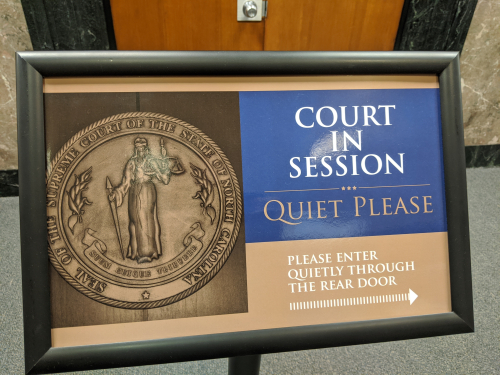
Back in December — only a few months ago, yet it seems like another world away — we attended oral arguments in Raleigh in a case we’ve been following for a long time, about North Carolina’s “Map Act.”

This case is the follow up (after remand) of the N.C. Supreme Court’s landmark decision in Kirby v. North Carolina Dep’t of Transportation, No 56PA14-2 (June 10, 2016), in which the court held that the “Map Act,” a statute by which DOT designated vast swaths of property for future highway acquisition, was a taking because the Act prohibited development and use of designated properties in the interim. The court concluded “[t]hese restraints, coupled with their indefinite nature, constitute a taking of plaintiffs’ elemental property rights by eminent domain.” The court remanded the case for a parcel-by-parcel determination of just compensation. Shortly after the decision in Kirby, the North Carolina Legislature

Continue Reading NC: There Isn’t Just One Way To Value An “Indefinite Negative Easement”

In a case that uses terms that might reasonably lead you to think it was lifted from the script for the next stoner comedy, the U.S. Court of Appeals for the Federal Circuit, in Gadsden Indus. Park, LLC v. United States, No. 18-2132 (Apr. 22, 2020), held that an owner of land on which the byproduct of milling steel was dumped possessed a property interest in some of the “slag,” but not as much of it as the owner claimed. The court also held that the property owner did not introduce evidence of its loss of use of the “kish” or the “scrap.” 

Before we go any further, here’s your daily dose of learning:

Slag, a byproduct of steel manufacturing, is “a non-ferrous material that separates during smelting.” Gadsden Indus. Park, LLC v. United States, 138 Fed. Cl. 79, 92 (2018) (Decision). Kish is “a ferrous byproduct

Continue Reading Fed Cir Bummer: Govt Bogarted None Of Your Kish, Slag, Or Scrap

Here’s a short one from the Florida District Court of Appeal where the background might be more relevant to today’s circumstances than the court’s actual holding about which party bears the burden of proof on valuation (and goes first at trial). 

First, the decision. In Florida Dep’t of Agriculture v. Mahon, No. 5D19-3102 (Apr. 9, 2020), the court held that in during the valuation phase (which comes after the trial judge determined there was a taking), the government bears the burden of proof and makes its presentation to the jury first. The court rejected the Department’s argument that, hey, in an inverse condemnation case the property owner is the plaintiff, and the usual rule in every other civil case is that plaintiffs go first. Making us go first here would deprive the Department of due process!   

Not so, held the court of appeal, government goes first in an

Continue Reading Fla App: In Valuation Phase Of Inverse Case, Condemnor Has Burden Of Proof

Well, here it is. What looks like the first complaint to be filed challenging a state governor’s order to shut down businesses to “flatten the curve.” 

The complaint seeks class action status, and raises section 1983, due process, and Fifth and Fourteenth Amendment takings claims. It seeks damages, compensation, a declaratory judgment, and, interestingly, an injunction prohibiting enforcement of the shut down order “unless, and until, a mechanism is established to provide (a) just compensation for affected businesses and (b) appellate review of Governor Wolf’s classifications determining whether individual businesses are ‘life sustaining.'” Complaint at 39.

We’ve written about this issue recently here:

More, from law.com

Continue Reading First Takings Lawsuit Challenging Business Shut-Down Order