


Tiffany Lashment’s “Ag Law in the Field” podcast is one of those you really should follow. Every episode is worthwhile in our opinion. The latest episode is a chat with Texas property owner lawyer Jim Spivey. From the show notes:

Eminent domain is one of the most popular topics we cover. Today, we are focusing on the important issue of compensation when property is being condemned. San Antonio-based attorney, Jim Spivey, joins us to talk us through many helpful concepts related to compensation, and offers important tips to Texas landowners dealing with eminent domain.

Check it out.
Continue Reading New Ag Law In The Field Podcast Ep: Jim Spivey On Eminent Domain & Just Compensation
In Utah Dep’t of Transportation v. Coalt, Inc., No. 20161063 (Aug. 17, 2020), the Utah Supreme Court dealt with a public use and a just comp issue.

The first is perhaps the more interesting. After a federal court upheld environmentalists’ challenge to the Environmental Impact Statement prepared by UDOT for its Legacy Parkway Project and enjoined highway construction, UDOT and the enviros settled. The settlement called for “additional measures to protect the wetlands and its wildlife inhabitants from the effects of the Parkway.” Slip op. at 6.

One of those measures? Get additional land for the Legacy Nature Preserve. Guess whose property was, as a consequence, now slated for eminent domain? You guessed it: Coalt’s. It objected to the taking, “arguing that UDOT did not have the authority to condemn Parcel 84 because it was not doing so for a transportation purpose or a public use, but to settle

Continue Reading Utah: As Long As A Taking Is For The Birds, Not The Enviro Plaintiffs, It’s A Public Use

A short one from the U.S. Court of Appeals for the Eleventh Circuit. In Sabal Trail Transmission, LLC v. 18.27 Acres, No. 19-10705 (Aug. 3, 2020) (unpub.), the court concluded that the trial court did not abuse its discretion when it allowed the property owner to testify about the value of his property. 

This is a ruling that should not be a surprise, given the same court’s earlier published opinion holding the same thing in a case by the same pipeline condemnor against different property owners. Here, the court noted the “low bar” an owner must satisfy to testify (having “some basis” for the testimony).

One owner had some training as an appraiser. The other had experience buying and selling property in the relevant market:

Lee and Ryan Thomas satisfied the low bar of providing some basis for their valuation testimony. Lee trained as a land appraiser early in

Continue Reading CA11: In Eminent Domain, There’s A “Low Bar” For An Owner To Testify About The Value Of His Own Property

PENDULUMPODCAST

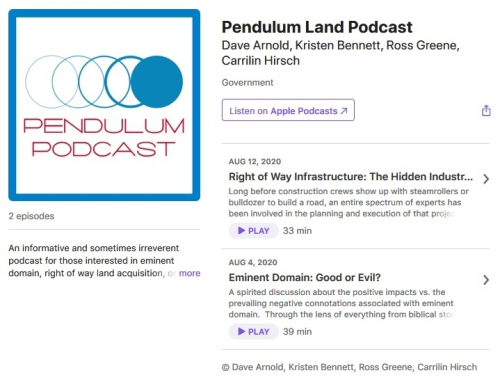
Check this out, a new podcast for your dirt lawyer types to follow, Pendulum Podcast. As it describes itself:

An informative and sometimes irreverent podcast for those interested in eminent domain, right of way land acquisition, or infrastructure development. Topics for discussion frequently include condemnation of real property for public use, just compensation, the Uniform Relocation Act, as well as your hosts’ hot takes on popular culture.

Uniform Relocation Act? Right of way and eminent domain? Be still our hearts.

Two eps are posted so far, “Eminent Domain: Good or Evil?” (embedded above), and “Right of Way Infrastructure: The Hidden Industry. From the Uniform Relocation Act to Eminent Domain.” We’ve listened to the first one, and will soon do so with the second.

Count us as subscribers. Highly recommended you become one as well. Continue Reading New Property/Eminent Domainey Podcast: Pendulum Land Podcast

Here’s the latest in a case we posted about last year. There, the North Dakota Supreme Court noted an open issue, but declined to resolve it. Now, in Fargo v. Wieland, No. 20200100 (July 22, 2020), the court addressed it head-on. 

Here’s how the noted the issue:

whether a landowner who appeals an award in eminent domain proceedings, without accepting or withdrawing deposited funds, is entitled to the payment of post-judgment interest subsequent to the deposit of the full amount of the judgment

Slip op. at 2.

After a just comp judgment, the city deposited the funds to cover the verdict, plus money for the court’s award of attorneys’ fees. The property owner appealed. Even though she could have, she didn’t withdraw the money because doing so would have waived her right to appeal on all issues except a claim for more compensation. Her appeal asserted the taking

Continue Reading Time Isn’t Money: Landowner Not Entitled To Interest On Deposited Funds Satisfying Just Comp Verdict, Even If That Forces Property Owners Into A Bad Choice

Here’s the latest in a case we posted about last year. There, the North Dakota Supreme Court noted an open issue, but declined to resolve it. Now, in Fargo v. Wieland, No. 20200100 (July 22, 2020), the court addressed it head-on. 

Here’s how the noted the issue:

whether a landowner who appeals an award in eminent domain proceedings, without accepting or withdrawing deposited funds, is entitled to the payment of post-judgment interest subsequent to the deposit of the full amount of the judgment

Slip op. at 2.

After a just comp judgment, the city deposited the funds plus money covering the court’s award of attorneys’ fees. The property owner appealed. Even though she could have, she didn’t withdraw the money because doing so would have waived her right to appeal on all issues except a claim for more compensation. Her appeal asserted the taking was invalid, so pulling

Continue Reading Interesting Just Comp Ruling: Landowner Not Entitled To Interest On Deposited Funds Even If That Forces Property Owners Into A Bad Choice

The Louisiana Court of Appeal’s opinion in Lowenburg v. Sewerage & Water Board of New Orleans, No. 2019-CA-0524 (July 29, 2020) is long (54 pages) and detailed. But for those of you interested in inverse condemnation liability stemming from the impacts on property owners from public construction projects, this is your case.

This consolidated appeal involves a group of homeowners, Plaintiffs-
Appellees (“Lowenburg Appellees”) and a non-profit church with a daycare center Plaintiff-Appellee, Watson Memorial Spiritual Temple of Christ d/b/a Watson Memorial Teaching Ministries, (“Watson Appellee”) who claim that they, along with their properties, sustained various types of damages as a result of the construction of the Southeast Louisiana Urban Drainage Project (SELA Project). This federally sponsored and funded project involved the construction of multiple drainage canals and was carried out by the United States Army Corps of Engineers (“USACE”) and Defendant-Appellant, Sewerage and Water Board (“Appellant”).

Slip op.

Continue Reading Construction Impacts From Public Project Are Not “Quality Of Life” General Damages, But Takings Requiring Compensation

How much can a condemnor alter the scope of the taking before the good faith offer required by state law also needs to be re-done?

That’s the question the Wyoming Supreme Court resolved in EOG Resources, Inc. v. Floyd C. Reno & Sons, Inc., No. S-20-0013 (July 23, 2020).

There, the condemnor’s original good-faith offer to the property owner was for a take of rights-of-way, easements, and surface use rights on 2,100 acres. Later, however, it amended the complaint to take only 70 acres. The owner objected to the amended take, arguing that the condemnor had not complied with the statute’s good faith offer requirement. The condemnor responded that the 70 acres it now wanted was within the 2,100 acres its original offer covered, so what’s the big deal?

It is a big deal in this case, held the court. The point of the good faith offer requirement

Continue Reading If A Condemnor Alters The Scope Of The Take, A Good-Faith Offer Carries Over Only If The Amended Taking “Significantly Resembles” The Original Offer

This is a case about trees. The County highway maintenance department entered the plaintiffs’ rural undeveloped land (with permission) to cut and remove certain trees, but then went to the wrong place and cut the wrong trees.

The plaintiffs wanted compensation for the trees, measured as the cost to replace the trees. The County offered compensation only for the loss of use or damage to the land, $200. But you really didn’t take or damage the land (other than to remove the trees), you took or damaged the trees argued the owners. The trial court agreed with the County, as did the court of appeals.

In this post (Apparently, Trees Are Not Property In Nebraska“) we expressed our dissatisfaction with the court of appeals’ ruling and rationale. The court held this wasn’t a permanent taking, so no recovery. In our view, the court also wrongly focused on

Continue Reading Apparently, Trees Still Aren’t Quite “Property” In Nebraska

Today’s case is a short one, but worth the short bit of your time it takes to read it.

In Borders-Self Storage & Rentals, LLC v. Ky. Transp. Cabinet, No. 2019-CA-000217 (July 2, 2020), the Kentucky Court of Appeals held that the assessed value of property for property tax purposes is admissible if the value was fixed by the property owner, and the condemnor offers it as an admission against interest. But if the landowner offers the same property tax assessed value, it is not admissible.

The Court of Appeals didn’t make up this uneven rule, but was merely applying a long-standing rule in Kentucky, first adopted by the Kentucky Supreme Court in Culver v. Commonwealth, Department of Highways, 459 S.W.2d 595, 597-98 (Ky. 1970). And the Court of Appeals has to follow Supreme Court precedent.

After Borders upgraded the property, it commissioned an appraisal which, in accordance

Continue Reading Kentucky App Ct: Even Though We Don’t Agree, Tax Assessment Is Admissible In Eminent Domain Only By Condemnor Against Property Owner